







What makes Jamaica Blue Mountain coffee so distinctive?
Jamaica Blue Mountain coffee draws its reputation from scarce production and a long growing history. The Blue Mountain range in eastern Jamaica runs from about 1,000 to 1,700 meters, and the legally defined growing area is regulated. Clifton Estate carries nearly three centuries of coffee-growing tradition within that zone.
The island's tropical rainforest climate brings rain from May to June and September to November, with a dry period from December to March. Volcanic soil, high humidity, and near-constant fog support the typica coffee variety grown there. The cup profile reflects those conditions, which is why the region's beans hold a firm place in the market.
Jamaica Blue Mountain coffee is world-renowned for its scarce production and long history, and Clifton Estate, as a representative of the Blue Mountain region, carries nearly three centuries of coffee-growing tradition. This article will guide you through how Jamaica's geography and climate give rise to top-tier Blue Mountain coffee, the legally defined boundaries and regulatory system of the Blue Mountain region, the growing conditions at Clifton Estate, the characteristics of the Typica variety, and the brewing performance of Front Street Jamaica Blue Mountain No.1 coffee beans. Whether you are a seasoned coffee enthusiast or a newcomer just beginning to explore, this article will lift the mysterious veil on Blue Mountain coffee.
In North America, coffee cultivation is not uncommon—Guatemala, Costa Rica, Panama, and Jamaica are all well-known origins. Among them, Jamaica's Blue Mountain coffee enjoys an exceptionally high reputation in the coffee world thanks to its scarce production and deep historical heritage.
Jamaica
Jamaica is an island nation located in the northwest Caribbean Sea, facing Haiti across the Jamaica Channel to the east, and is the third-largest island in the Caribbean region. The coastal areas are alluvial plains, the east is dominated by mountains, while the central and western regions consist of hills and limestone plateaus, with well-developed lava topography, few surface rivers, and caves scattered throughout.
Jamaica has a tropical rainforest climate. May to June and September to November are the rainy seasons each year, while December to March of the following year is the dry period. The north-central region receives abundant rainfall, with temperatures typically ranging between 22 and 32 degrees Celsius and an average annual temperature of about 27 degrees. This area lies on a seismic belt, with fertile volcanic soil, fresh air, high humidity, and fog and rain throughout the year. It is precisely these natural conditions that have produced the world-famous Jamaica Blue Mountain coffee.
The Blue Mountain Coffee Region
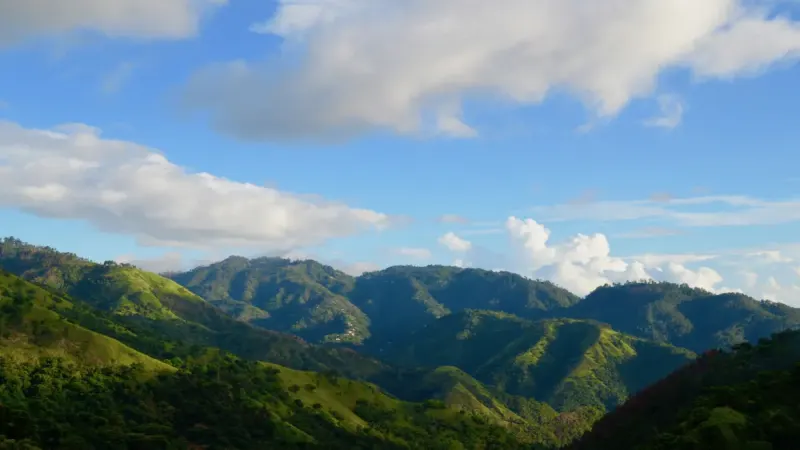
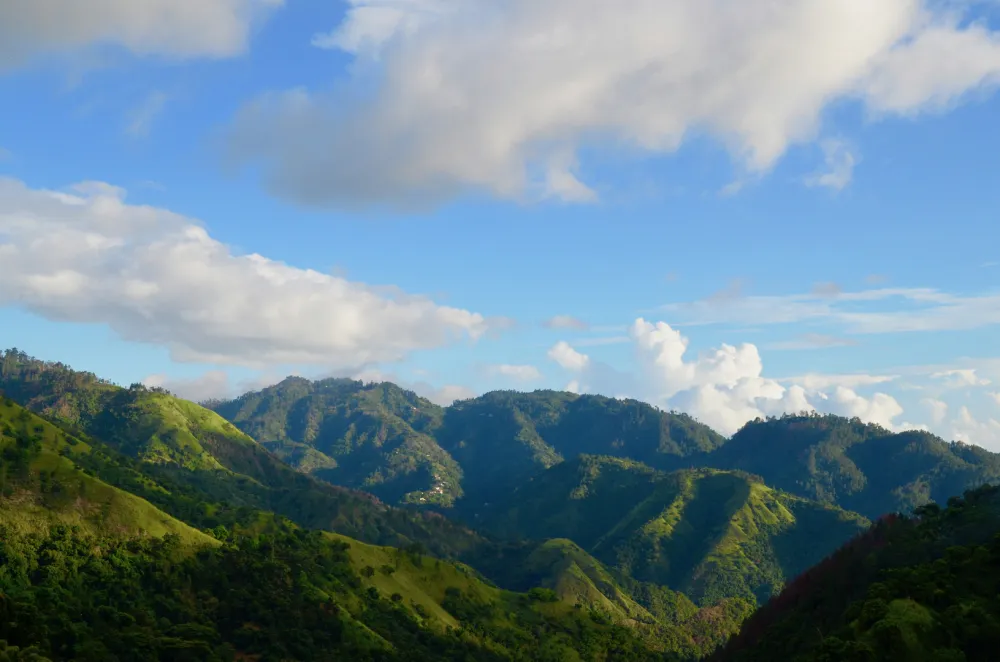
The Blue Mountain range sits in eastern Jamaica, at elevations ranging from 1,000 to 1,700 meters. On clear days, when sunlight strikes the sea surface, the peaks reflect a sea-like blue glow, which is how the Blue Mountains got their name. The Blue Mountains are a volcanic range, and their coffee-growing belt possesses fertile volcanic soil, fresh air, a humid climate, and an environment of fog and rain year-round. Together, these factors have created the world-renowned Jamaica Blue Mountain coffee. The variety grown in this region is Blue Mountain Typica, which after more than two hundred years of evolution has developed stronger disease resistance than ordinary Typica.
The Jamaican government has long attached great importance to the development of the coffee industry. In 1891, the government passed legislation to teach producers coffee-growing knowledge in order to improve quality, while also improving infrastructure to achieve centralized processing and grading of coffee. In 1944, the Central Coffee Clearing House was established, and all coffee had to pass review by this institution before export. In 1950, The Jamaica Coffee Industry Board (CIB) was established; this organization later merged with other commodity bodies in 2018 to form JACRA (Jamaica Agricultural Commodities Regulatory Authority), and today every barrel of Blue Mountain coffee beans must undergo quality supervision through JACRA. At the time of its founding, the Coffee Industry Regulation Act was also enacted, delineating the world-famous "Blue Mountain Coffee Growing Region." According to this regulation, the Blue Mountain growing region is distributed across four parishes—St. Andrew, St. Thomas, Portland, and St. Mary—and only Typica coffee grown within this region at elevations between 915 and 1,700 meters is eligible to be named Jamaica Blue Mountain.
Clifton Estate
As early as the mid-18th century (around 1750), Clifton Estate had already begun cultivating and producing coffee. The estate's coffee-growing and processing facilities are located at an average elevation of 1,310 meters, allowing the coffee trees to grow at sufficient altitude and enjoy ample sunshine and rainfall, as well as mineral-rich volcanic soil, thereby obtaining excellent growing conditions.
Blue Mountain coffee is currently the only coffee exported in wooden barrels. Only Jamaica Blue Mountain (No.1, No.2, No.3, PB) and Jamaica High Mountain (High Mountain Supreme, High Mountain PB) may use wooden barrels, in specifications of 70 kg, 30 kg, and 15 kg. Among them, the highest grade, Blue Mountain No.1, must meet a screen size of 17 or above, with defective beans not exceeding 2% and moisture content around 10% to 12.5%. The barrel lids are printed with the Jamaica Blue Mountain coffee trademark, while all other grades of Jamaican coffee are exported exclusively in 60 kg jute sacks.
Typica
The Typica variety, together with the Bourbon variety, belongs to the oldest surviving coffee varieties, both originating in southwestern Ethiopia. Typica coffee trees have ridged leaves with pointed tips, green or bronze in color, longer internodal spacing on the branches, predominantly red fruit, and elongated beans, with the whole plant being relatively tall. This variety is suited to high-altitude cultivation, where quality is better, but yields are low, and it is highly susceptible to leaf rust, nematodes, and berry disease. Currently, Typica is grown in countries such as Peru, Papua New Guinea, and Jamaica.
The Front Street Jamaica Blue Mountain No.1 coffee beans sourced by Front Street are washed and medium-dark roasted, allowing Front Street Blue Mountain No.1 coffee to present both a rich body and gentle fruit acidity. Front Street uses a KONO dripper, brewing at a 1:15 ratio with 90°C water. You can smell a faint floral aroma, and on the palate, you can sense a slight citrus acidity accompanied by nutty and cocoa flavors, with a silky mouthfeel and overall balance.
The above content is compiled by CoffeeHunters, a coffee news website.


