







What Sets Honduras' Six Coffee Farm Regions Apart?
Honduras is Central America's second-largest coffee exporter and the world's tenth-largest, with 280,000 hectares of coffee farms, mostly smallholder plots. The Honduran Coffee Institute, founded in 1970, split the country into six regions: Copán, Opalaca, Montecillos, Comayagua, Agalta and El Paraíso. Differences in altitude, rainfall and microclimate give each region its own profile, from chocolate to tropical fruit and lemon blossom.
The country lies in northern Central America, bordered by the Caribbean Sea and the Gulf of Fonseca, with mountains and highlands covering more than three-quarters of its area and forests about half. Main varieties grown include Bourbon, Catuai, Pacas, Lempira, Typica and Caturra. Coastal plains hold a tropical rainforest climate and northern mountains can see annual rainfall near 3,000 millimeters, conditions shared with other coffee from the Caribbean basin.
Honduras is the second-largest coffee exporter in Central America and the tenth-largest in the world, with 280,000 hectares of coffee farms within its borders mostly run by smallholder farmers. The Honduran Coffee Institute (IHCAFE), founded in 1970, divided the country into six major regions: Copán, Opalaca, Montecillos, Comayagua, Agalta, and El Paraíso. Each region, due to differences in altitude, rainfall, and microclimate, presents distinct flavors such as chocolate, tropical fruit, and lemon blossom. Front Street Coffee takes you through the terroir characteristics and main cultivated varieties of these regions one by one, including Bourbon, Catuai, Pacas, Lempira, Typica, and Caturra.
Honduras
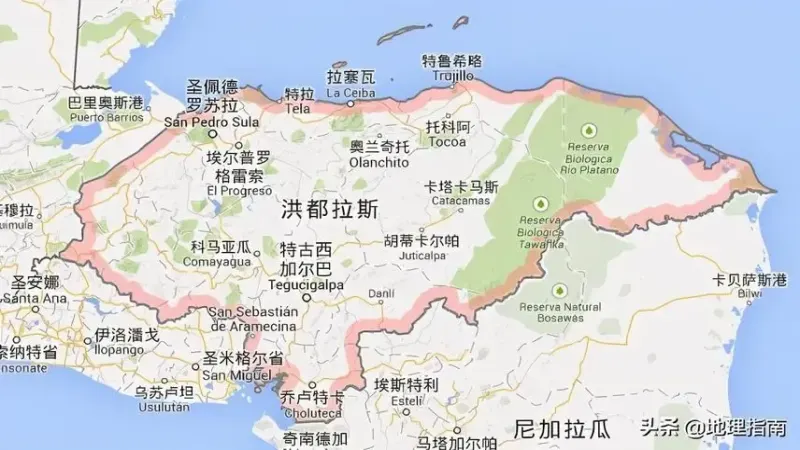
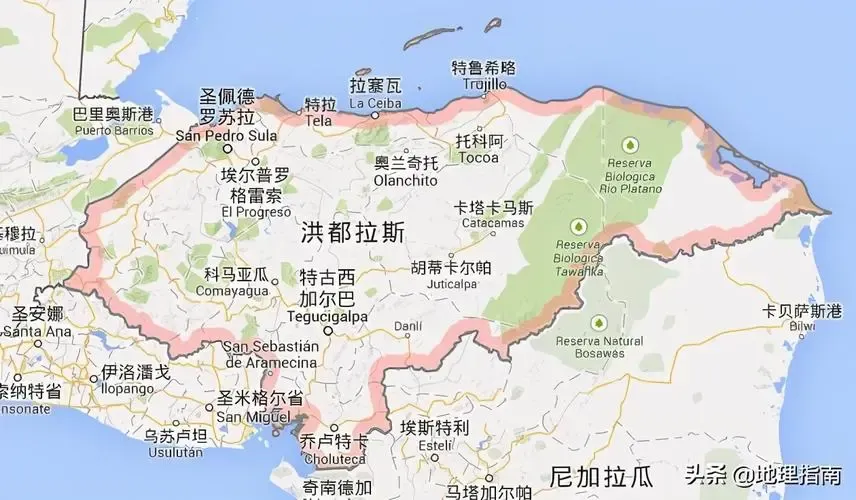
The Republic of Honduras (República de Honduras) is located in northern Central America, bordered by the Caribbean Sea to the north and the Gulf of Fonseca on the Pacific Ocean to the south, while also sharing borders with Nicaragua, El Salvador, and Guatemala. It covers a land area of 112,500 square kilometers and is administratively divided into 18 departments.
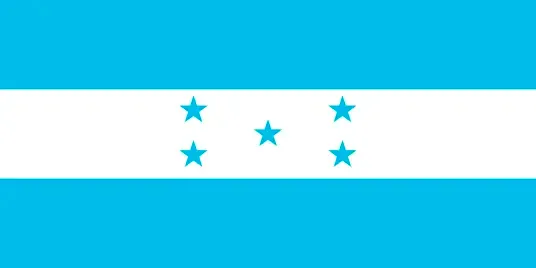
The flag of Honduras consists of three equal horizontal stripes of blue, white, and blue from top to bottom. The blue and white color scheme is inherited from the former Federal Republic of Central America. The two blue stripes at the top and bottom represent the Pacific Ocean and the Caribbean Sea respectively, while the white in the middle symbolizes the aspiration for peace. The five blue five-pointed stars were added in 1866, expressing the hope for the reunification of the five Central American nations.
Honduras is predominantly mountainous and highland terrain, accounting for more than three-quarters of the country's area. Mountain ranges stretch from west to east, with a lava plateau in the interior, numerous inter-mountain valleys, and coastal plains along the coast. Forests cover about half of the country. The country has a tropical climate, with a tropical rainforest climate along the coastal plains, an annual average temperature of 23°C, and abundant rainfall. Annual precipitation in the northern coastal areas and mountainous regions can reach 3,000 millimeters. Between May and July each year, tornadoes form over some sea surfaces, sweeping fish from the sea into the sky and then dropping them onto land, creating the rare spectacle of fish rain.
Honduras is one of the least developed countries in Latin America, with agriculture dominating the national economy and a relatively weak industrial base. Coffee is the pillar of agriculture, with coffee farms covering 280,000 hectares nationwide. The operators are mostly small coffee merchants, with coffee farms generally smaller than 3.5 hectares, and these small producers contribute 60% of the country's output. Honduras is currently the second-largest coffee exporter in Central America and the tenth-largest in the world.
Coffee Regions
In 1970, the Honduran government established the Honduran Coffee Institute (IHCAFE), whose main responsibilities are to help local coffee farmers improve cultivation techniques and enhance coffee quality, and to divide the country into six regions: Copán, Opalaca, Montecillos, Comayagua, Agalta Tropical, and El Paraíso. These regions have an average altitude above 1,100 meters, with the harvest season from November to March of the following year.
Copán Region: Located in the western part of the country, between the departments of Copán, Ocotepeque, and Lempira, the coffee exhibits intense chocolate flavors combined with the sweetness of honey and caramel, with relatively mild fruit flavors. Cultivation altitude is 1,000-1,500 meters, annual precipitation is 1,300-2,300 millimeters, and the main varieties grown are Bourbon, Catuai, Pacas, Lempira, and IHCAFE-90.
Opalaca Region: Located between the departments of Santa Bárbara, Intibucá, and Lempira, the acidity is very delicate and the overall expression is balanced. The cup profile features tropical fruit notes such as grape and mulberry, with a sweet-tart finish, prominent lemon flavors, and the sweetness of honey and caramel balancing it out, with obvious fruit flavors. Altitude is 1,100-1,700 meters, annual precipitation is 1,350-1,900 millimeters, and the main varieties grown are Bourbon, Catuai, Lempira, and Typica.
Montecillos: Located between the regions of La Paz, Comayagua, Santa Bárbara, and Intibucá, it is full of rich fruit and sweet aromas, accompanied by lemon and floral notes. Lemon and fruit aromas are its important characteristics, especially peach and orange, with lively and bright acidity, a velvety texture, and a long-lasting finish. Altitude is 1,200-1,700 meters, annual precipitation is 1,300-2,300 millimeters, the harvest season is from December to April of the following year, and the main varieties grown are Bourbon, Catuai, Lempira, and Pacas.
Comayagua: Located between the departments of Comayagua and Francisco Morazán, it is dominated by lemon flavors with distinct and sweet fruit aromas, a creamy and rich mouthfeel, along with citrus sweetness and notes of sweetness and chocolate. Altitude is 1,100-1,700 meters, annual precipitation is 1,350-1,700 millimeters, and the main varieties grown are Bourbon, Typica, Caturra, and Lempira.
Agalta Tropical: This region spans parts of the departments of Olancho, El Paraíso, and Francisco Morazán, mainly located in the eastern provinces. It is the most dispersed region, composed of 14 protected areas to increase plant diversity and balance the ecosystem, with high ecotourism value. The coffee has honey aromas and fragrance, strong citrus notes, subtle yet distinct acidity, and a pleasant finish. Altitude is 1,100-1,700 meters, annual precipitation is 1,350-1,950 millimeters, and the main varieties grown are Bourbon, Typica, Caturra, and Lempira.
El Paraíso: Located in southern Honduras, distributed among the departments of El Paraíso, Choluteca, and Olancho. The coffee is dominated by gentle fruit acidity, with caramel aromas and a balanced mouthfeel. Altitude is 1,100-1,700 meters, annual precipitation is 950-1,950 millimeters, and the main varieties grown are Catuai, Caturra, Pacas, and Lempira.
The above content is compiled by CoffeeHunters, a coffee news website.


