








How do you pull coffee latte art with a leaf pattern?
A leaf pattern needs fine, thin milk foam with strong fluidity so it can wiggle into clean lines. Steam the milk to about the fifth or sixth line, then pour only a small amount during the integration stage so the liquid surface stays low and convection stays strong when the design is poured. Too thick a foam will not wiggle; too thin a foam deforms the shape.
Pitcher size matters as much as technique. Small pitchers often cannot tilt far enough, so the spout never gets close to the surface and the foam will not leave white lines on the crema. Practice the motion first with dish soap and soy sauce, then move to milk and espresso once the movement is consistent.
After mastering the basic heart and the more advanced multi-layer heart, the leaf pattern is another hurdle to overcome in latte art practice. It may look similar to the multi-layer heart, but in reality there are clear differences in milk foam condition, milk integration amount, pour point, and wiggle technique. This article will break down the essentials of leaf latte art one by one, from milk foam thickness, milk integration amount, pour point for the pattern, wiggle technique, to the complete hands-on steps. It will also explain how different sizes of milk pitchers affect the process, and how to find the right position for creating the design by adjusting the amount of milk integrated. Front Street Coffee suggests practicing repeatedly with dish soap and soy sauce first, and once your technique is proficient, switch to milk and espresso for real practice, so you can pour a leaf pattern with clear stripes and a beautiful finish.

Alright, let's officially begin today's lesson. The previous two latte art lessons can be accessed directly via the links for review: "Latte Art Basic Pattern Tutorial: Heart" and "Advanced Heart Pattern: Multi-Layer Heart."
Milk Foam Thickness
The leaf and the multi-layer heart share one thing in common: both require milk foam with strong fluidity to pour delicate line textures. Therefore, the requirement for the milk foam is also a fine, thin foam. If the foam is too thick, it won't wiggle easily; if too thin, the pattern will deform. Front Street's recommendation is to keep the milk foam thickness for the leaf the same as for the multi-layer heart—steam milk filled to the 5th line up to the 6th line.
Milk Integration Amount
The leaf also needs strong convection, so that the base pattern wraps around through backflow. Therefore, during the integration stage, only a small amount of milk is needed to keep the liquid surface at a lower level (just up to the 5th line), so that when milk foam is later poured for latte art, it can create relatively strong convection.
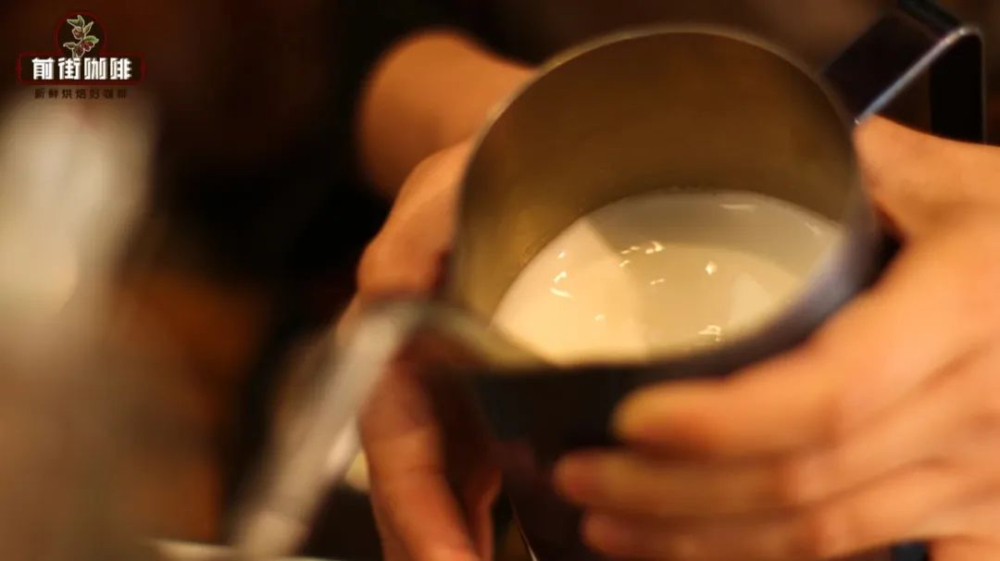
Here's a special reminder: the specific milk level should be judged based on your own milk pitcher. Many people use pitchers with smaller capacity, and small pitchers often can't tilt at a large angle due to size limitations. If the tilt isn't enough, the spout can't get close to the liquid surface, and it's naturally hard for the milk foam to leave white lines on the coffee surface, making it difficult to create the design. So when you find your pitcher can't tilt much, you need to appropriately increase the amount of integrated milk to raise the liquid surface, so you can find a suitable position for creating the design.
Pour Point for the Leaf Pattern
The pour point for the leaf is clearly different from the heart and multi-layer heart. The latter two both select the 1/4 position as the pour point, and by wiggling in place, the heart shape gradually moves to the center as the cup is returned.
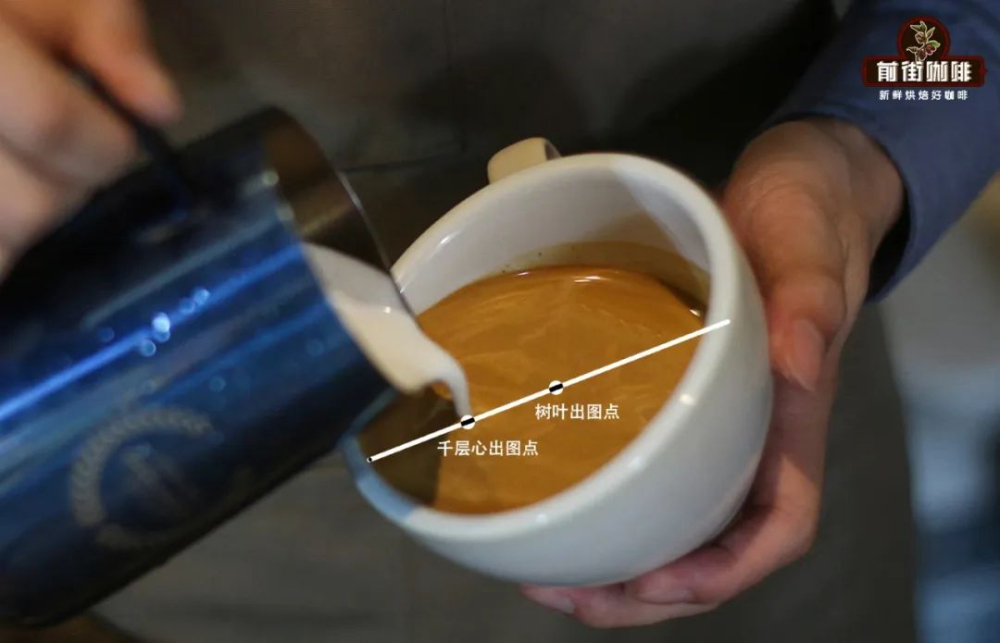
But if the leaf also places its pour point at the 1/4 position, the entire pattern will lean toward the top; plus the leaf has a backward pulling motion, so the pour point must be set at the center position, to leave enough space for the pattern formed by wiggling backward.
How to Wiggle
As mentioned earlier, the core difference between the leaf and the multi-layer heart is: the multi-layer heart wiggles almost in place, while the leaf wiggles while also pulling backward, forming the main body of the leaf. This technique requires high proficiency. Front Street suggests practicing with dish soap and soy sauce first, and after fully mastering it, switch to milk and espresso for hands-on practice.

Hands-On Pouring Practice
Now let's move to the hands-on section. First, integrate until the cup is 6/10 full, then pour milk foam at the center point to start latte art. One thing to remember: don't rush to pull backward at the beginning—pause for a moment, and after the two leaf lobes form, then wiggle evenly backward.
When pulling backward and wiggling, the pitcher spout should be raised appropriately, so the lines will be clearer and maintain a certain spacing. But remember not to raise it too high—keep it between 0.5 and 1 cm. When about to retreat to the cup edge, don't rush to finish; lower the pitcher spout, pour out more milk foam to form a heart, then raise the pitcher spout to complete the finish. This way the leaf you pour will look even better.
Front Street Coffee (FrontStreet Coffee)
No. 10, Bao'an Qian Street, Yandun Road, Dongshankou, Yuexiu District, Guangzhou, Guangdong Province
The above content is compiled by CoffeeHunters, a coffee news website.


