







How Much Caffeine Does Arabica Coffee Contain?
A standard cup of coffee contains roughly 95 milligrams of caffeine, but the exact figure depends on the bean and the brew method. Arabica beans hold about 0.9% to 1.4% caffeine by weight, averaging near 1.3%, while Robusta beans run about twice that at 2% to 4%. Growing region and environment also shift these numbers slightly.
Knowing what are arabica beans helps explain the range: they are the milder, lower-caffeine species used in most specialty coffee, which is why a cup brewed from them tends to be gentler than one made with Robusta. Daily intake for most healthy adults is generally cited as up to about 400 milligrams, roughly four 8-ounce cups of regular coffee.
Many coffee lovers are used to starting their day with a cup of coffee, but do you really know how much caffeine you're drinking? People often assume coffee is the drink with the highest caffeine content, but the truth is quite different—tea leaves actually contain twice as much caffeine as coffee beans. So how much caffeine do different varieties of coffee beans actually contain? How much is in a cup of pour-over, cold brew, or espresso? And how much caffeine is safe for an adult to consume daily? This article will start with coffee bean varieties, break down the caffeine content of each brewing method one by one, combine extraction efficiency to provide practical figures, and finally answer the popular question of how many cups of coffee you can drink per day. Store information for Front Street Coffee is included at the end for reference.
However, when many people choose to drink coffee for the caffeine, they often fall into a common misconception: they believe coffee must have the highest caffeine content of any beverage, for a simple reason—"it's literally named after caffeine." The reality is quite the opposite: tea leaves actually contain more caffeine than coffee beans, roughly twice as much. This is also why some people can drink a cup of coffee and still fall asleep peacefully, but after one cup of milk tea they may toss and turn until dawn.
That's a bit of a tangent, so let's return to the core question everyone cares about most: how much caffeine is actually in a cup of coffee? How many cups per day is safe? Next, Front Street will answer these one by one. Before discussing these questions, we first need to clarify a basic issue—how much caffeine do coffee beans themselves contain?
Caffeine Content in Coffee Beans
Coffee drinks are brewed from coffee beans, so without knowing the caffeine content of the beans, it's naturally impossible to calculate the caffeine in a cup of coffee.
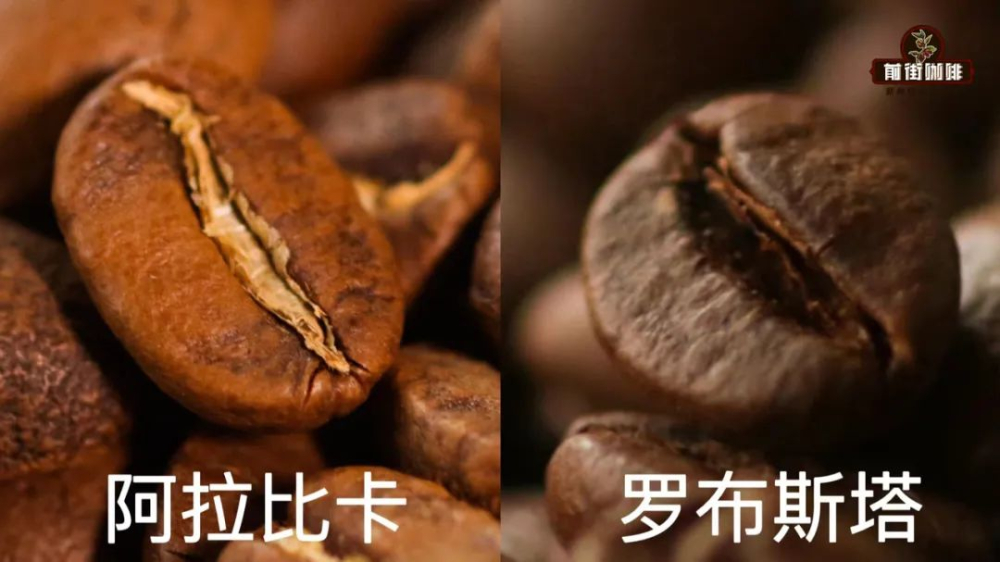
Caffeine content varies by variety. The coffee varieties with commercial value today fall mainly into two categories: Arabica and Robusta. Arabica has a caffeine content of roughly 0.9% to 1.4%, averaging about 1.3%; Robusta has about twice that, ranging from 2% to 4%, averaging around 3%.

These fluctuations in caffeine content mainly stem from differences arising in different producing regions and growing environments. In addition, varieties with extremely low caffeine content have been cultivated, containing roughly only half the caffeine of regular Arabica; these beans are called "decaf coffee." (For details, see the article "What Is Decaf Coffee.")
How Much Caffeine Is in a Cup of Coffee?
I believe many of you have already grasped the calculation method: simply multiply the grams of coffee beans used for a cup by the average caffeine content of that variety to get the peak value. For example, if you use 15 grams of coffee grounds to brew a pour-over, the peak value is calculated as 15 grams times 1.3% (the Arabica average), giving a peak caffeine content of about 195 mg for that pour-over.
But note that this is only the peak value, not the actual caffeine content. In other words, only if all the caffeine in the coffee beans were fully extracted would it reach 195 mg. In actual drinking, the caffeine content will be far lower than this.
Front Street explains it this way because caffeine is a soluble substance. The soluble substances in a coffee bean make up about 30% of its total weight, but we don't need to extract all 30%—usually extracting just 18% to 22% is enough. If all 30% of the soluble substances were extracted, the entire cup would be so bitter it would be undrinkable.
Caffeine is a bitter substance. As Front Street has shared before, bitter substances are released throughout the entire extraction process, but relatively slowly—far slower than acidic and sweet substances. The higher the extraction efficiency, the more the caffeine content increases.
Therefore, calculated at normal extraction efficiency, a pour-over brewed with 15 grams of grounds actually contains about 60 to 90 mg of caffeine.
Applying the above conclusions to other brewing methods, based on their respective extraction times and efficiencies, the corresponding caffeine content can be calculated:
A cup of cold brew (200 ml / 20 g beans / 12 hours) contains about 200 mg of caffeine;
A cup of French press coffee (225 ml / 15 g beans / 5 minutes) contains about 120 mg of caffeine;
A cup of pour-over coffee (225 ml / 15 g beans / 2 minutes) contains about 60 to 90 mg of caffeine;
A shot of espresso (30 ml / 15 g beans / 30 seconds) contains about 85 mg of caffeine.
Note: Lattes, cappuccinos, Dirty, Americanos, and the like are all made with espresso as the base. If the amount of espresso is not reduced, their caffeine content is comparable to that of espresso.
How Many Cups of Coffee Can You Drink a Day?
This has been a hot topic recently. According to surveys, adults should not exceed 400 mg of caffeine per day. In other words, as long as you stay below this figure, there's no need to worry. Taking an average pour-over with 80 mg of caffeine as an example, keeping your daily pour-over intake to within five cups is fine. (Though few people would drink more than five cups.)
Front Street Coffee
No. 10, Bao'an Qian Street, Yandun Road, Dongshankou, Yuexiu District, Guangzhou, Guangdong Province
The above content is compiled by CoffeeHunters, a coffee news website.


