








What Makes Sudan Rume Distinct Among Arabica Beans?
Sudan Rume is an ancient coffee variety from the border area between the Boma Plateau in southeastern Sudan and Ethiopia's Rume Valley, registered in 1942 under the code RS-510. It has very low yield but high cup quality, marked by bright acidity and juicy lemon and plum notes, and became widely known after winning the 2015 World Barista Championship.
For more than fifty years it served mainly as a hybridization father, valued as one of the highest-quality arabica beans gene sources. The plant grows tall, needs frequent pruning and heavy phosphorus fertilizer, and its bronze-colored leaves are its most visible marker in the field. A washed Costa Rica batch showed the flavor potential this green coffee carries.
Sudan Rume is an ancient coffee variety with extremely low yield but outstanding flavor, made famous overnight when it was chosen by the 2015 WBC champion. It originated in the border area between the Boma Plateau and the Rume Valley in Africa, was only formally recorded in the 1940s, and has long been used as a hybridization father since then. Front Street Coffee once tasted a washed Sudan Rume batch from Costa Rica, and its bright acidity and juicy mouthfeel reminiscent of lemon and plum were deeply impressive. This article will sort out the historical origin, plant characteristics, flavor performance, and important position in modern breeding of this rare variety.

On the stage of the 2015 World Barista Championship (WBC), Australian competitor Sasa Sestic won the championship with a Sudan Rume coffee. That cup of coffee had soft floral aromas, sweet fruity notes, and a lemongrass-like fragrance, bringing this rare and little-known variety into the public eye ever since.
Many coffee lovers, like Front Street, can infer some clues just from the name. Sudan Rume is indeed one of the earliest native coffee varieties rooted in the African continent, with its origin in the Boma Plateau in southeastern Sudan, adjacent to the Rume Valley along Ethiopia's western border, in the area of today's Boma National Park in South Sudan. The name Sudan Rume comes precisely from this, and in Chinese it is usually translated as "鲁美苏丹" or "苏丹鲁美."

Before the 1940s, Sudan Rume was still an obscure wild variety scattered in the African tropical rainforest at the border between western Ethiopia and eastern South Sudan, with bronze-colored leaves as its most conspicuous marker. In 1942, people discovered this wild variety and registered it under the code "RS-510," which can be understood as an archive number for a wild coffee variety used in hybridization experiments. For more than fifty years afterward, Sudan Rume played the role of hybridization father and is widely recognized as one of the highest-quality Arabica gene sources.
After consulting materials, Front Street learned that the Sudan Rume plant is quite tall and requires frequent pruning to control its height for picking, while also having a high demand for phosphorus fertilizer, resulting in relatively high management costs. Its branch spacing and branch bud spacing are medium, and the coffee cherries are dispersed along the entire branch. The fruit is medium to long, and bean size is not very uniform, but overall it is not as small as Ethiopian beans. Like Geisha, Sudan Rume has a very limited yield, making large-scale commercial cultivation difficult, and what circulates on the market is mainly micro-lots produced by a small number of farms in Central and South America.
Front Street previously obtained a Sudan Rume coffee from Costa Rica's Coffea diversa Garden, processed by the traditional washed method. After brewing, it showed bright acidity like lemon, plum, and green apple, with a very prominent juicy mouthfeel on entry, a tail note with a faint oolong tea aroma and a sugarcane-like sweetness returning, and an overall rich yet clean cup profile.
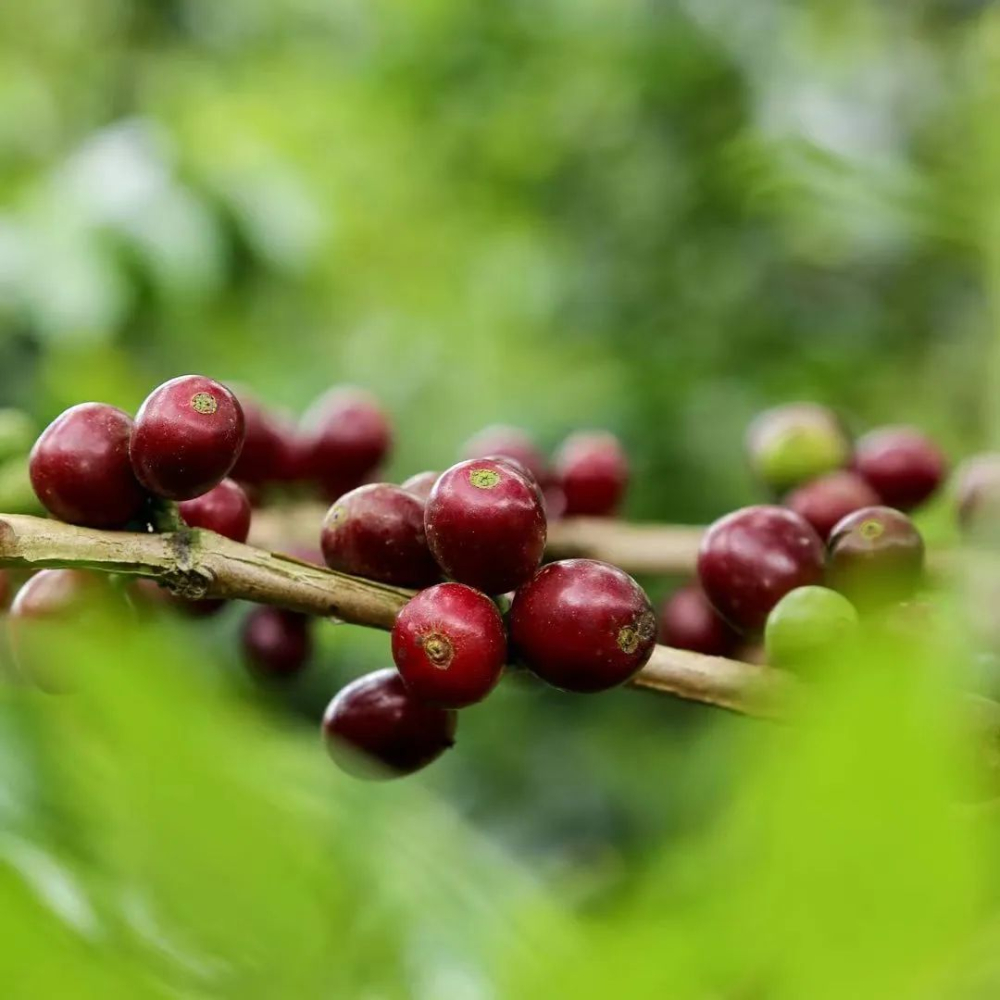
Sudan Rume not only performs excellently in flavor but also carries certain disease-resistance genes, especially resistance to coffee berry disease (CBD). Therefore, rather than putting it into production alone, more people choose to use it as breeding material. Researchers cross Sudan Rume, which possesses excellent genes, with other varieties, and often can cultivate new varieties with good flavor, strong disease resistance, and ideal yield. Many well-known modern varieties were born in this way, such as Castillo launched by Colombia's National Coffee Research Center, and SL28, Kenya's representative high-quality variety.
In recent years, with the continuous improvement of specialty coffee cultivation standards, more and more coffee farmers have begun planting Sudan Rume, and new discoveries have emerged during cultivation—a mature Sudan Rume coffee tree, just like Bourbon, has produced rare yellow fruit. Perhaps in the near future, yellow-fruit Sudan Rume will appear on the market.
- END - FrontStreet Coffee
No. 10, Bao'an Qian Street, Yandun Road, Dongshankou, Yuexiu District, Guangzhou City, Guangdong Province
The above content is compiled by CoffeeHunters, a coffee news website.


