







How Does Sidama Arabica Coffee Reach the Cup?
Ethiopia is the birthplace of arabica coffee and holds about ten thousand to fifteen thousand varieties, most still without formal genetic identification. The Sidama region in the south, next to Kenya, is one of its noted origins. Shantawene processing station there uses a 96-hour anaerobic natural process, and lot 74158 comes from the JARC digital variety system.
After 1995 Ethiopia redrew regions by ethnic settlement and language, restoring the name Sidama, though the registered coffee name Sidamo remains in everyday use. The area's varied soils and microclimates give the coffee its distinct character. Ethiopia is Africa's largest arabica coffee producer, and its highlands, generally above 1,500 meters, support the dense flavor associated with the south.
Ethiopia, as the birthplace of coffee, is home to over ten thousand incompletely identified Arabica varieties, and the Sidamo region is one of its most representative star origins. Starting from Sidamo's geographical and cultural background, this article sorts through the evolution of its name and its terroir advantages, focusing on the unique microclimate of the Shantawene processing station and its 96-hour anaerobic natural process, while offering an in-depth interpretation of 74158 within the JARC digital variety system. At the same time, drawing on Front Street Coffee's example of bean selection, it presents the complete picture of this Sidamo Shantawene coffee bean from origin to processing method, taking you to appreciate the diverse charm of African specialty coffee.
Ethiopia is not only the largest producer of Arabica coffee in Africa, but also possesses a long-standing coffee-growing tradition, and is widely regarded as the birthplace of coffee. It is estimated that there are currently about ten thousand to fifteen thousand coffee varieties in the country, the vast majority of which have not yet undergone formal genetic identification. Within Ethiopia, there are numerous renowned coffee regions, such as Sidamo, Guji, Yirgacheffe, Jima, and Harrar.
Sidamo Region
The Sidamo region is located in southern Ethiopia, adjacent to Kenya. After 1995, Ethiopia began implementing a federal system, and out of respect for the cultures of the various ethnic groups within the country, local governments redivided regions according to the main ethnic settlement areas and languages. As a result, Sidama was incorporated into the newly established Southern Nations, Nationalities, and Peoples' Region, and the area accordingly restored its historical name: Sidama. However, at the time, in order to strengthen the promotion of the distinctiveness of coffee within the country, the Ethiopian government applied for patents for the names of three regions in 2004, and chose the old name Sidamo® as the registered name for Sidama coffee. To this day, domestic consumers are still accustomed to calling the coffee here "Sidamo."
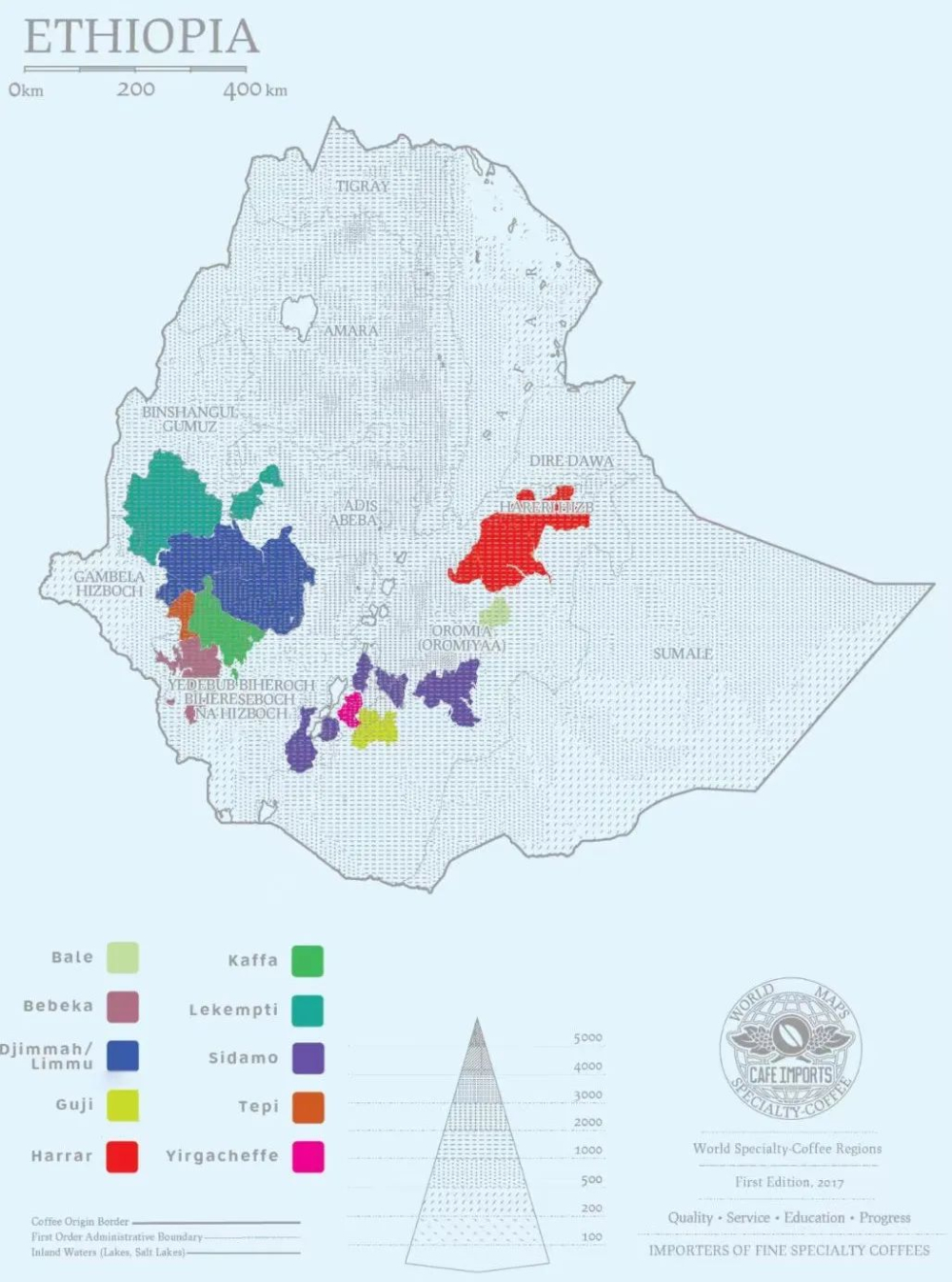
The Sidamo region contains a variety of different soil types and microclimates, and it is precisely these conditions that give the region's coffee its distinctive characteristics and excellent quality. The terrain in the area is rich and varied, encompassing mountains, highlands, valleys, and plains. The local geology is rich in nutrients, and the well-drained volcanic soil provides an ideal growing environment for coffee. In addition, the Sidamo region is also home to many well-known processing stations, including the Shantawene processing station and the Garse processing station.
Shantawene Processing Station and Processing Methods
The Shantawene processing station is about a 40-minute drive from the small town of Shantawene. DWD operates 17 processing stations in the Sidamo region, and the Shantawene processing station is one of the higher-altitude ones. Compared with the Garse processing station, which also belongs to DWD, Shantawene's climate is drier and its average temperature is lower, so even when the same processing method is used, the control of details will differ. For example, for the same fermentation process, it takes longer in Shantawene.
The Front Street Ethiopian Shantawene coffee beans currently sourced by Front Street Coffee use a 96-hour anaerobic natural process. After the coffee cherries are harvested, they are first sorted and selected, and the selected cherries are put into fermentation tanks, injected with carbon dioxide, and subjected to anaerobic fermentation for as long as 96 hours. After fermentation is completed, they are taken out, placed on raised beds to dry, and turned regularly. The drying time is about 20 to 24 days, and it is complete once the moisture content drops to 12%.
Digital Coffee Varieties
Today, Ethiopian coffee varieties can be grouped into two major categories: JARC varieties and regional varieties. Regional varieties refer to Ethiopian forest coffee varieties that grow wild on the land of a specific area. Because Ethiopia has an enormous number of coffee bean varieties that are difficult to distinguish, they are usually collectively referred to as "Heirloom." Heirloom is translated into Chinese as native species or heirloom.
JARC varieties, on the other hand, were developed by the Jimma Agricultural Research Center (JARC), one of Ethiopia's federal agricultural research centers. Between 1973 and 1975, the research center collected coffee beans from 15 regions and carried out identification and cultivation experiments on a total of 639 different coffee varieties. Among these samples, 13 lots performed outstandingly, possessing characteristics such as disease resistance, high yield, and drought tolerance, along with good flavor performance. Therefore, JARC classified these beans as "1974/1975 CBD-Resistant Selections," that is, the numerical numbering series, among which the more common ones are 74110 and 74158. The first two digits of the number, 74/75, represent the year of discovery, while the following digits are the variety number. The Front Street Sidamo Shantawene coffee beans sourced by Front Street Coffee are precisely the digital variety 74158.
Front Street Ethiopian Shantawene Coffee Beans
The above content is compiled by CoffeeHunters, a coffee news website.


