







What makes Yirgacheffe coffee stand apart from other origins?
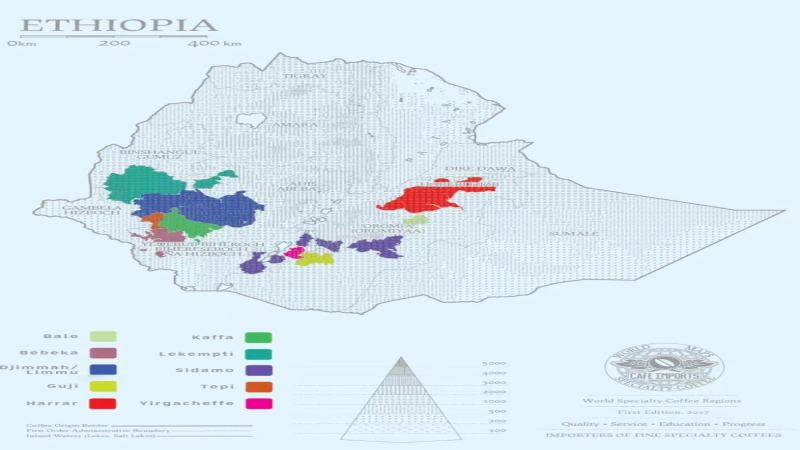
Yirgacheffe is a distinct Ethiopian coffee region on the eastern edge of the East African Rift Valley, where coffee trees grow between 1,700 and 2,100 meters. The coffee shows bright citric acidity, citrus notes, and jasmine aroma. Because its cup profile differs from neighboring Sidamo, the Ethiopian government registered a trademark, and the Ethiopia Commodity Exchange holds the right to the name.
Ethiopia is the birthplace of coffee and holds roughly 10,000 to 15,000 varieties, most never formally identified. In 2007 the Dutch green bean merchant Trabocca started the Red Cherry Project, paying high prices for 100 percent hand-picked ripe red cherries to reward quality in Yirgacheffe, Sidamo, and nearby areas. Yirgacheffe natural Red Cherry beans use heirloom varieties and natural processing.
Ethiopia, as the birthplace of coffee, is home to over ten thousand native varieties that have not been fully identified, making it a holy land in the hearts of specialty coffee lovers. Among them, the Yirgacheffe region stands as a separate origin thanks to its bright citric acidity, citrus notes, and jasmine aroma, and is protected by the EXC trademark. In 2007, the Dutch green bean merchant Trabocca launched the Red Cherry Project, which incentivizes coffee farmers to improve quality by purchasing 100% hand-picked ripe red cherries at high prices, mainly covering Yirgacheffe, Sidamo, and other areas. Front Street Coffee's Yirgacheffe Natural Red Cherry coffee beans use heirloom varieties and natural processing; after a light roast, they are brewed with a V60 at 1:15 and 92°C, presenting berry, lemon, fermented fruity, and strawberry flavors with a refreshing mouthfeel—well worth a try.
For many coffee enthusiasts, Ethiopia is a land of longing—not only is it the birthplace of coffee, but today it is also a major exporter of specialty coffee worldwide. According to statistics, there are approximately 10,000 to 15,000 coffee varieties in Ethiopia, the vast majority of which have not yet undergone formal genetic identification. The country is currently home to several renowned coffee regions, such as Sidamo, Guji, Yirgacheffe, Jima, and Harra.
Yirgacheffe Region
Yirgacheffe is located on the eastern edge of the East African Rift Valley, at an altitude between 1,700 and 2,100 meters. Administratively, Yirgacheffe was originally a small town under the Sidamo region and initially existed as a sub-region of Sidamo. However, because the coffee produced in Yirgacheffe displays bright citric acidity, fresh citrus notes, and lifted jasmine aromas—similar to Sidamo yet distinctly different—it was later demarcated as a separate region.
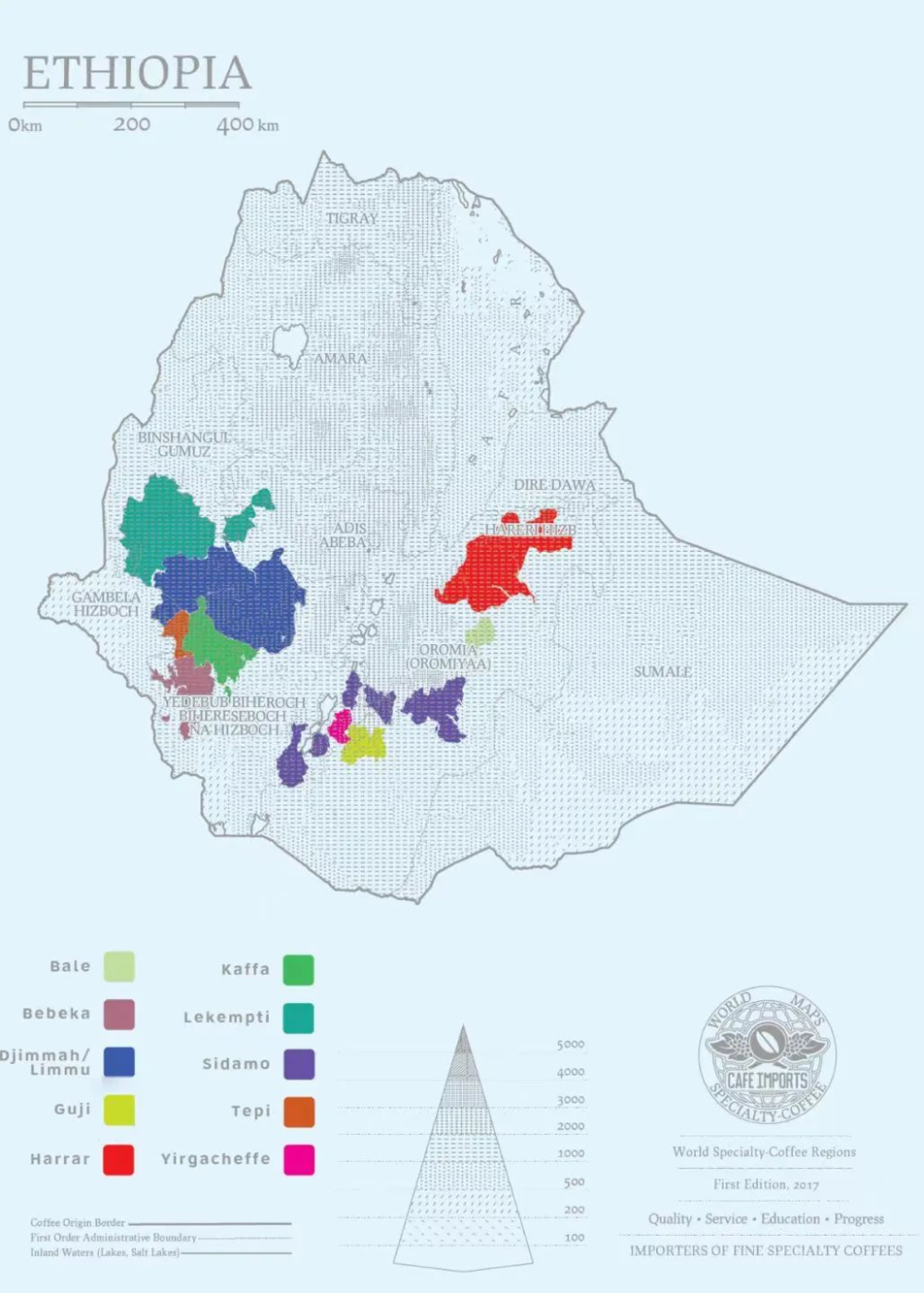
The Ethiopian government has also registered a trademark for this region, and the Ethiopia Commodity Exchange (EXC) holds the right to use this trademark. According to the trademark rules, only coffee produced in the Yirgacheffe region and approved through EXC cupping can be labeled with the name Yirgacheffe.
Heirloom Varieties
In Ethiopia, coffee is mostly grown in garden-style plots, with coffee trees planted alongside other crops near farmers' homes, tended daily by the farmers, harvested by them during the season, and then collected and processed by intermediaries or processing stations. Coffee produced in this model accounts for more than half of Ethiopia's total coffee output.
According to official statistics, Ethiopia has about 15,000 coffee varieties that have not yet undergone genetic identification. Statistically identifying and classifying each of these varieties one by one is extremely difficult; moreover, under Ethiopia's main cultivation model, the beans collected by processing stations may contain multiple varieties. Therefore, it is stipulated that Ethiopian coffee beans are collectively called Heirloom, which translates into Chinese as 原生种 or 传家宝. This is also why Ethiopian beans vary in size.
Red Cherry Project
Before the concept of specialty coffee beans emerged, coffee cultivation often focused only on yield while ignoring quality in order to gain more profit. At harvest time, coffee cherries—whether overripe or unripe—were all picked together, ultimately resulting in coffee with poor flavor.
So in 2007, the Dutch green bean merchant Trabocca proposed the "Red Cherry Project" (ORC). This Dutch green bean merchant first invited all farms in Ethiopia to produce small lots of about 1,500 to 3,000 kilograms of beans for them, and required that these lots be made from 100% hand-picked ripe red cherries, then purchased them at prices several times higher than the market. In this way, farmers' incomes increased, and green coffee bean prices rose accordingly, since more labor and capital costs were required for harvesting, sorting, and processing.
However, not all green beans would be bought by Trabocca at high prices; Trabocca would further screen them, and the beans had to meet cupping quality standards at both its Ethiopia and Netherlands offices. Overall, the Red Cherry Project encourages farmers to carefully complete every step of coffee cherry harvesting and processing by raising the purchase price of high-quality green coffee beans. The beans produced in this way are of better quality and taste better, while also gaining market recognition and commanding relatively higher purchase prices. At present, the main regions of the Red Cherry Project include Yirgacheffe, Sidamo, Bonga Forest, Lekempti, Kembata, Harrar, Limu, and others.
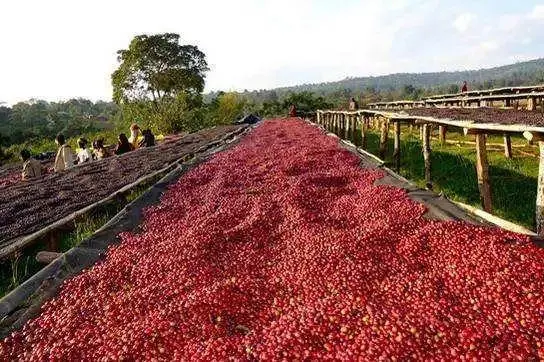
Front Street Coffee Ethiopia Yirgacheffe Natural Red Cherry Coffee Beans Region: Yirgacheffe Region Altitude: 1,700-2,200 meters Variety: Heirloom Processing Method: Natural Flavor: Berry, Lemon, Fermented Fruity, Strawberry The Ethiopia Yirgacheffe Red Cherry coffee beans sourced by Front Street Coffee are naturally processed and light roasted. Front Street uses a V60 , 1:15 ratio, and a water temperature of 92°C for brewing. It smells of slight fermented fruity notes, and on the palate presents fresh citric acidity with berry and strawberry flavors, and a refreshing mouthfeel.
The above content is compiled by CoffeeHunters, a coffee news website.


