








Why is refined coffee, or ristretto, the base used in a flat white?
A flat white differs from a latte and a cappuccino not only through its thin, light milk foam but through its base, ristretto. Ristretto is a restricted espresso: a short, concentrated shot pulled from the same machine, often called extra-concentrated or refined coffee. Among the many espresso drinks, the flat white is the one that relies on it, while almost every other milk drink is built on standard espresso.
Two approaches to making it circulate online. One limits the yield and keeps only the front and middle segments of the shot; the other grinds finer and controls the flow rate to build concentration. Each has trade-offs in consistency and speed, and most coffee shops choose the first because it is repeatable during a busy service. Both aim at coffee extracted in small concentrated amounts rather than a full-length shot.
The reason why a flat white is different from a latte and a cappuccino lies not only in its delicate, light milk foam, but more crucially in its base—Ristretto. However, opinions on the internet about how to make Ristretto vary widely, leaving many beginners confused. From the perspective of Front Street Coffee, this article systematically sorts out what Ristretto actually is, its relationship with Espresso, and the two mainstream approaches to making it: one is to directly limit the yield and take only the front and middle segments, and the other is to grind finer and control the flow rate to build up concentration. The article will also analyze the advantages and disadvantages of each method, and why most coffee shops ultimately choose the former.

"Flat White" is a refined small-cup milk coffee, and because of its rich and sweet distinctive experience, it is widely loved by coffee enthusiasts. The key component that distinguishes it from a latte and a cappuccino, aside from its delicate, light milk foam, is that this deliciousness would not be possible without the flat white's base—"Ristretto."
Because the Ristretto-making methods circulating online are just too! Many! This leaves beginners dizzy and unable to truly understand the extraction significance of Ristretto. Therefore, Front Street Coffee will talk about this "Ristretto" today—what it is~ and how it is made~ What is Ristretto? "Ristretto" is literally translated as "芮斯崔朵." Just looking at these two words, it may be hard to imagine what kind of coffee it is. So we might as well look at its other aliases: "Extra-concentrated coffee," "refined espresso."

How about that, does it suddenly become clear? These completely different terms all refer to the same kind of coffee—"espresso." But, "this espresso is not that espresso." Ristretto is very niche. Although it and Espresso both belong to espresso extracted from an espresso machine, it is so niche that among dozens of espresso drinks, only the flat white uses it as a base. And apart from the flat white, almost all espresso drink bases use Espresso! The reason is that Ristretto's production method does not exist independently, but was later derived as an extraction mode based on the Espresso production method !
Ristretto itself also carries a meaning of "restriction." As the name suggests: since it is an extraction method derived from Espresso, and with the word "restriction" added, we can understand it as adding a certain restriction when extracting Espresso. This restriction does not mean controlling one of its parameters, but rather limiting the substances extracted in the making of the espresso. Obviously! In espresso extraction, the most critical things are the dose and the liquid, and what can limit the extracted substances must be the "liquid"! So next, let us look at how this "liquid" is restricted~

How to make Ristretto At present, there are mainly two ways to extract Ristretto. One is to directly limit the Espresso yield, preventing it from extracting the later-stage substances. For example, Front Street Coffee's Espresso recipe is: use 20 g of beans, take 30 seconds, and extract 40 ml of liquid weight. Then, to make Ristretto, you need to abandon the later stage of extraction and take only the front and middle segments of the Espresso, that is, extract 70% of the total 40 ml—28 ml.
The benefit of extracting this way is that it "cuts off" the point at which a large amount of bitter substances is released in the later stage, reducing the proportion of bitter substances , increasing the proportion of sour and sweet substances, and allowing the coffee to highlight more sweetness! In addition, there are many other methods with a similar extraction philosophy: for example, some coffee shops extract only 2/3 of the total espresso; or use a dose-to-yield ratio of 1:1 for extraction, and so on. So we do not need to be bound to a certain parameter; we only need to understand the principle. No matter which method is used, it is correct!
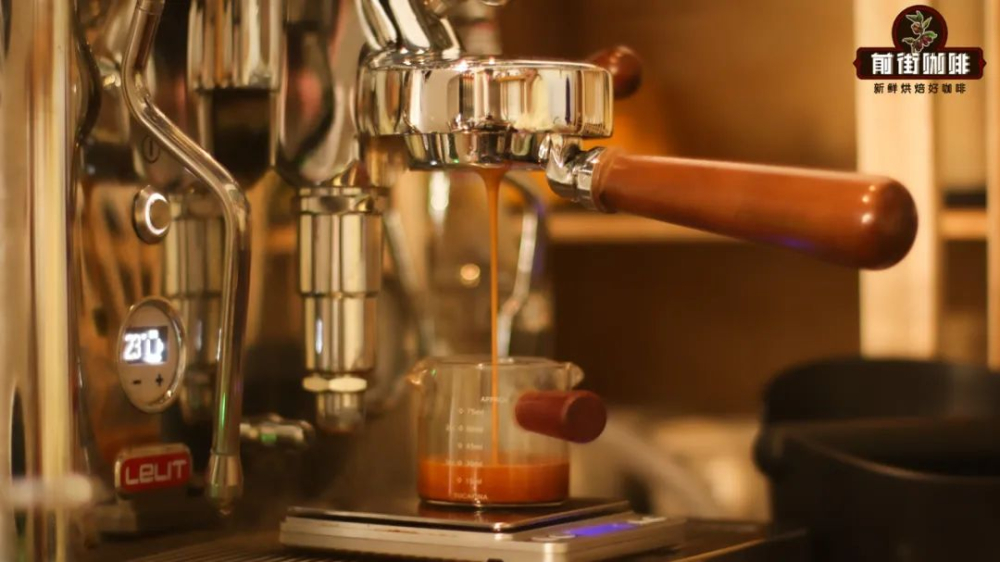
Then there is the second method: "control the flow rate of the coffee liquid"! By grinding finer to control the flow rate, you obtain a more concentrated espresso! Still using Front Street Coffee's Espresso recipe as an analogy: use 20 g of beans, take 30 seconds, and extract 40 ml of liquid weight. If you want to make Ristretto, then we need to grind finer, and still use 20 g of beans for 30 seconds, extracting 70% of the original total, that is, 28 ml!
The advantage of this extraction method is that it obtains a high-concentration espresso through layering. Compared with the former, this method makes it easier for people to distinguish Ristretto from Espresso, since it directly designs a brand-new extraction recipe! In terms of taste, it is also thicker than the former, with a fuller flavor! But when it comes to practicality, the former still wins!
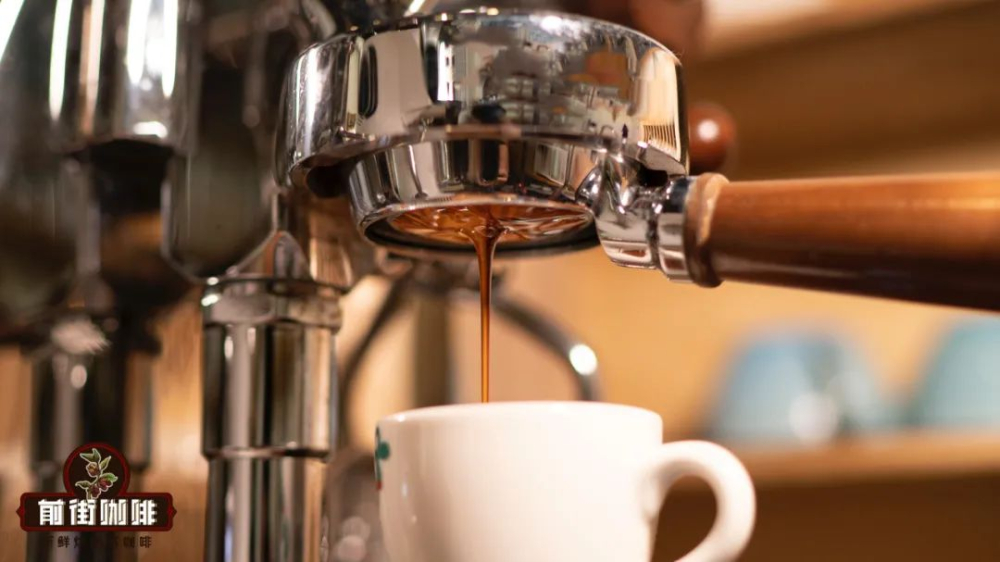
As said at the beginning, most espresso drinks use Espresso as the base, and Ristretto is currently used in large amounts only by the flat white. If the second method were used for production, then in order to ensure that other espresso drinks and the flat white can be served at the same time, the coffee shop would also have to be equipped with an additional grinder, and it would also cost time and materials for dialing in, greatly increasing costs! A business cannot just use one grinder and then "repeatedly jump back and forth" between coarse grinding and fine grinding. That is not realistic (unless it is for your own drinking). So, rather than using the latter to give themselves a "professional" title, shops mostly use the former extraction method, which is convenient, tasty, and also reduces waste ~
Front Street Coffee (FrontStreet Coffee)
No. 10, Baoqian Street, Yandun Road, Dongshankou, Yuexiu District, Guangzhou City, Guangdong Province
The above content is compiled by CoffeeHunters, a coffee news website.


