








What does the ICO November report say about global coffee exports?
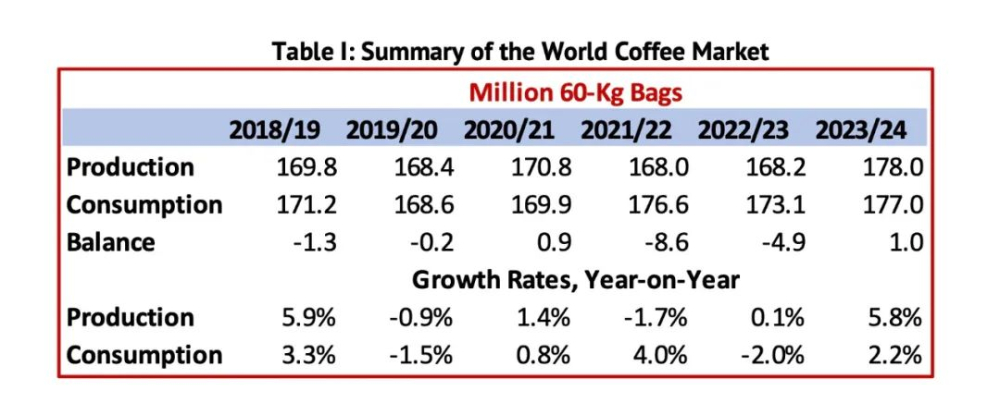
The International Coffee Organization's November report puts 2022/23 global coffee production at 168.2 million bags, up just 0.1% from the previous year. The Americas grew while Asia, Africa, and Oceania declined. Global consumption fell 2%, and EU and exchange stocks shrank sharply, so the flat headline number hides a sharp regional split.
Asia and Oceania production dropped 4.7% to 49.84 million bags and Africa fell 7.2% to 17.9 million bags, with Vietnam, Côte d'Ivoire, and Uganda hit hardest by extreme weather. South America rose 4.8% on Brazil's two straight years of 8.4% growth. For 2023/24, production is expected to reach 178 million bags, up 5.8%.
The latest monthly report from the International Coffee Organization (ICO) shows that global production in the 2022/23 coffee year edged up 0.1% to 168.2 million bags. Beneath the seemingly stable data lie drastic shifts in the regional landscape. The Americas achieved growth thanks to Brazil's strong recovery, while Asia, Africa and Oceania generally saw production declines due to severe weather. At the same time, global coffee consumption unexpectedly fell 2%, and EU and exchange stocks shrank sharply. The report also looks ahead to production prospects for 2023/24, with the alternating effects of El Niño and La Niña becoming the biggest variable.
In its latest monthly report, the International Coffee Organization (ICO) noted that total global coffee production in the 2022/23 coffee year rose only slightly by 0.1% from the previous year, reaching 168.2 million bags. Behind this near-stagnant growth rate, however, the performance of different producing regions showed sharply divergent trends—an expansion camp represented by the Americas stood in stark contrast to contraction in the rest of the world.
Specifically, production in Asia and Oceania fell 4.7% to 49.84 million bags, while Africa declined 7.2% to 17.9 million bags. The main reason for this situation is that extreme weather hit coffee cultivation in different countries to varying degrees, with Vietnam, Côte d'Ivoire and Uganda particularly hard hit. By contrast, South America saw its overall production rise 4.8%, driven by Brazil's back-to-back two years of 8.4% output growth.
Overview of the World Coffee Market
Total coffee beans in the Americas reached 100.5 million bags, of which Arabica production rose 1.8% to 94 million bags, while Robusta fell 2% to 74.2 million bags. Looking ahead to the 2023/24 coffee year, global production is expected to grow 5.8% to 178 million bags, with Arabica likely rising to 102.2 million bags and Robusta expected to reach 75.8 million bags.
The aftereffects of Brazil's 2021 frost disaster have gradually faded, bringing benefits to producing regions in the Americas. However, the alternating arrival of La Niña and El Niño, which emerged in 2022 and continued into 2023, will pose a threat to production prospects for 2023/24. Take Vietnam as an example: the country is about to face the test of drought and high temperatures.
The global coffee industry is gradually digesting the aftermath of the 2019 COVID-19 pandemic, and consumption trends should have returned to a normal track to withstand external shocks. According to earlier expectations, consumption in 2022/23 should have shown slight positive growth, but in reality global coffee consumption shrank 2% to 173.1 million bags.
Overview of World Coffee Production
High living costs, shrinking disposable income and persistently low inventories together meant that coffee consumption in 2022/23 did not follow the established pattern. Although coffee is a commodity with low demand elasticity, the severe challenges of the global economic environment still dragged on its consumption. The inventory situation is equally discouraging: coffee stocks in EU and U.S. Intercontinental Exchange warehouses combined fell by 4.8 million bags, from 14.5 million bags to 9.8 million bags. In addition, the implementation of the EU Deforestation Regulation is expected to further push inventory levels lower. Taken together, the world coffee market in 2023/24 is expected to show a surplus of 1 million bags.
Disclaimer: Some images in this article are from the internet. For some content on the website, such as images, we will respect the original author's copyright and indicate the source. However, due to the large volume, some images and texts may not have been credited in time. Please forgive us. If the original author has any dispute, they may contact the website for handling, and once verified we will correct it immediately. Compiled and edited by "Coffee Review vdailycom". Please indicate the source when reprinting. This article is intended to spread coffee culture. If there is any infringement, please inform us and we will delete it. Thank you~!
The above content is compiled by CoffeeHunters, a coffee news website.


