







How does dry ice change coffee aroma and the way a drink is served?
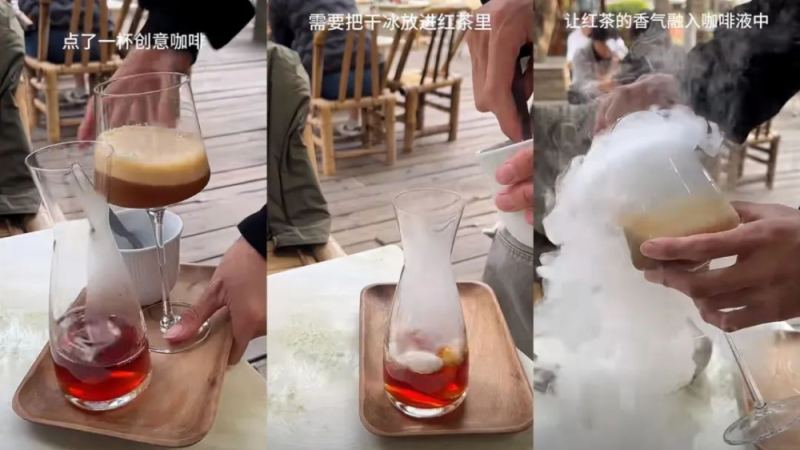
Dry ice dropped into tea produces rolling white mist, and bars use that effect to build smoky specialty coffee drinks served at the table. The barista adds dry ice to a black tea pot, lets the gas drift over a goblet, and the smoke is said to carry the hot tea's coffee aroma into the drink, adding a layer of fragrance before tasting.
The technique goes beyond visuals. Some baristas freeze coffee beans before grinding, and others use dry ice instead of ice cubes during pour-over. Amber Coffee Brewery in Hong Kong is cited as an example. The base is usually a coffee liquid mixed with juice and flavored syrup, with the smoke lifting aroma rather than changing the bean variety or the coffee beans name on the menu.
When dry ice is dropped into black tea, white mist billows and bubbles surge, and a cup of smoking creative coffee is born. This style of presentation, which appeals to both sight and smell, is sparking a new wave in the coffee world. From Hong Kong champion barista's Amber Coffee Brewery, to the extraction technique of freezing coffee beans before grinding, to the alternative approach of using dry ice instead of ice cubes during pour-over, the applications of dry ice in coffee are far more diverse than imagined. This article takes you through the principles and flavor logic behind these creative operations, and shows how baristas use modern technology to make a cup of coffee's layered expression even richer.
Recently, a new trick has emerged in the coffee scene—creative coffee that puffs out clouds of smoke when served at the table.
After a three-piece drink set is placed in front of you, the barista does not rush to mix the components together. Instead, they first add a large amount of some "secret material" into the black tea pot. Immediately after, white smoke pours out uncontrollably, clumps of foam spill over the rim of the cup, accompanied by a "puff puff" sound, just like a moving train blasting steam from its chimney.
Then, this pot of black tea is lifted and moved in a circle around the rim of another goblet, letting the gas slowly drift into the mixed drink, and only then does the tasting formally begin. Before leaving, the barista will also kindly remind you: if halfway through drinking the "gas runs out," it can be replenished at any time, keeping that misty, cloud-wrapped effect going longer and maxing out the ritual of tasting.
It is not hard to see that what the barista added in the video is dry ice, and the rolling white smoke is merely a physical phenomenon produced when dry ice meets the tea. It is said that this approach is not only for creating visual impact, but also uses the smoke to bring out the aroma of the hot tea, adding an extra layer of black tea fragrance to the whole specialty drink and making the layered sensation after sipping even richer. (As for the specific flavor, it is still best to judge by trying it yourself.)
A quick search online reveals that this kind of smoking creative coffee is highly similar in structure: the main body is a specialty coffee liquid mixed with fruit juice and flavored syrup, supplemented by a tea component with dry ice acting as the supporting role, with the core selling point being the provision of tea aroma. In the "smoking" step, the only difference lies in whether the tea is poured into a container holding dry ice, or dry ice is directly dropped into the teapot.
It is understood that the earlier figure to introduce dry ice into creative coffee presentation was a Hong Kong barista named Dwan Chan, who won the Hong Kong Barista Championship for two consecutive editions. His creative drink Amber Coffee Brewery uses dry ice gas to infuse Earl Grey tea aroma into it, and with this unique selling point it attracted a large number of coffee lovers to make special trips to check in.
In fact, compared with creating mist effects or adding aroma during service, the more common use of dry ice is freezing coffee beans. Freezing coffee beans before grinding is a method that allows the particle distribution to be more uniform. At present, there are two common frozen grinding methods in the coffee field: dry ice freezing (-79°C) and liquid nitrogen freezing (-196°C).
After treatment with dry ice or liquid nitrogen, coffee beans become more brittle while cooling down. After grinding, the surface area of the particles increases, and the proportion of extremely fine powder rises accordingly, making flavor substances easier to extract. The "penalty-standing coffee" 3 and 1/2 store previously introduced by the workshop also uses liquid nitrogen freezing to treat the beans before extraction, which is also a method commonly used by competition contestants to enhance coffee aroma and sweetness.
In addition, pour-over enthusiasts have also come up with an alternative玩法: using dry ice instead of ice cubes during extraction, so the concentration will not be diluted and weakened by ice cubes, while allowing the coffee to cool naturally to the greatest extent, thereby pursuing a fuller mouthfeel for iced coffee. As the coffee liquid drips into the lower pot, the atomized dry ice drifts out along the mouth of the pot, pushing the visual effect of the entire brewing process to the extreme.
Among these creative coffees that cleverly use dry ice, perhaps some are just playing gimmicks, with the sole aim of making the presentation more visually striking and the coffee more photogenic. But it cannot be ruled out that some baristas are genuinely pursuing innovation, using modern technology to give coffee a richer layered expression.
Disclaimer: Some images in this article come from the internet. For some content on the website, such as images, we will respect the original author's copyright and indicate the source. However, due to the large quantity, there may be个别 images and texts that have not yet been credited in time. Please understand. If the original author has any dispute, they may contact the website for handling. Once verified, we will correct it immediately. Compiled and edited by "Coffee Workshop." Please indicate the source when reposting. If there is infringement, please inform us for deletion. Thank you~!
The above content is compiled by CoffeeHunters, a coffee news website.


