








Why does latte art from street coffee beans pour jagged edges?
Jagged edges in latte art usually come from three causes, not from your pouring technique. They are beans that are too fresh, milk foam steamed too thin, and steaming temperature that is off. Beans roasted only a day or two earlier still release large amounts of carbon dioxide, which pushes into the crema under pressure and leaves a coarse surface that milk foam cannot glide across.
Carbon dioxide trapped in the crema after extraction makes it thicker and more viscous than it should be, so the foam breaks into jagged lines instead of holding a clean shape. Resting the beans a few extra days lets gas escape naturally and gives a finer crema. The same street coffee troubleshooting also covers thin foam and temperature, and each cause has its own fix.
When jagged patterns frequently appear along the edges of latte art, many people's first reaction is to blame their technique, adjusting repeatedly with little effect. In fact, the root cause of jagged patterns often lies in three areas: the condition of the coffee beans, the texture of the milk foam, and the steaming temperature. This article approaches the issue from the practical experience of Front Street Coffee, breaking down the principles behind each cause one by one and offering concrete, actionable solutions to help you create latte art with clean edges and smooth lines at home.

When jagged patterns appear in latte art, most people's first instinct is to look for faults in their own technique, but even after repeated adjustments, the jagged patterns stubbornly persist. This suggests the real problem may not lie in the technique itself, but rather that the direction of improvement is off. Front Street recommends troubleshooting from the following angles one by one, checking whether your process has hit the conditions that produce jagged patterns, and then making targeted adjustments.
I. Coffee beans that are too fresh
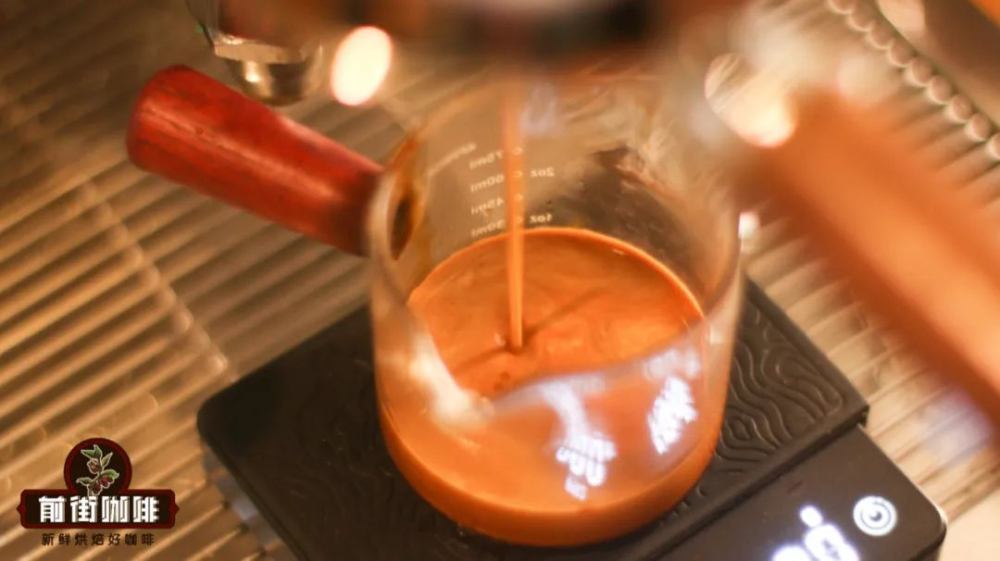
If your latte art comes out jagged several times in a row, take a look at the roast date of the beans on hand. If the beans were roasted only a day or two ago, a large amount of carbon dioxide is still sealed inside the beans and has not yet finished off-gassing. When you extract with an espresso machine, these active gases get pushed into the crema under pressure, making the crema on the surface of the espresso thicker and heavier than it would be after the beans have finished resting.
The problem is that this thick crema lacks the smoothness and fineness needed for latte art—its texture is coarse and viscous, with extremely poor flow. Milk foam struggles to be pushed smoothly across this kind of crema surface, so the edges of the pattern naturally tend to shatter into jagged lines, and you may even find yourself unable to push out a heart shape. The solution isn't complicated: give the beans a few more days of resting time to let some of the carbon dioxide release naturally, and the crema will become fine and suitable for latte art. At the same time, with less gas interference, the coffee's flavor will come through more fully.
II. Milk foam steamed too thin
The second common scenario is milk foam that's been steamed too thin. When milk foam is thin, its fluidity increases greatly and it can't support a stable pattern structure. Flat whites are the worst hit by this problem, because they inherently call for a lower foam thickness, and many people can't get the proportion right when steaming—the result being foam that is thin yet coarse in texture, so the moment latte art goes slightly out of control, jagged patterns appear.
For milk foam that's too thin, you can appropriately extend the aeration phase—that hissing process at the beginning of steaming. If the foam isn't fine enough, increase the duration of the texturing phase, the step after the hissing stops where the foam is spun and homogenized. Fine-tuning these two stages can effectively reduce the likelihood of jagged patterns. Also, beginners needn't be afraid of steaming foam too thick—if it's too thick, you can scoop some out to thin it down, and once your feel becomes more proficient, you can practice precise control.
III. Steaming temperature too high
When milk foam temperature exceeds 70°C, the originally fine bubble structure becomes coarse from overheating. This situation usually comes with an obvious signal: the sound during steaming shifts from a low, gentle whoosh to a sharp, piercing pitch. Milk foam that's too hot not only tends to cause jagged patterns, but also brings a series of negative effects such as faster foam collapse, a noticeable drop in sweetness, and a deteriorating mouthfeel.
Therefore, Front Street recommends keeping milk foam steaming temperature between 55~65°C. This range both fully brings out the lactose sweetness in the milk, making the whole cup's flavor rounder, and helps reduce the occurrence of jagged patterns. In addition, it's best to refrigerate the milk beforehand to lower the starting temperature, which gives you more steaming time and reduces problems like thin foam, excessive temperature, and poor integration.
Front Street Coffee
No. 10 Bao'an Front Street, Yandun Road, Dongshankou, Yuexiu District, Guangzhou, Guangdong Province

The above content is compiled by CoffeeHunters, a coffee news website.


