







What did the ICO report say about global coffee exports?
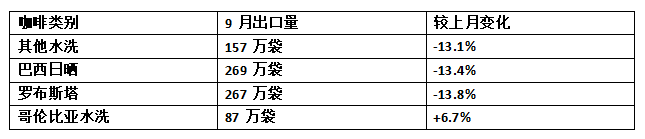
The International Coffee Organization's October report put the monthly average composite indicator price at 151.94 US cents per pound, down 0.8% from September 2023. Global green coffee exports totaled 7.8 million bags in September, an 11.6% drop from 8.83 million bags a year earlier. Only Colombian washed coffee rose, up 6.7%, while other washed, Brazilian natural and robusta all declined.
Every major producing region posted lower exports year on year: South America shipped 4.74 million bags, down 3.4%, Africa fell 1.9%, and Central America and Mexico dropped 9.2%. Robusta spot prices fell 4.1% to 118.83 US cents per pound while most arabica varieties rose. The report also reviewed coffee production and consumption for 2022/23, noting economic pressure pushed buyers toward cheaper robusta.
The latest monthly report from the International Coffee Organization (ICO) shows that the composite indicator price of coffee edged down in October, but while robusta spot prices fell, most arabica varieties rose. At the same time, global green coffee exports fell sharply year on year, with exports from all major producing regions declining. The report also reviewed global coffee exports and production and consumption for 2022/23, noting that economic turmoil pushed the market toward cheaper robusta coffee, while lower global arabica production also intensified this trend. The ICO gave a growth forecast for global coffee production in 2022/23 and revised the previous year's production and consumption demand figures.
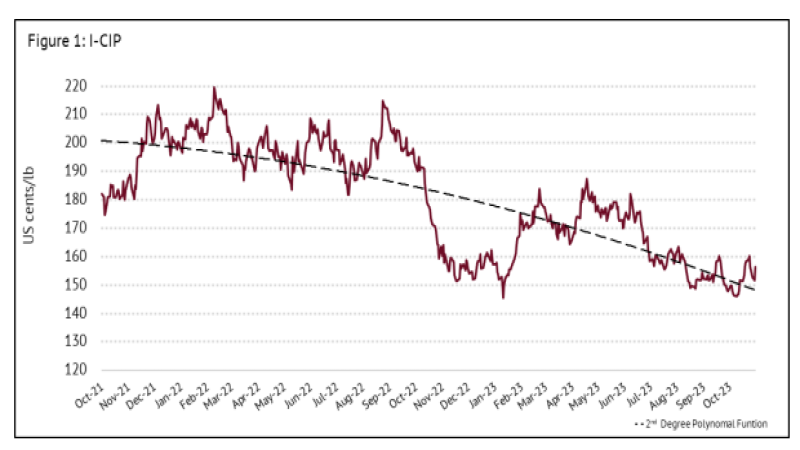
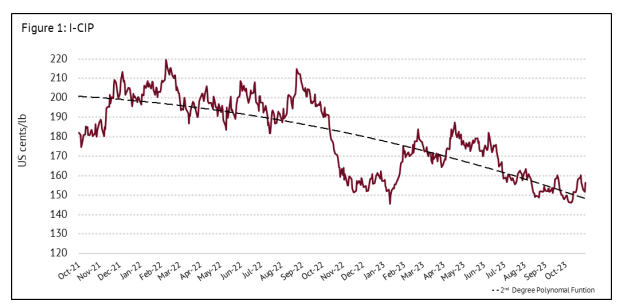
According to the latest report released by the International Coffee Organization (ICO), the monthly average composite indicator price of coffee in October was 151.94 US cents/lb, down 0.8% from September 2023; the median price was 151.58 US cents/lb, with prices fluctuating during the month between 145.99 US cents/lb and 160 US cents/lb.
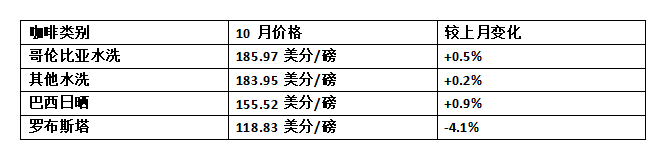
The report shows that spot prices for robusta green beans fell 4.1% to 118.83 US cents per pound, while spot prices for other arabica green beans generally rose. Among them, the increase for Brazilian natural coffee was the most pronounced, reaching 0.9%, at 155.52 US cents per pound.
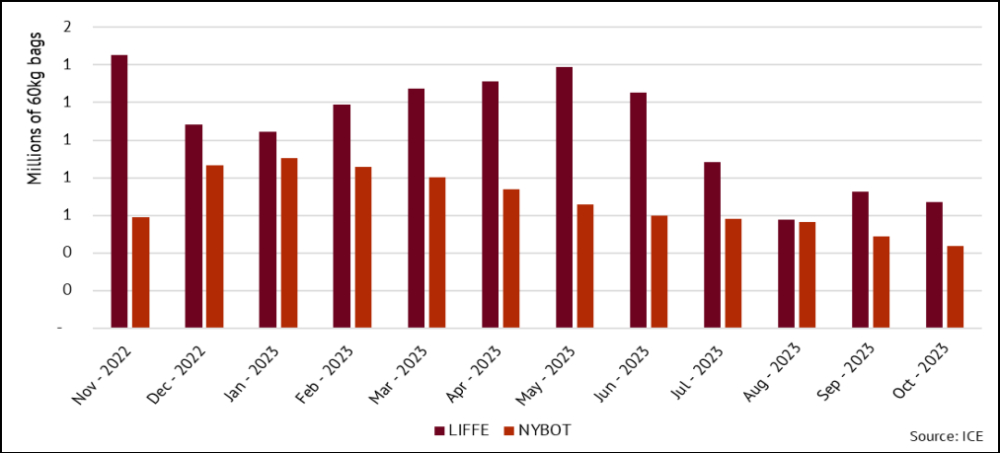
Beyond green bean spot prices, coffee stocks on the US ICE exchange and the European ICEU exchange also changed significantly. Coffee stocks on the US ICE exchange fell to 440,000 bags, down 10.7% year on year; coffee stocks on the European ICEU exchange fell sharply to 670,000 bags, a year-on-year decline of 7.9%.
The report notes that global green coffee exports totaled 7.8 million bags in September this year, down 11.6% from 8.83 million bags in the same period last year. Apart from a 6.7% increase in exports of Colombian washed coffee, exports of the other three major categories—other washed, Brazilian natural and robusta—all declined, falling 13.1%, 13.4% and 13.8% respectively from the previous month.
By global region, coffee exports all showed declines of varying degrees compared with the same period last year. South American coffee exports were 4.74 million bags, down 3.4% year on year; African coffee exports fell 1.9%; coffee exports from Central America and Mexico decreased 9.2%; and coffee exports from Asia and Oceania fell sharply by 35.7%.
Looking back at 2022/23, green coffee exports fell from 117 million bags in 2021/22 to 110 million bags, a decline of 5.5%. Among them, total arabica exports decreased from 74.63 million bags the previous year to 67.05 million bags, down 10.1%; while robusta exports rose from 42.66 million bags in 2021/22 to 43.76 million bags, an increase of 2.6%.
The industry believes that global economic turmoil has made the market more inclined to choose lower-priced robusta coffee as a substitute for arabica, while lower global arabica production may also be one of the reasons for this change.
In addition, the ICO revised global coffee production and consumption demand for 2021/22 and released forecasts for global coffee production and consumption demand for 2022/23. The ICO expects global coffee production to grow 1.7% in 2022/23, reaching 171.3 million bags.
In the 2021/22 coffee year, higher fertilizer prices and unfavorable conditions offset the positive impact of the high point in Brazil's coffee production cycle, ultimately leading to a decline in total global production. Although 2022/23 was a low point in Brazil's production cycle, increased coffee production in regions such as Africa filled this gap, so total global production increased.
Disclaimer: Some images in this article are from the internet, and for some content on the website, such as images, we will respect the original author's copyright and indicate the source. However, due to the large volume, a few images and texts may not have been credited in time; please forgive us. If the original author has any dispute, they may contact the website for handling, and once verified we will correct it immediately. Compiled and edited by "Coffee Review vdailycom"; please indicate the source when reposting. This article is intended to spread coffee culture. If there is any infringement, please inform us for deletion. Thank you~!
The above content is compiled by CoffeeHunters, a coffee news website.


