







How Arabica Coffee Varieties Get Verified by SNP Testing
World Coffee Research, working with the Swedish lab Intertek Agritech, has released a free reference database of SNP genetic fingerprints covering 23 common Arabica coffee varieties. Samples were collected across Latin America and Africa between 2021 and 2023. The database lets producers confirm variety identity from a single leaf, addressing the misidentification that costs the coffee industry money each year.
The problem is real: in a genetic integrity study of 88 samples submitted for Geisha identification, only 61% matched the expected profile, meaning 39% of coffee trees were not the claimed variety. Testing has stayed rare because conventional genetic work is expensive. SNP markers are small, readable variations in a plant's DNA, and comparing a sample's profile against known fingerprints confirms identity at low cost.
The World Coffee Research (WCR), together with the Swedish laboratory Intertek Agritech, collected samples of common Arabica varieties in Latin America and Africa and successfully built a reference database based on SNP fingerprints. This database currently covers 23 varieties and is freely open to the public, aiming to solve the long-standing problem of variety misidentification in the coffee industry caused by the high cost of genetic testing. Through simple leaf collection and genotyping, producers can verify the genetic purity of coffee trees at low cost and avoid economic losses caused by variety mismatches. WCR plans to continue expanding the number of varieties in the future, promoting variety identification and protection throughout the coffee supply chain.
Between 2021 and 2023, World Coffee Research (WCR) collected samples of common Arabica coffee varieties in multiple locations across Latin America and Africa, and worked with the Swedish laboratory Intertek Agritech to complete genotyping work, thereby constructing SNP fingerprints of the samples and developing a reference database.
What are SNP markers?
SNP (single nucleotide polymorphism) is a type of molecular genetic marker and a key means of analyzing genetic variation in plant lines. These subtle variations are like a string of markers scattered throughout a plant's DNA sequence, and can be used to construct a genetic "fingerprint" for a variety.
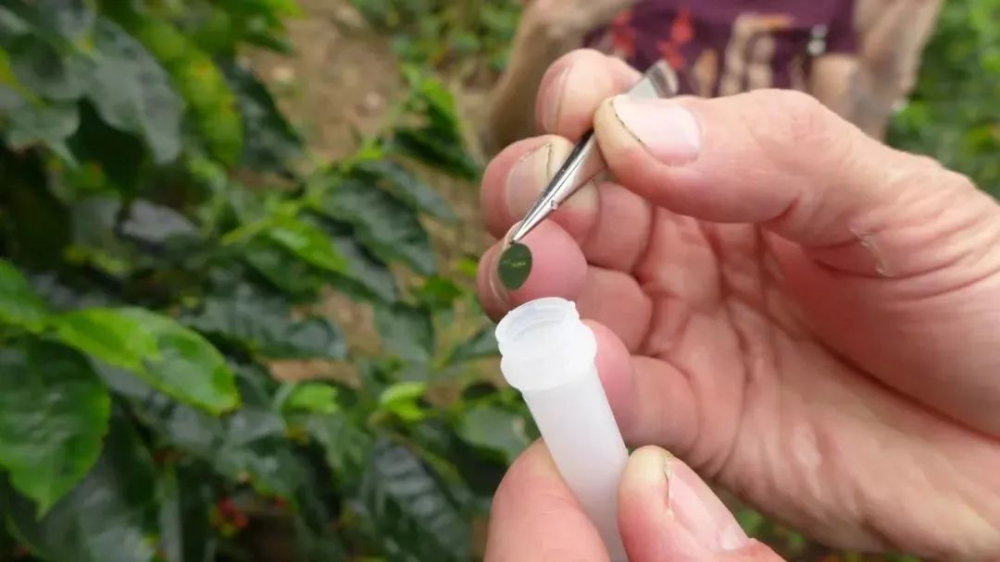
Collecting coffee leaf samples for genetic analysis
How to use SNPs to test the genetic characteristics of coffee
If a producer wants to verify the genetic purity of coffee trees to confirm that what they are growing is indeed the target variety, they only need to pick a small leaf from the coffee tree to be identified and send it to a genotyping laboratory. The laboratory will extract DNA from the leaf, read the SNP profile, and then compare the sample's SNP fingerprint with the known fingerprints of the relevant variety. Once the fingerprints match, the identity of the variety can be confirmed.
WCR points out that current plant genetic testing is still too expensive to be widely adopted in the coffee industry, and the lack of variety verification may lead to certain commercial coffee varieties being misidentified by producers or downstream supply chain participants. A previous study on "genetic integrity" found that in an experiment of 88 coffee samples to be identified as to whether they were Geisha, only 61% of the coffee trees were genetically consistent (meaning 39% of the samples did not match the expected genetic profile of that variety). This "genetic inconsistency" can have disastrous economic consequences for farmers. For example, a farmer may plant a so-called disease-resistant variety, but it ultimately proves to be genetically inconsistent and instead more susceptible to disease.
Developing low-cost, rapid genotyping tools helps participants in the global coffee supply chain identify and track coffee varieties during production. Therefore, one of the most important applications of this database is the development of low-cost variety authentication. The database currently covers 23 common varieties and is openly available to the public without restriction. WCR plans to add SNP fingerprints for more varieties in the coming months and years.
Coffee varieties included in the database
The database can help people in the coffee industry identify and protect different Arabica coffee varieties more effectively, and provide accurate reference materials for coffee authenticators. Coffee suppliers and research institutions can use the database for low-cost, high-quality genotyping for breeding and seed quality control; seed suppliers and nurseries can then provide coffee farmers with sufficient quantities of genetically pure, healthy seedlings. This will increase coffee farmers' access to improved and adaptable varieties, thereby increasing yields and profits.
Disclaimer: Some images in this article are from the internet. For some content on the website, such as images, we will respect the original author's copyright and indicate the source, but due to the large volume, some images and texts may not have been credited in time. Please forgive us. If the original author has any disputes, they may contact the website for handling, and once verified, we will correct it immediately. Compiled and edited by "咖评 vdailycom". Please indicate the source when reprinting. This article is intended to spread coffee culture. If there is any infringement, please inform us for deletion. Thank you~!
The above content is compiled by CoffeeHunters, a coffee news website.


