








Where did the first coffee maker and pour-over method come from?
Pour-over coffee traces back to Amalie Auguste Melitta Bentz, a German housewife who punched holes in a brass pot and used paper to filter coffee, removing the sediment that earlier linen and metal filters left behind. Her idea became the paper filter and dripper still used today.
The history of coffee maker design continued with devices such as Chemex, Hario, and Kalita, while Japan pushed pour-over culture further. Before these filters, coffee was boiled with grounds and strained through cloth or mesh, which left fine sediment in the cup. The third wave later brought drip brewing back into daily use.
Pour-over coffee has now become the preferred daily brewing method for countless enthusiasts—weighing beans, grinding, folding the paper, pouring water—every step is full of ritual. But have you ever wondered where this drip-brewing method actually came from? And who invented the first dripper and filter paper? This article will take you back through the century-long history of pour-over coffee, from the flash of inspiration of German housewife Melitta, to the successive introduction of classic devices like the Chemex, Hario, and Kalita, and on to Japan pushing pour-over culture to its extreme. We will not only trace the evolution of the dripper, but also reveal why pour-over coffee could become popular once again in the third wave. Whether you are a beginner just starting out or a veteran player, this history is worth savoring in detail.

Pour-over coffee has now become one of the preferred ways for coffee lovers worldwide to explore flavors, and almost every coffee fan keeps a set of pour-over equipment at home. In spare moments, choose a bean you like and slowly brew a pot. Weighing the beans, grinding, folding the filter paper, rinsing the dripper, adding the grounds, pouring water in circles, tasting… this series of actions gives every cup of coffee a unique sense of ritual.
However, if you often brew pour-over, do you understand the origins behind this drip-brewing method? This article will take you through the development history of pour-over coffee and several classic drippers.
The Birth of the Dripper
For a long historical period, coffee-making methods around the world were quite crude: coffee beans were crushed and thrown into a pot to boil with water, then strained through linen cloth or metal mesh to remove the grounds before drinking. Due to the manufacturing limitations of the time, the filters could not be made fine enough, so quite a lot of fine sediment still remained in the filtered coffee liquid.
The turning point came in the 20th century. A German housewife named Amalie Auguste Melitta Bentz loved freshly brewed coffee in her daily life, but was troubled by the bitter taste caused by traditional filtering methods and the coffee grounds left between her teeth after drinking. To improve the experience, Melitta began constantly exploring new methods, and finally had a flash of inspiration:
She punched holes in the bottom of a brass pot to make a sieve-like container, then laid a piece of blotting paper over it, put in ground coffee, poured in hot water, and the coffee liquid dripped through the filter paper into the brass pot.
Compared with linen cloth and metal filters, Melitta's combination could effectively intercept residue while preserving the coffee's aromatic substances, and it was inexpensive and easy to operate. Most importantly, the filtered coffee liquid was clear and free of sediment, and the taste achieved a qualitative leap.
The Evolution of the Dripper
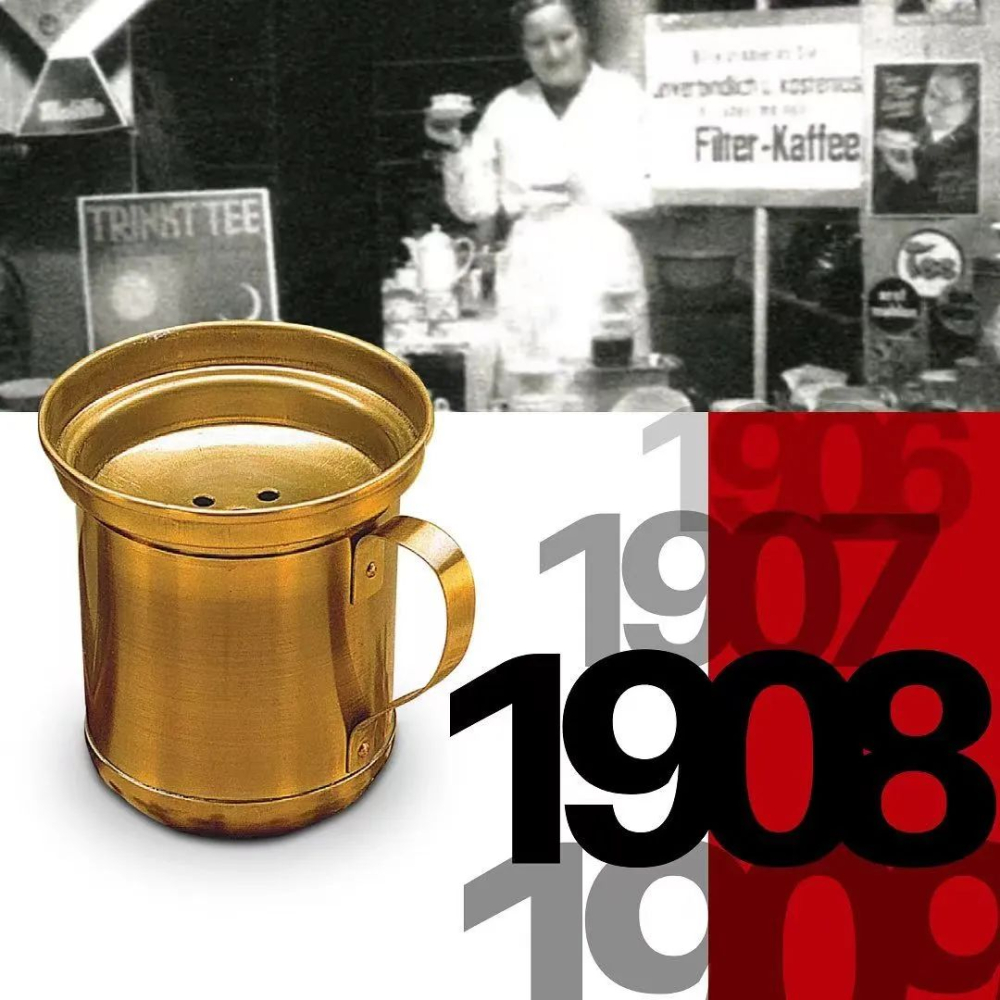
In June 1908, Melitta applied for a patent for this invention at the German Imperial Patent Office: an arched brass coffee filter with outlet holes at the bottom, paired with filter paper. This may have been the world's earliest pour-over drip coffee cup. At the same time, she founded the Melitta company and officially began selling pour-over equipment.
Since its founding, the Melitta company has continuously researched and improved details such as the shape, size, holes, and grooves of the dripper to adapt to changes in coffee trends and consumer needs. Pour-over equipment has also constantly innovated, launching a series of new products, among which the trapezoidal dripper we know well today was one of Melitta's best-selling representative works at the time.
During the same period when the Melitta dripper appeared, many new types of pour-over equipment also successively entered the scene. For example, the Chemex coffee maker, developed and designed in 1941 by chemist Peter Schlumbohm, combined high aesthetics with practicality.
In addition, some pour-over equipment made in Japan was also widely popular. Japan's Hario company was founded in 1921 and initially focused on producing heat-resistant glass products. Because the Melitta dripper popular at the time had relatively small outlet holes and a slow flow rate, the coffee grounds were almost in a soaking state during the latter stage of extraction. So Hario's designers changed the dripper into a cone shape, with the body at a 60° angle. This allowed the water to converge toward the center, extending the contact time between water and coffee grounds. At the bottom, a large single-hole design was adopted, making the water flow more smoothly.
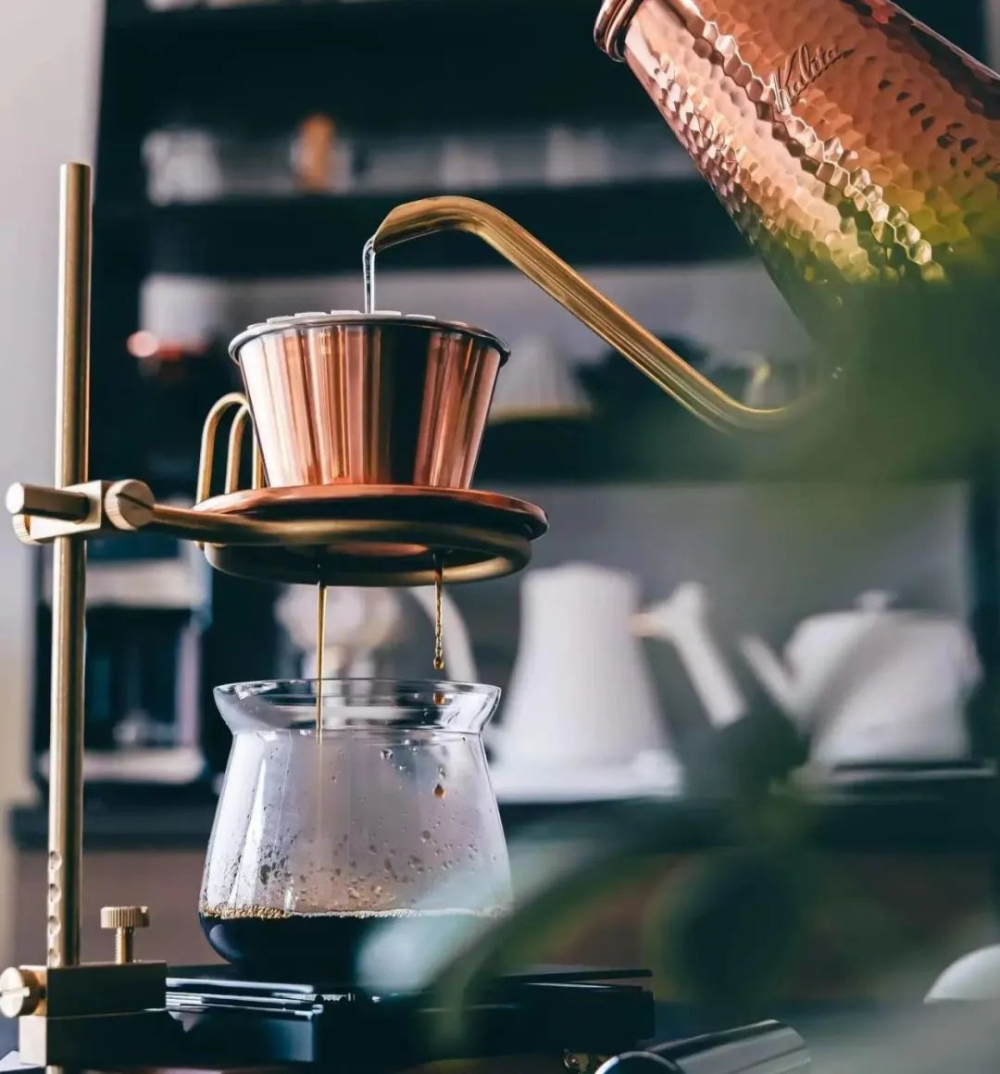
The Kalita Wave dripper, also known as the cake cup, likewise originated in Japan. Its feature is a flat-bottom structure with 3 to 4 small holes, which can make the coffee bed thinner and tends toward immersion-style extraction. The direct contact area between the filter paper and the dripper is minimized, so even if the water flow accidentally hits the filter paper, it must pass through the coffee grounds layer before reaching the outlet holes .
The Spread of Pour-Over Coffee
Although pour-over coffee was born in Germany, due to its cumbersome process and long time consumption, combined with the later invention of espresso machines and the rise of a coffee culture emphasizing speed, this purely handmade drip-brewed coffee did not become widespread in European countries at the time. What truly made pour-over coffee popular was the Japanese.
From the 1950s onward, Japanese people's obsession with pour-over coffee reached an almost infatuated level. Drip-style and pour-over coffee equipment of various materials emerged one after another, and they not only established a complete set of theories and operating techniques for pour-over coffee, but also made pour-over rise again with the third wave of coffee, winning favor with more and more people and ushering in unprecedented vigorous development.
- END - Front Street Coffee
No. 10, Baoqian Street, Yandun Road, Dongshankou, Yuexiu District, Guangzhou, Guangdong Province
The above content is compiled by CoffeeHunters, a coffee news website.


