








Can Variable-Temperature Coffee Brewing Change the Flavor?
Water temperature is not a fixed parameter in pour-over coffee brewing. A comparative test using the same Panama Elida Typica beans brewed with constant temperature, a hot-then-cooling profile, and a cool-then-hot-then-cool profile showed measurable differences in concentration and in the cup's acidity, sweetness, and aftertaste. Variable-temperature brewing can therefore shift flavor direction within one recipe.
The test used 15 grams of grounds at a 1:15 ratio, poured in three stages of 30, 120, and 90 milliliters. Raising the front and middle temperatures by 2 degrees Celsius supported extraction and fruity notes, while a cooler final stage limited extraction of less desirable compounds. Lowering the bloom temperature produced a softer cup, an approach useful when working with floral coffee beans.
In the world of pour-over coffee, water temperature is never a fixed parameter. In world-class brewing competitions, many contestants use variable temperature brewing, precisely regulating the flavor direction of coffee by using different water temperatures at different stages. Front Street Coffee conducted a comparative experiment using the same Panama Elida Typica beans, brewing with three schemes: constant temperature, high temperature in the front stage then cooling in the back stage, and low temperature in the bloom stage then high temperature in the back stage then cooling. They measured concentration and tasted the flavors. The results showed that variable temperature brewing can significantly change the acidity, sweetness, and aftertaste of coffee. This article will guide you through the operational techniques, experimental data, and flavor differences of variable temperature brewing, helping you more flexibly control your pour-over parameters.

Not long ago, a world-class coffee brewing competition concluded, and Front Street noticed that many contestants used variable temperature brewing techniques during the competition. Some might wonder: for the same coffee beans, brewed with the same method, just adjusting the water temperature—will the flavor really differ noticeably? Today, Front Street will take you to briefly explore the mysteries of variable temperature brewing.
Brewing plan: 15 grams of coffee grounds, powder-to-water ratio 1:15, poured in three stages, with each stage using 30 milliliters, 120 milliliters, and 90 milliliters of water respectively. First, the first pot uses the conventional constant-temperature three-stage method as a baseline control. The next two pots are adjusted with variable temperatures.
The idea behind the first pot's variable temperature is to highlight the coffee's fruity notes, so the temperature is increased by 2 degrees Celsius in the front and middle stages to maintain extraction yield; the final stage uses a lower water temperature to reduce extraction yield, avoiding the release of undesirable substances, creating a stepped cooling extraction.
The second pot's variable temperature aims for a softer cup of coffee, so the water temperature during the bloom stage is lowered to reduce the acidity released during blooming, with the second stage as the main extraction phase using high temperature; the tail stage returns to low temperature combined with immersion, just like variable temperature #1, to prevent extracting off-flavors.
The high-temperature stage is higher than the conventional extraction temperature; conventional brewing uses 92 degrees Celsius, and we increase it by 2 degrees Celsius; the low-temperature stage uses 85 degrees Celsius (Front Street has tested that for light-to-medium roasted coffee beans, if the water temperature is below 85 degrees Celsius, under-extraction will occur).
Start the experiment
Brewing preparation: several pour-over kettles, several thermometers (can be omitted if using a temperature-controlled kettle), coffee beans, V60 dripper, and a not-so-important coffee concentration meter (TDS) to verify the extraction yield of variable temperature brewing.
Experimental beans: light-to-medium roasted Panama Elida Typica, which is rich in floral and fruity notes, helping with flavor identification in this experiment. Grind to medium-fine, i.e., 80% passing through a Chinese No. 20 sieve. (Front Street uses a store grinder EK43s, grind setting 10)
Experiment begins
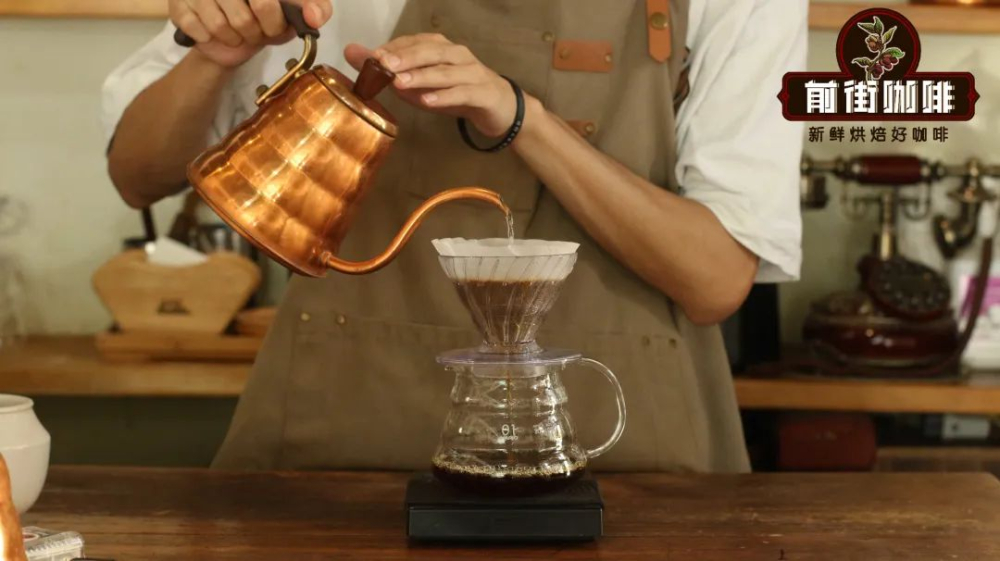
(This experiment aims to compare the flavor performance of the same beans under different variable temperature schemes, so Front Street will not show the brewing process in detail.)
Measurement results

After brewing, Front Street measured the concentration of each group of coffee to confirm whether all three groups achieved reasonable extraction. None of the three groups showed under-extraction, and the differences were small. ( Concentration TDS ( % ) × Coffee liquid weight ( g ) ÷ Coffee grounds weight ( g ) =Extraction yield ( % ) ) Now let's move on to the flavor tasting comparison~
Flavor tasting
First, look at the conventional constant-temperature brewing: delicate white floral notes, bright citrus acidity, and honey-like texture with a tea-like aftertaste, overall balanced and smooth!
Variable temperature #1 with high temperature in the front stage and cooling in the back stage shows richer tropical fruit flavors compared to the constant-temperature group, with slightly weaker floral notes; at medium-low temperatures, tropical fruits and honey-like texture intertwine, evolving into a fuller juice-like sensation.
Variable temperature #2 with low temperature during blooming and the tail stage reduces acidity, with floral notes slightly better than the conventional constant temperature, carrying a subtle sweetness of peach, soft citrus, and a clean tea-like finish, overall like an elegant English fruit and flower tea.
Sharp-eyed friends may have already noticed: even though the first pot was brewed at constant temperature, its concentration is lower than the second pot's variable temperature brewing. What is the principle behind this?
First, the constant-temperature brewing used as the baseline actually also involves a temperature change process. The temperatures we mentioned earlier are all measured at the start of brewing. As time passes, the hot water in the kettle gradually cools. Taking 92 degrees Celsius as an example, from 92 degrees Celsius during blooming to the third stage pouring (about 1 minute 20 seconds), the water temperature has already dropped to around 89 degrees Celsius.
Second, water temperature is crucial to extraction, and the water temperature at each stage affects the corresponding extraction effect. For example, lowering the water temperature during the bloom stage can significantly reduce the acidity of the entire cup of coffee; while cooling in the tail stage directly slows down the extraction speed, limiting the release of certain large-molecule substances (such as bitter compounds).
Understanding this framework, everyone can better control their brewing and get the delicious cup of coffee they want.
Front Street Coffee (FrontStreet Coffee)
No. 10, Bao'an Qian Street, Yandun Road, Dongshankou, Yuexiu District, Guangzhou City, Guangdong Province
The above content is compiled by CoffeeHunters, a coffee news website.


