







What the s.o.e coffee Card Deduction Dispute Reveals
Starbucks Star Gift Cards have drawn complaints after expiration because a monthly extension management fee is deducted automatically from the remaining balance. One user reported 22 consecutive monthly deductions of roughly 2 to 3 yuan before noticing. Customer service said the charge follows the prepaid card charter, which sets a 3-year validity period and a 1% monthly fee on the balance, with a 2 yuan minimum.
The dispute centers on disclosure rather than the fee itself. Terms about the extension management fee appear in bold in the app, but users are not required to confirm reading them when binding a card. The card also does not show an activation date, so consumers and the company define expiration differently. That gap affects the s.o.e coffee prepaid card debate over the right to know and the limits of automatic deductions.
Recently, Starbucks Star Gift Cards have sparked multiple consumer complaints due to automatically deducting a monthly extension management fee after expiration without obvious notice. Some users reported that the deductions continued for 22 months before they accidentally discovered them, and when they called customer service, they were told the practice was compliant. An investigation found that although the relevant terms are displayed in bold within the App, users are not required to actively confirm reading them during the binding process. Additionally, the Star Gift Card does not indicate the activation time, and consumers' understanding of the "activation date" differs from the official definition. This article will sort out the focus of complaints, rule details, and the core controversy, and explore the rationality of prepaid card deductions and the boundaries of users' right to know.
It is reported that the Starbucks Star Gift Card is a prepaid consumption card with stored-value functionality. After purchase, the card contains a corresponding amount, and it can also be recharged for purchasing various products under the Starbucks brand.
However, the issue concentratedly reflected by consumers this time is: once the Star Gift Card expires, a monthly extension management fee is deducted from the card balance, and if one does not actively check, no deduction notice is received at all. A consumer showed the deduction details for the extension management fee, with a single deduction amount not large, roughly between 2 and 3 yuan. The consumer also revealed: "It has been continuously deducted for 22 months. If I hadn't checked recently, I would still be kept in the dark."
A consumer called 4008206998 (Starbucks customer service phone number) to inquire about the reason and received the reply that this practice is compliant and legal, and the collection of the "extension management fee" is based on the "Starbucks Single-Purpose Commercial Prepaid Card Charter." The Star Gift Card (prepaid card) has a validity period of 3 years from the date of activation. After expiration, an extension management fee of 1% of the account balance (minimum 2 yuan) is charged until the balance is exhausted. The relevant rules have been explained on the official website, App, and mini-programs and other channels.
After searching within the App, the terms regarding the collection of the extension management fee can indeed be found, and the explanation is specifically bolded.
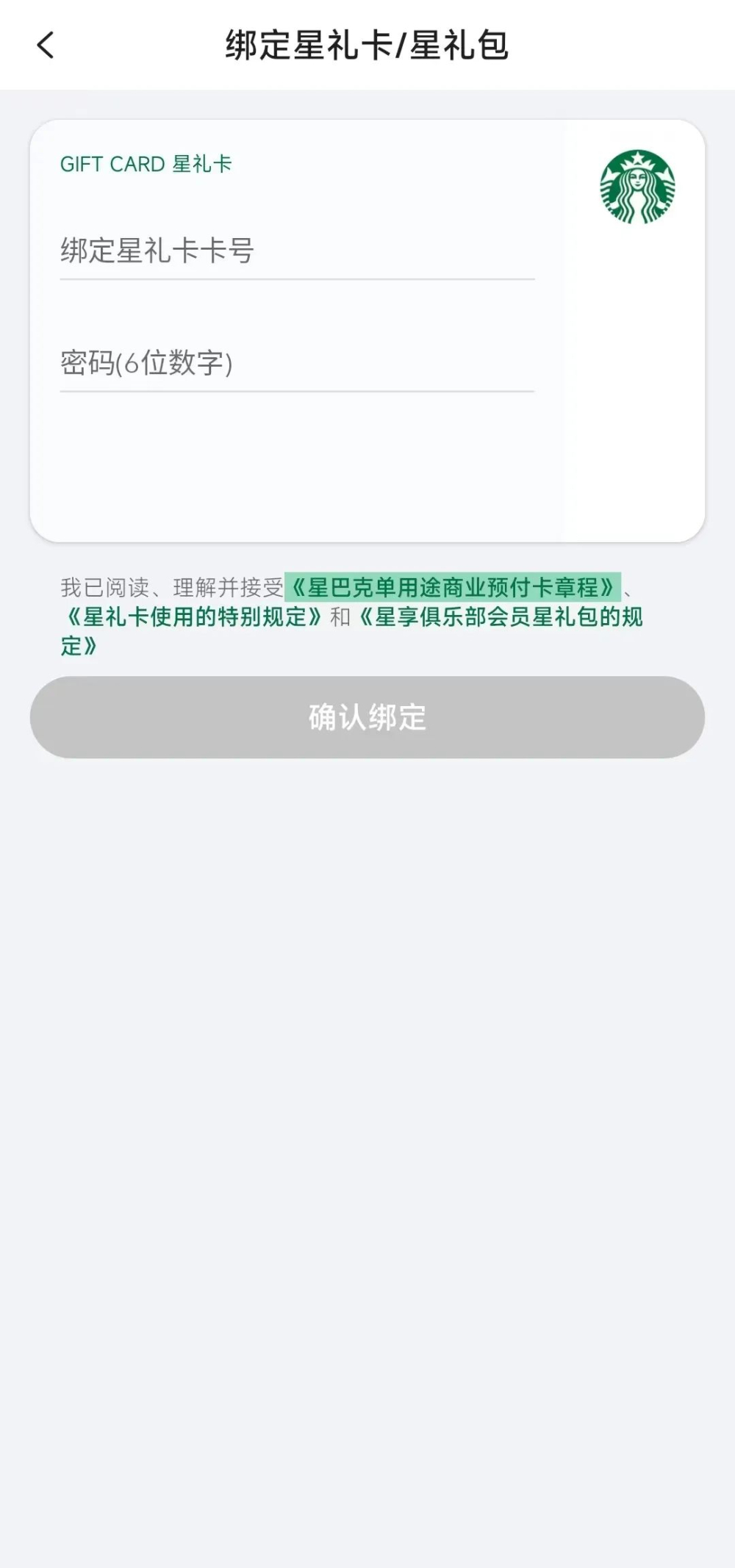
This charter can be found on the page in the App for binding the Star Gift Card, but when confirming the binding, the user is not required to first read the terms and then check "√." Pressing the confirm button is deemed as the user having read and accepted all contents therein.
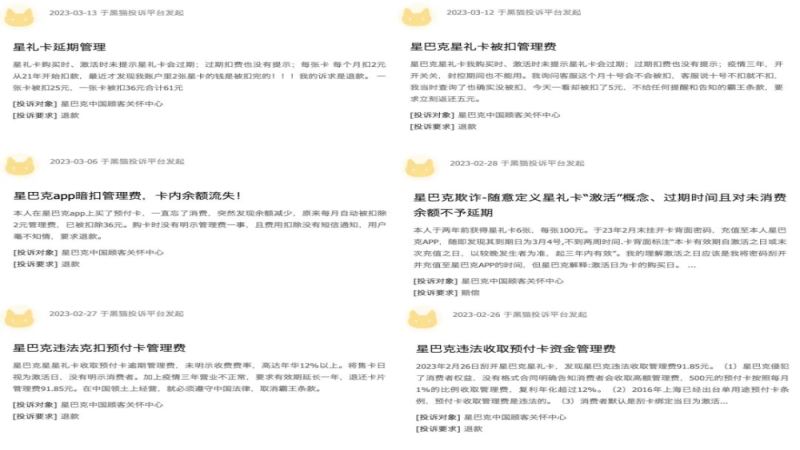
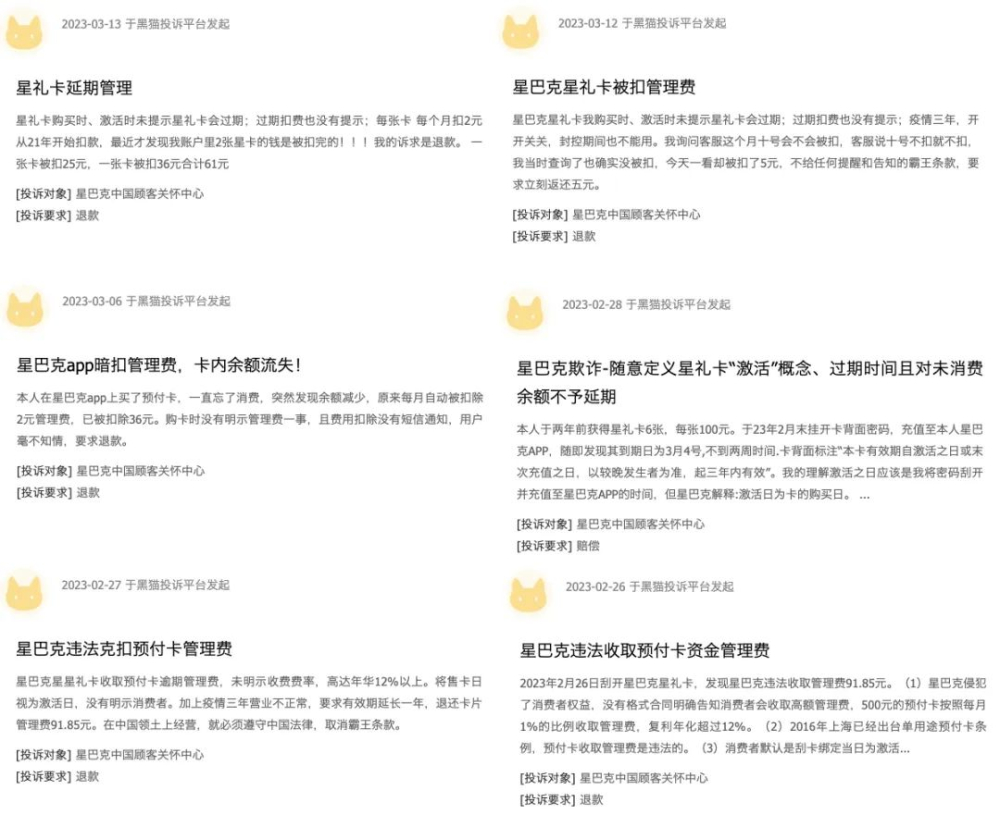
In this consumer complaint, in addition to being puzzled by Starbucks' practice of deducting a monthly extension management fee after the Star Gift Card expires, the core accusation is that Starbucks did not provide prominent notice when the Star Gift Card expired or after deducting the extension management fee, and even after the extension management fee is deducted, the expired Star Gift Card can still be used normally. On the Black Cat Complaint platform, a consumer stated that they only discovered the Star Gift Card had expired after being charged for several months.
Another complainant pointed out that the "Star Gift Card" has a very vague definition of activation time. The card surface has neither a start time nor an expiration time marked, and only the card back notes: "The validity period of this card is from the activation date or the last recharge date, whichever occurs later, and is valid for three years." As a result, consumers easily understand the "activation date" as the day when the password is scratched off and bound to the Starbucks App, while in fact the "activation date" refers to the date of card purchase.
Setting aside for now whether it is reasonable to charge an extension management fee after a prepaid card expires, at least users' right to know should be guaranteed, rather than only realizing a fee has been deducted when they notice the amount in the card has decreased.
The above content is compiled by CoffeeHunters, a coffee news website.


