







What Does Coffee Knowledge Say About Milk Coffee in China?
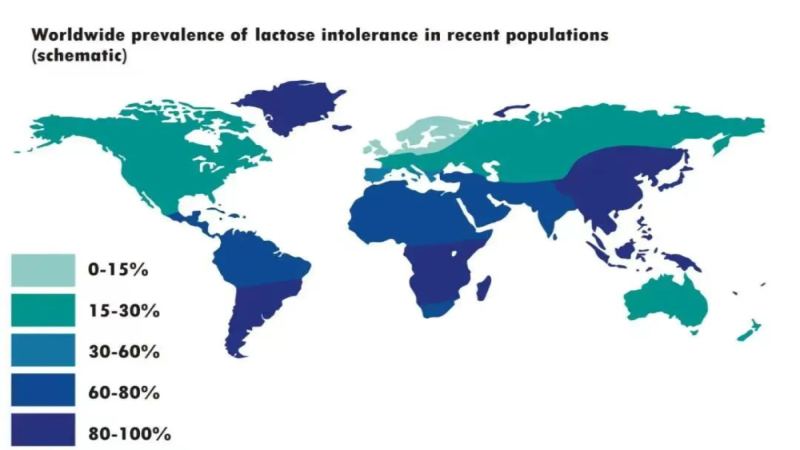
A widely shared lactose intolerance chart claims that 90% of Chinese people cannot drink milk, but the underlying data come from a study of lactose malabsorption, not intolerance. Malabsorption means the small intestine absorbs lactose less efficiently; intolerance means symptoms such as bloating, gas, and diarrhea appear after eating dairy. The two are not the same condition, so the chart overstates the problem.
A clear black coffee definition also helps here: it is coffee without milk or added dairy, which is why the specialty wave treats it as the purest expression of a roast. Milk coffee and milk tea remain popular in China because most people who absorb lactose slowly still drink milk without discomfort, and the coffee industry keeps building drinks around milk.
A lactose intolerance data chart produced by a foreign website has led many people to mistakenly believe that 90% of Chinese people cannot drink milk. But medically, lactose intolerance and lactose malabsorption are actually two different concepts. The former refers to the appearance of symptoms such as abdominal pain, bloating, and diarrhea, while the latter merely indicates that the small intestine's efficiency in absorbing lactose is relatively low, and does not necessarily cause discomfort. If so many people really felt unwell after drinking milk, how could milk tea and milk coffee be so popular in China? Starting from data sources, physiological mechanisms, and the evolution of the coffee industry, this article discusses why Chinese people prefer milk coffee, as well as the respective positions of black coffee and milk coffee in the specialty coffee wave.
Professional coffee knowledge exchange. For more coffee bean information, please follow Coffee Workshop (WeChat public account: cafe_style)
For more specialty coffee beans, please add the private WeChat of Front Street Coffee (FrontStreet Coffee), WeChat ID: qjcoffeex
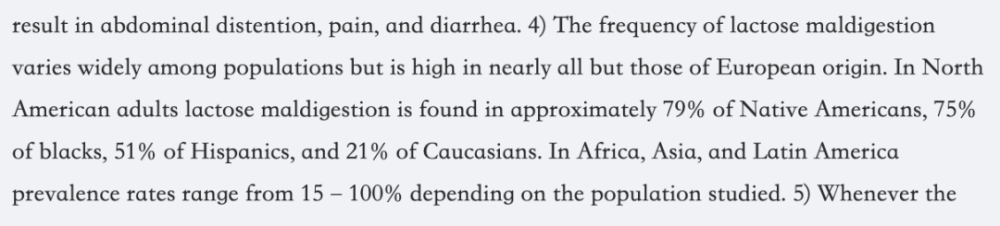
The source of this chart is an overseas website specializing in lactose intolerance. However, tracing the cited source marked in the original article reveals that the chart data actually comes from an academic paper (https://academic.oup.com/ajcn/article-abstract/48/4/1142/4716179), which statistically measures the proportion of people with lactose malabsorption around the world, among which the prevalence rates in Africa, Asia, and Latin America fall within the range of 15% to 100%.
However, when these data reached the lactose intolerance website, they were directly repackaged. So what exactly is the difference between lactose intolerance and lactose malabsorption? First, let us look at the current medical definitions of these two conditions:
Lactose intolerance — a clinical syndrome in which patients develop related symptoms such as abdominal pain, bloating, flatulence, nausea, and diarrhea after ingesting lactose or lactose-containing foods. Lactose intolerance is not necessarily related to lactose malabsorption.
Lactose malabsorption — due to lactase deficiency, ingested lactose cannot be absorbed by the small intestine. Lactose malabsorption is not necessarily accompanied by symptoms of lactose intolerance.
From the definitions, it can be seen that there is no inevitable connection between lactose intolerance and lactose malabsorption. Lactose intolerance brings varying degrees of gastrointestinal discomfort, while lactose malabsorption only indicates that the small intestine's efficiency in absorbing lactose is relatively low, and does not cause gastrointestinal discomfort.
Based on such data, it can be inferred that the vast majority of Chinese people may have lactose malabsorption, but the number of people who truly suffer from lactose intolerance is far smaller than what is promoted online.
So why do a large number of articles emphasize that China has the highest number of lactose-intolerant people in the world? It cannot be ruled out that some brands and merchants are laying the groundwork and promoting for specific products, nor can it be ruled out that they hope the public will have a deeper understanding of lactose intolerance.
If the data were really that high, and so many people felt gastrointestinal discomfort after drinking milk, then milk tea and milk coffee could not possibly have become popular in China. There is a saying: existence is reasonable.
At this point, another voice will pop up: That's not right! Every time I drink milk coffee, I want to run to the toilet!
Hmm...
The acidity in coffee promotes the secretion of gastrin, which in turn speeds up gastrointestinal motility. Because the acidity of coffee irritates the gastrointestinal tract, it is not recommended to drink coffee on an empty stomach! People with weak stomachs who drink coffee on an empty stomach are prone to symptoms such as stomach pain and diarrhea.
Of course, it cannot be ruled out that lactose is at work, since the manifestations of lactose intolerance vary from person to person. Some people may only experience slight stimulation of gastrointestinal motility, giving you the urge to go to the toilet. If you want to confirm whether milk is the cause, try drinking a glass of milk on an empty stomach after getting up next time and you will know.
"Why do Chinese people like milk coffee so much?"
In any case, from merchants' new product recommendations and product development, it can be seen that Chinese people really do love products containing milk. Nowadays, milk tea is gradually reducing the addition of milk and turning toward refreshing and pleasant tea-based drinks, but in the coffee sector, milk is being added more and more.
Pure milk, fresh milk, skim milk, purified milk, evaporated milk, cream... the choices of dairy products can be described as diverse! The most fundamental reason why coffee drinks have so many dairy products to choose from is that the taste of coffee itself is simply too one-dimensional!
At this point, another voice rises: Coffee has so many flavors! How can it be one-dimensional?!
Everyone's ability to identify flavors varies greatly. Most people can only taste the acidity and bitterness of coffee, and cannot detect flavors such as cranberry, cedar, 97% dark chocolate...
So in the eyes of most coffee consumers, the taste of coffee is indeed very monotonous. Without adding milk, flavored syrups, or other ingredients, it is simply difficult to attract everyone's attention to coffee.
"When did Chinese people become addicted to milk coffee?"
It probably has to be traced back to the time when various kinds of coffee first entered China. At that time, what people drank was mostly canned or instant coffee, and such products were mainly made from Robusta beans... In order to make the coffee taste more palatable, most products added non-dairy creamer, milk powder, and so on. Therefore, many people's first cup of coffee began with instant coffee with milk.
After instant and canned coffee, Starbucks, the pioneer of the Chinese coffee shop trend, further strengthened people's habit of pairing coffee with milk. Although freshly ground coffee has a richer aroma and flavor, the mellow intensity and strength of espresso, even when diluted with water, still makes people feel it is bitter.
So people chose freshly ground coffee with milk added. In order to better cater to the taste preferences of consumers around the world, Starbucks continuously launched various flavored syrups for seasoning, pushing freshly ground coffee, milk coffee, and flavored coffee to their peak.
Such promotion naturally led consumers to form a perception: if you want coffee to taste better and have more different flavors, choosing coffee with milk is the right way! As the new generation of main coffee consumers pursues novel flavors, highly adaptable milk coffee has naturally become the key to traffic for various brands.
"Milk coffee VS black coffee"
With the prevalence of specialty coffee culture, the quality of coffee beans has received more and more attention over the past two decades. People have also begun to pursue the original flavor of coffee. Light roasting and high-ratio filter coffee, roasting and extraction methods that can showcase the most delicate and original coffee flavors, have gradually gained attention and affection.
But in fact, whether black coffee or milk coffee, they are both part of specialty coffee. Specialty coffee emphasizes a professional perspective throughout the entire process from cultivation to delivery to the consumer. As long as coffee consumers are satisfied with the whole service and the final product, then it is a cup of specialty coffee.
There is no right or wrong, only greater preference. The development of specialty coffee requires continuous innovation to create more products that the public can accept. Whether it is the continuous improvement of the quality of the coffee beans themselves, or the creation and innovation of milk coffee, the meaning itself is the hope that more people can know coffee and fall in love with coffee.
Image source: Internet
The above content is compiled by CoffeeHunters, a coffee news website.


