







What is a boutique cafe doing in a county-level market?
Coffee shop growth in third-tier Chinese cities has outpaced first- and second-tier cities as returning office workers bring daily coffee habits home. Mainland China had 117,300 coffee shops as of May 2022, with 15,000 added in a single year, and small towns now host chains such as Luckin and Starbucks alongside independent shops.
The push into lower-tier markets comes from local entrepreneurs and major brands moving at the same time. County-level consumers include former big-city residents who already drink coffee, which supports both chain outlets and independent shops, whether a boutique cafe or a private roastery. That combination brings new opportunity alongside tighter competition for the same customers.
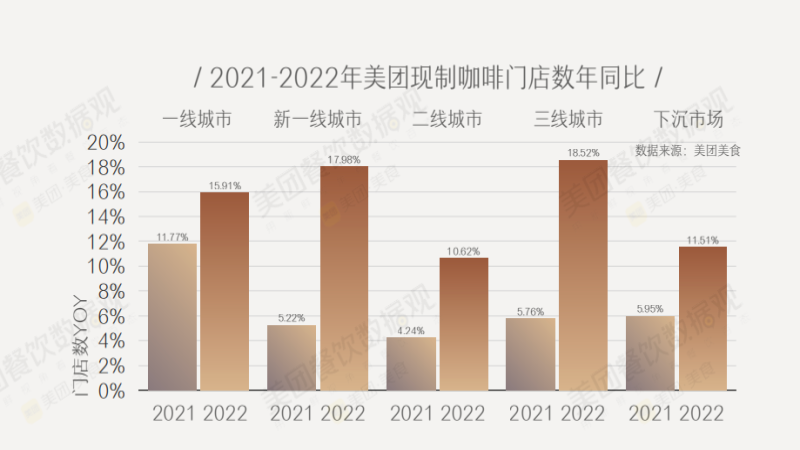
Over the past three years, the pandemic kept many people from returning to their hometowns, and the festive spirit there faded considerably as a result. This Spring Festival, however, small towns came alive again, and coffee shops of every kind quietly sprang up in busy, high-traffic areas—from internet-famous spots and boutique private cafés to chains like Luckin and Starbucks. Data shows that the growth rate of coffee shops in third-tier cities has already surpassed that of first- and second-tier cities. As of May 2022, mainland China had 117,300 coffee shops, with 15,000 new ones added in a single year. The coffee habits brought home by returning office workers are igniting new consumer demand in county-level areas. Local entrepreneurs are seizing the momentum, and major brands are accelerating their push into lower-tier markets. In this market full of potential, coffee shop startups face both new opportunities and fiercer competition.
For professional coffee knowledge exchange and more coffee bean information, please follow Coffee Workshop (WeChat official account: cafe_style).
For more specialty coffee beans, please add the private WeChat of Front Street Coffee (FrontStreet Coffee), WeChat ID: qjcoffeex
Three years of the pandemic made it impossible for many people to get home smoothly, and the hometowns that once brimmed with festive spirit seemed much quieter.
But this Spring Festival, home finally regained its former liveliness. On this visit, I also noticed that quite a few coffee shops had suddenly appeared in high-traffic areas—there were internet-famous-style shops and privately run specialty cafés, as well as chains like Luckin and Starbucks.
So why is everyone setting their sights on small county towns? Relevant data shows that coffee shop openings in most third-tier cities are climbing rapidly, even outpacing the growth rate of first- and second-tier cities. According to the "2022 China Freshly Made Coffee Category Development Report" jointly released by Meituan and Kamen, as of May 1, 2022, the total number of coffee shops in mainland China reached 117,300, an increase of 15,000 over the previous year.
Some industry insiders point out that the main force behind coffee consumption in third-tier cities is very likely office workers. Most of these people once lived in big cities, have already developed the habit of drinking coffee, and are the core force driving the development of coffee in county towns.
For various reasons, they chose to return to their hometowns to find work or start businesses, and they brought their coffee demand back with them. Under their influence, local residents in county towns gradually developed an interest in coffee as well.
The emergence of this demand naturally caught the attention of a group of local entrepreneurs. Leveraging their understanding of the local market and local industrial structure, they built coffee brands of their own.
Beyond local entrepreneurs tapping into it, major coffee brands have likewise seen the potential of the county-town coffee market. Luckin, Starbucks, and others have all announced plans to expand into county towns.
On the 5th of last month, Luckin announced on its official account that it would recruit new retail partners in a targeted manner in 41 cities across 9 provinces, and these cities are basically all third- and fourth-tier.
In the 2025 China Strategic Vision released by Starbucks China, it mentioned plans to add 3,000 new stores by 2025 at an average pace of one new store every 9 hours, covering more than 300 cities in China.
Liu Wenjuan, Chief Operating Officer of Starbucks China, said that these more than 300 prefecture-level markets include nearly 3,000 county-level cities.
From these statistics and the development plans of coffee brands, it is not hard to see that lower-tier markets are indeed the direction where coffee brands will focus their efforts in the future. Some professionals analyze that in recent years the state has continuously increased its support for county-level cities, and the consumption level of county-level cities will keep rising.
At the same time, various county-level cities are also introducing local policies to support people returning to their hometowns and attract out-of-town populations to return for employment and entrepreneurship. Against this backdrop, county-level cities will continue to attract population inflows.
As the population continues to flow back, the age structure and consumption preferences of county towns will also change, which means the county-level consumer market will have enormous room for development in the future.
With such strong consumer potential and broad prospects for the coffee market, it is foreseeable that competition in the lower-tier coffee market will only become fiercer in the period ahead.
Image source: Internet
The above content is compiled by CoffeeHunters, a coffee news website.


