








What is Arabic coffee and how is it served?
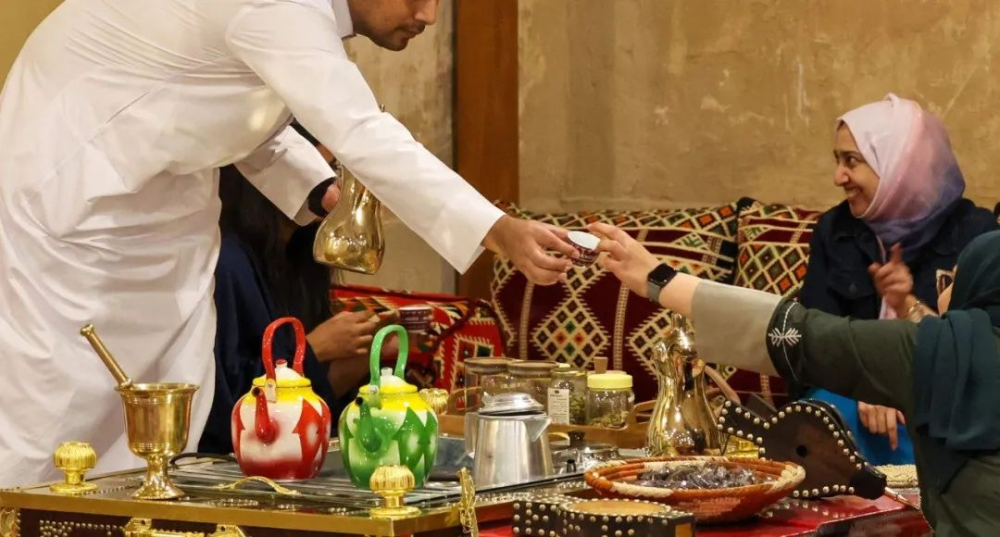
Arabic coffee, known as gahwa, is a traditional Gulf drink at the center of Qatari hospitality. During the World Cup, fans saw locals offer dates, snacks, and coffee after matches. Serving follows set rules: the host holds the pot in the left hand, presents the cup with the right, and pours in a thin, thread-like stream.
Spices such as saffron and cardamom shape the drink, and the word coffee itself traces back to Arabic. The beverage evolved from qishr to gahwa and became a folk heritage passed down through generations. Training centers even teach younger people how to make coffee and how to present it to guests, reflecting how deeply coffee culture is rooted in the region.
While watching the World Cup in Qatar, fans not only felt the excitement of the matches but were also deeply moved by the locals' tradition of warm hospitality. After every match, Qataris would offer fans traditional snacks, dates, and coffee, showcasing the Gulf region's culture of hospitality where "the pot never leaves the fire." This article takes you through the preparation methods of traditional Qatari coffee, the etiquette of drinking it, and the historical evolution of Arabian coffee from "Qishr" to "Gahwa." From the meticulous practice of holding the pot in the left hand and presenting the cup with the right, to the use of spices like saffron and cardamom, and to the origin of the word "coffee" from Arabic, it fully presents the story behind this beverage that carries folk heritage.
Professional coffee knowledge exchange. For more coffee bean information, please follow Coffee Workshop (WeChat public account: cafe_style).
For more specialty coffee beans, please add the personal WeChat of Front Street Coffee, WeChat ID: qjcoffeex
While watching the World Cup in Qatar, although fans could not drink alcohol to celebrate, they were moved by the locals' warm hospitality after every match. Many shared on social media that Qataris would prepare various traditional snacks, dates, and coffee for fans after the matches, making people exclaim: I really love this so much!
In response to fans' sharing, local netizens replied that this is a beautiful cultural tradition, embodying the spirit of sharing, giving, and treating others kindly. For Qataris, hospitality has long been a nature deeply rooted in their bones, nothing out of the ordinary.
In Qatar and other Gulf countries, people often use "the pot never leaves the fire" to describe a hospitable host. In this region, coffee symbolizes generosity and warmth, and holds a pivotal place in traditional folk heritage. Some training centers have even been established locally specifically to teach the younger generation how to make coffee and how to serve coffee to guests.
How to serve coffee and how to drink it are not random actions, but folk heritage passed down from generation to generation. Among the most crucial points: the host holds the coffee pot with the left hand, presents the coffee cup to the guest with the right hand, and then pours the coffee into the cup with a thin, thread-like gentle motion.
When visiting a Qatari home, the host will surely treat you with freshly roasted, freshly ground, and freshly brewed coffee. And they will keep refilling cup after cup until the guest gently shakes the finjan (a cup specially used for Arabian coffee) left and right to indicate they no longer need more.
The most important thing about traditional Qatari coffee is the emphasis on "freshness." Only after the guest arrives does the host begin roasting the green beans until they turn yellow—at which point a sweet aroma resembling corn begins to emerge—and then crush the coffee beans into coarse particles in the most primitive way.

Next, put the coffee particles and water together into an Arabian coffee pot (this kind of pot is made of metal, with stainless steel, brass, gold-plated, or even pure gold versions... very much in line with Qatari style... 😂), then add crushed cardamom, saffron, cloves, rose water, and other spices to boil together. Afterward, insert a kind of wood fiber into the spout to filter out the coffee grounds.
When pouring coffee, you must use your left hand. When pouring, you should raise the coffee pot high so that the coffee makes a crisp sound as it falls into the cup, indicating that the coffee is ready, and then hand the cup to the guest with your right hand.
The guest must receive the coffee cup with the right hand. If the guest does not drink the coffee in hand, it will be regarded as an insult to the host. Likewise, if you do not want another cup, you should shake the cup when handing it back, otherwise the host will continue pouring coffee into the cup.
From the coffee, dates, and traditional sweets that Qataris prepared for fans this time, it can be seen that the locals truly welcome everyone's arrival. Although the production process is not as refined as that of modern coffee, what it contains is the locals' best wishes for every visitor.
History of Arabian Coffee
The word "coffee" comes from the Arabic "Gahwa." In medieval Arabic, Gahwa referred to something addictive that caused loss of appetite, generally referring to alcohol, because excessive drinking makes people lose their appetite. After 1400, this word was borrowed to refer to coffee, implying that drinking too much coffee makes it hard to sleep, just as drinking too much alcohol makes it hard to eat, carrying a somewhat cautionary meaning.
In the early period when coffee spread from its place of origin, Ethiopia, to the Arabian Peninsula (around the 9th to 10th centuries AD), related knowledge was used as medicine. The earliest known document recording coffee is the 9th-century Persian famous physician Rhazes' "Comprehensive Book of Medicine," which mentions that the liquid "bunchum" boiled from "bunn" has the effect of refreshing the mind and treating headaches, and that drinking too much makes it hard to fall asleep. The word "bunn" refers precisely to the coffee cherry.
Between 1400 and 1500, a hot drink called "Qishr" was popular in the Yemeni ports of Mocha and Aden. The method was to dry ripe coffee berries in the sun, then use only the pulp part (the core, namely the coffee bean, was discarded), then lightly roast the pulp over a low fire, crush it, add spices such as ginger and cinnamon, brew and boil it with hot water, and drink it while hot.
The pulp part still contains about 1% caffeine, so it also has a refreshing effect, and its flavor is far sweeter and more delicious than directly chewing coffee cherries. This method quickly spread throughout the Arabian Peninsula. The reason people discarded the core at that time may have been that when coffee was still green, the texture was too hard and the taste too bitter, so it was not favored.
It was only after 1450 that someone discovered that as long as the core part was roasted longer and then cooked together with the pulp, the hot drink would be more fragrant and rich, and the refreshing effect would increase exponentially! To distinguish it from "Qishr," this hot drink made by boiling the roasted coffee core together was called "Gahwa."
This is also the earliest version of the coffee we know today. The pronunciation of coffee in various languages today all comes from the word "Gahwa." The word "Coffee" was first included in an English dictionary in 1599.
Interestingly, the pronunciation of "Gahwa" is similar to "Kaffa" in southern Ethiopia. Early Ethiopians would call the wine made from coffee cherries by a word similar in pronunciation to "Gahwa." On 2,000-year-old drinking vessel artifacts unearthed in Ethiopia, inscriptions with similar pronunciations are carved. And because believers in the Arabian region strictly forbid alcohol, they drank "Gahwa" as if it were alcohol to satisfy their inner craving.
Image source: Internet YT-Mr.Q
The above content is compiled by CoffeeHunters, a coffee news website.


