







What Does Luckin's Kunshan Base Mean for Green Coffee Beans?
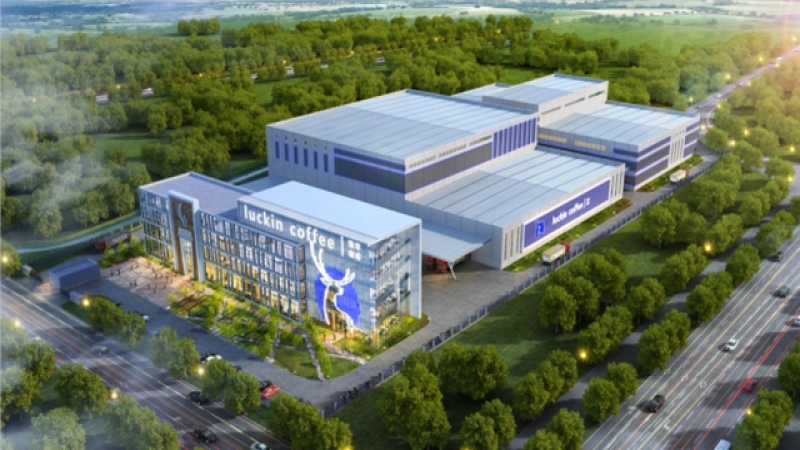
Luckin Coffee's second self-built roasting base broke ground in Kunshan, Jiangsu, with production expected in 2024. The facility involves roughly US$120 million in investment and covers 53,000 square meters, adding 30,000 tons of annual roasting capacity using equipment such as the Italian BRAMBATI roasting system. Combined with the Pingnan plant in Fujian, Luckin's annual capacity should exceed 45,000 tons.
With more than 7,846 stores, Luckin needs more roasting capacity to supply fresh green coffee beans nationwide. A single plant could not keep pace as the brand expanded into lower-tier cities and leaned toward everyday, functional coffee rather than only specialty coffee. The Kunshan base supports a more refined, globalized supply chain and fresher, safer beans for stores.
Luckin Coffee, with over 7,846 stores, is accelerating its upstream supply chain layout. Following the commissioning of its first roasting plant in Pingnan, Fujian, Luckin's second fully automated smart roasting base, independently invested and built in Kunshan, Jiangsu, broke ground recently and is expected to begin production in 2024. The base represents a total investment of about US$120 million, covers 53,000 square meters, and will have an annual roasting capacity of 30,000 tons, introducing core equipment such as the Italian BRAMBATI roasting system. By then, Luckin's two major roasting bases will have a combined annual capacity of more than 45,000 tons, providing fresher and safer green coffee beans to stores nationwide while advancing the brand toward its goal of a globalized, refined supply chain.
For professional coffee knowledge exchange and more coffee bean information, please follow Coffee Workshop (WeChat public account: cafe_style)
For more specialty coffee beans, please add the private WeChat of Front Street Coffee (FrontStreet Coffee), WeChat ID: qjcoffeex
With its store count surpassing 7,846, Luckin Coffee's demand for roasting capacity is becoming increasingly urgent.
As its market share continued to expand, Luckin gradually realized that specialty coffee, which emphasizes unique flavors and a refined experience, is not the only form of domestic consumption, and that the daily coffee market, which pursues value for money and functionality, may have broader space. Therefore, Luckin continues to penetrate more lower-tier cities in China and launches products that cater to the public's innovative tastes.
Driven by the joint efforts of its marketing team, several hit products successfully broke out of their circles, further driving sales higher, and the output capacity of Luckin's existing roasting plant began to strain. If it relied on only a single plant, production efficiency would likely be unable to keep pace amid the brand's continued outward expansion.
In fact, Luckin had planned to build a second coffee roasting plant as early as last year. After on-site research in multiple cities, it finally decided to build a new roasting base in Kunshan, Jiangsu, and in May this year officially signed a cooperation agreement with the Kunshan Development Zone.
After about half a year of approval procedures, Luckin Coffee (Jiangsu) Roasting Base officially broke ground in Kunshan yesterday. This is Luckin's second self-invested fully automated smart roasting base following the commissioning of its Fujian roasting base, and it will further improve its upstream supply chain system.
A relevant person in charge of Luckin pointed out that after the new plant is completed and put into production, it will supply fresher, safer, and pollution-free high-quality coffee beans to the domestic market. Over the next one to three years, Luckin will aim for global development, strengthen its brand strategy, build a refined global supply chain, and deepen technological innovation as well as talent and informatization development, striving to shape a world-class coffee brand originating from China.
For Luckin, the second roasting base can bring fresher and safer green coffee bean materials to the market; for Kunshan, the project is another major coffee industry project after Starbucks' "China Coffee Innovation Industrial Park" settled there.
Starbucks' "China Coffee Innovation Industrial Park" was already launched in November 2020, with a total investment of 1.1 billion yuan (about US$156 million), covering 80,000 square meters, and encompassing coffee bean import and export, roasting, packaging, warehousing, logistics distribution, and roasting training. It is Starbucks' largest productive strategic investment outside the United States.
It is understood that Luckin Coffee had previously obtained its business license. Information from Tianyancha shows that on May 27, 2022, Luckin Coffee Food (Jiangsu) Co., Ltd. was registered and established in Kunshan, with registered capital of US$40 million, legal representative Xia Wei, and wholly owned by Luckin Coffee Roasting Factory (Hong Kong) Co., Ltd.
Public information shows that Luckin's first roasting plant is located in Pingnan, Fujian, with a total investment of 210 million yuan, covering 45,000 square meters. It was established as a joint venture between Luckin and Louis Dreyfus Company (LDC), officially began production on April 18, 2021, and has an annual coffee bean roasting capacity of 15,000 tons.
Unlike that one, the new Kunshan plant is independently invested by Luckin, with a total investment of US$120 million (about 820 million yuan), covering 53,000 square meters. It is a full-industry-chain coffee roasting production base integrating green bean batching, roasting production, warehousing and logistics, and comprehensive research and development. It will also introduce core equipment such as the Italian BRAMBATI roasting system and ICA coffee bean packaging machines, and can roast and process up to 30,000 tons of coffee beans annually.
It is reported that Luckin Coffee (Jiangsu) Roasting Base is scheduled to be completed and put into production in 2024. By then, the two major roasting bases in Fujian and Jiangsu will form a self-processing roasting supply chain with an annual capacity of more than 45,000 tons, supplying higher-quality and fresher coffee to all 7,846 stores nationwide.
The above content is compiled by CoffeeHunters, a coffee news website.


