







What the High Test Coffee Debate Means for Nestlé's Under-16 Ad Ban
Nestlé announced that from July 1, 2023, it will stop advertising to children under 16 worldwide, covering candy, ice cream, and drinks with added sugar. The ban applies across television and online platforms, including social media and gaming, where roughly 25 percent of the audience is under 16, and the company says it will not collect data from minors.
The policy continues Nestlé's sugar-reduction shift, following the 2018 sale of its US candy business and a push into low-sugar, low-fat coffee products aimed at younger consumers. The company also set 2025 financial targets. For coffee drinkers watching sugar content, the move signals tighter marketing rules around sweetened coffee and high-sugar ready-to-drink lines.
As consumer demand for coffee becomes increasingly routine and health-oriented, major brands are facing new market challenges. Global food giant Nestlé recently announced that starting July 1, 2023, it will ban advertising to children under 16 worldwide, covering categories such as candy, ice cream, and sugary drinks. This move is seen as a key step for Nestlé to accelerate its "sugar reduction" transformation and reshape its brand image. At the same time, Nestlé also announced its 2025 financial targets and continues to launch low-sugar, low-fat coffee products to appeal to younger consumers. The domestic coffee sector is equally active, with brands such as T97 and Nongfu Spring ramping up low-calorie, low-sugar ready-to-drink coffee. This article will analyze from the perspectives of Nestlé's ban, financial expectations, and industry trends.
For professional coffee knowledge exchange and more coffee bean information, please follow Coffee Workshop (WeChat public account: cafe_style)
For more specialty coffee beans, please add the private WeChat of Front Street Coffee (FrontStreet Coffee), WeChat ID: qjcoffeex
Today, coffee consumption has gradually become integrated into daily life, becoming a rigid demand for many people. Against the backdrop of rising health awareness and continuously upgrading consumption concepts, the public has set higher requirements for food and beverages, and the competition for market share among coffee brands has become increasingly fierce.
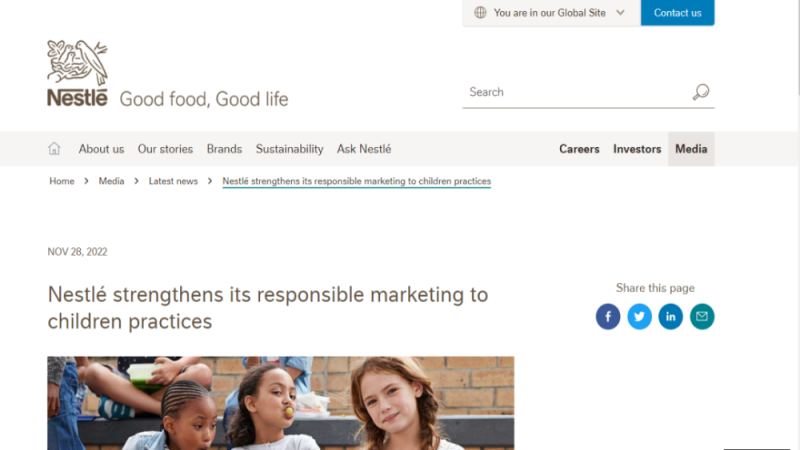
Recently, global food industry giant Nestlé issued a statement on its official website, saying that in order to further strengthen its leading practices in responsible marketing, starting July 1, 2023, it will ban advertising of its products to children under 16 worldwide, covering all categories such as candy, ice cream, and beverages with added sugar.
This ban will cover all television and online platforms, including social media and gaming platforms, where about 25% of the audience is under 16. At the same time, Nestlé promises not to collect data from minors and to cooperate only with social media influencers aged 18 or older.
Judging from its strategic layout in recent years, Nestlé is clearly striving to shed its high-sugar label and advance its "sugar reduction" transformation. In 2018, Nestlé sold its U.S. candy business and successively launched more healthy products that are low-sugar, zero-sugar, and zero-calorie, such as low-sugar beverages, sugar-free chocolate, and sugar-free coffee. Data shows that between 2016 and 2020, Nestlé reduced the sugar content of its products by a cumulative 5.1% globally.
Analyzing from industry market trends, in order to comply with the health trend in the food sector, Nestlé is abandoning high-sugar, high-calorie product categories and shifting toward more natural and healthier product directions, which is extremely beneficial for shaping its brand image. In the short term, stopping the promotion of high-sugar products to minors will inevitably drag down the performance growth of Nestlé's candy business and sugary products, but this decision is bound to bring more considerable returns for Nestlé's long-term goals.
Yesterday, Nestlé released its latest 2025 targets. The article pointed out that after the sharp rise in cost inflation in 2021 and 2022 put pressure on profit margins, the underlying operating profit margin is expected to recover to a range of 17.5% to 18.5% by 2025.
Nestlé forecasts that between 2022 and 2025, at constant currency, the annual underlying growth rate of earnings per share will reach 6% to 10%. Nestlé also plans to achieve free cash flow of 12% of sales by 2025 and achieve a return on invested capital of 15%.
Previously, Nestlé launched a lightly sweet black coffee product called "Black Coffee," featuring low sugar and zero fat, and it is also very suitable for the multi-scenario drinking needs of today's young consumer groups. Of course, Nestlé is not the only one entering the low-sugar, low-calorie field. In recent years, various companies and brands have continued to ramp up their layout of related products. The coffee brand T97, just established in April last year, entered the market with "low-calorie coffee" as its entry point.
In addition, Nongfu Spring, which crossed over into the coffee field from other sectors, is also continuously launching new low-calorie, low-sugar ready-to-drink coffee products, including black coffee, low-sugar latte, and sugar-free latte, and subsequently launched a new series of selected pure black coffee products called "Yirgacheffe." The competition can be described as increasingly intense.
Public information shows that Nescafé has a history of 83 years since its establishment. With the upgrading of consumption, young consumers have gradually become the main group, and Nestlé is accelerating the pace of making its brand younger, healthier, and more premium.
In terms of marketing models, Nestlé has used pop-up stores to attract young people's attention; at the product level, Nestlé has successively launched new special fruit-infused coffee and premium drip bag coffee, and continuously upgraded ready-to-drink coffee to attract young consumer groups with low sugar, low prices, and innovative flavors.
Image source: Internet
The above content is compiled by CoffeeHunters, a coffee news website.


