








Why Does Yirgacheffe Pour-Over Taste Bitter or Bland?
Burnt bitterness or a thin, watery cup in pour-over usually comes down to grind size, water temperature, and pouring technique rather than a bad bean. Grinding too fine or pouring too aggressively over-extracts and turns the cup bitter; grinding too coarse or pouring too slowly under-extracts and leaves it tasting like water. Adjust one variable at a time and taste again.
Bean choice matters too. A coffee enthusiast comparing the same variety, such as Yirgacheffe, from different roasters will find each one emphasizes a different profile. A recipe that suits one roaster's style can fall flat on another, so the same grounds and method do not guarantee the same result.
Many coffee enthusiasts encounter two headache-inducing problems during pour-over brewing: the coffee tastes burnt and bitter, or it tastes bland like water. Through daily interactions with customers at the shop, Front Street Coffee has found that truly mastering pour-over isn't about brewing a perfect cup every time, but about being able to accurately identify where the problem lies and find the corresponding solution. This article compiles the most common pour-over mishaps, analyzing the causes of burnt bitterness and blandness one by one—from differences in coffee bean roasting and grind size calibration to the technique of pouring water in circles. Whether you're a complete beginner or a pour-over player with some experience, you'll find practical troubleshooting ideas and adjustment directions here.

Front Street often mentions in conversations with coffee enthusiasts at the shop that truly mastering pour-over coffee isn't about brewing a perfect cup every time, but about being able to accurately identify the cause when problems arise and make targeted adjustments. Of course, there's a prerequisite for this: you first need to determine that the coffee indeed has a flaw, and you also need to accumulate a large number of failure cases to continuously broaden your understanding. Based on this approach, Front Street has organized some situations that frequently occur during pour-over brewing.
Sticking to One Brewing Method
Many friends like to buy the same coffee bean from different roasters for comparison. Although the beans are the same variety, each roaster has its own stylistic emphasis. In terms of the general flavor direction, the differences between roasters usually aren't huge, but in terms of detailed expression, the angles can be completely different—some pursue an extreme, clean acidity, some emphasize a balance of sweetness and acidity, and others focus on presenting high-sweetness fruit notes.
In most cases, using a universal brewing recipe can bring out each roaster's characteristics. But the problem is that after some people get used to brewing a certain bean one way, they use the same method for another roaster's beans, and the result is less than satisfactory.
At this point, it's easy to think: "I used the same method to brew the same bean, and it didn't taste good, so it must be the bean's problem." But in reality, the real reason is that you don't have a comprehensive enough understanding of this coffee bean.
Let Front Street give an example. Yirgacheffe is a bean that almost every roaster carries. Generally speaking, brewing various roasters' Yirgacheffe with a fairly conservative approach won't show dramatic differences in taste. Until one day, you see a roaster recommending brewing Yirgacheffe at 94°C, and after trying it, the result is surprisingly good. So you conclude that the optimal temperature for brewing Yirgacheffe is 94°C. Over time, this becomes your fixed habit. Until you try another roaster's Yirgacheffe and find "something's wrong, there's bitterness—I never get this when I brew other roasters' beans, so it must be the bean's problem"—this thought naturally arises. (If readers find the temperature example unconvincing, try replacing "temperature" with technique, grind size, or ratio, and read it again.)
For coffee beans from some lesser-known origins, the differences brought by roasting style become even more pronounced. Take Papua's Bird of Paradise coffee beans, for example. This bean is called "Little Blue Mountain" because the Typica variety grown locally was introduced from Blue Mountain, and it also belongs to the island-type coffee category. Some roasters give it a medium-dark roast, highlighting nuts, chocolate, and a style without acidity; some use a medium roast, presenting a soft, balanced sweet-sour-bitter expression; and others do a medium-light roast, bringing out flavors of white peach, plum, hawthorn, and other sweet-leaning fruits.
So even for the same coffee bean, using the same set of brewing parameters naturally can't suit beans of different roast levels. Only by first understanding the characteristics of the coffee bean itself can you choose the right brewing method. If you're not confident about this, you can also directly ask the merchant you bought the beans from for the corresponding brewing parameters. Getting the correct parameters is half the battle won.
The Root Source of Burnt Bitterness
After getting the correct parameters, whether you can actually use them correctly is the key. Things like water temperature and ratio are generally not prone to deviation—the most error-prone step is grind size. Many friends know roughly how coarse the grind should be, but in practice they often can't get it right.
If after brewing ends, the coffee bed shows a large area of muddy slurry, then either the grind is too fine or the proportion of fines is too high, causing water to drain slowly and the coffee grounds to soak in it for an extended time—naturally, burnt bitterness emerges.
Front Street's method for calibrating grind size is to use a No. 20 sieve and determine the appropriate coarseness through the passing rate. For medium-light roasted coffee beans, a grind size with a passing rate between 75% and 80% is suitable; for medium-dark roasted coffee beans, a coarseness with a passing rate between 70% and 75% is suitable.
If you don't have a sieve on hand, you can also judge by the speed and time of the water level dropping. Using Front Street's brewing parameters as a reference, for a normal 1-to-2 serving coffee, the extraction time is roughly between 1 minute 50 seconds and 2 minutes 10 seconds. If the grind is on the fine side, the extraction time will be longer; if the grind is on the coarse side, the extraction time will be shorter. By looking at the extraction duration, you can make a preliminary judgment about whether the grind size is appropriate.
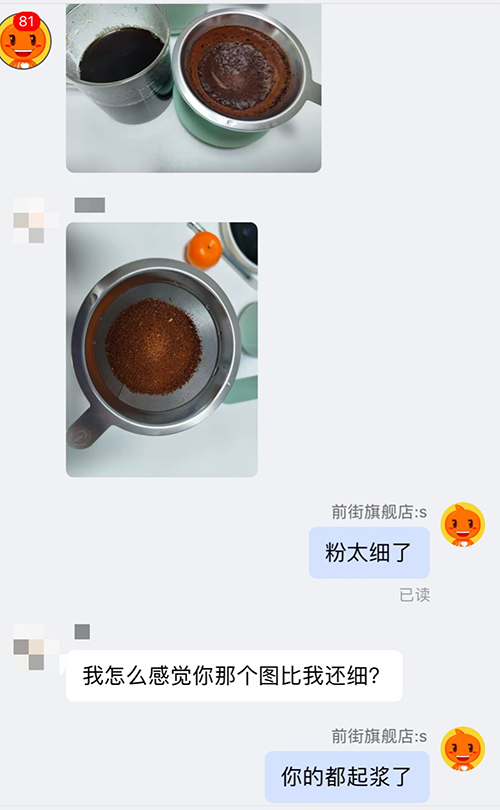
Then look at the speed at which the water level drops. Under normal conditions, the coffee bed should sink at a steady, slow pace. If you notice it dropping very quickly, the grind may be too coarse; if it sinks slower and slower, or even clogs, it's most likely that the grind is too fine or there are too many fines, and the bottom of the coffee bed will appear muddy.
Reasons Why Coffee Tastes Bland
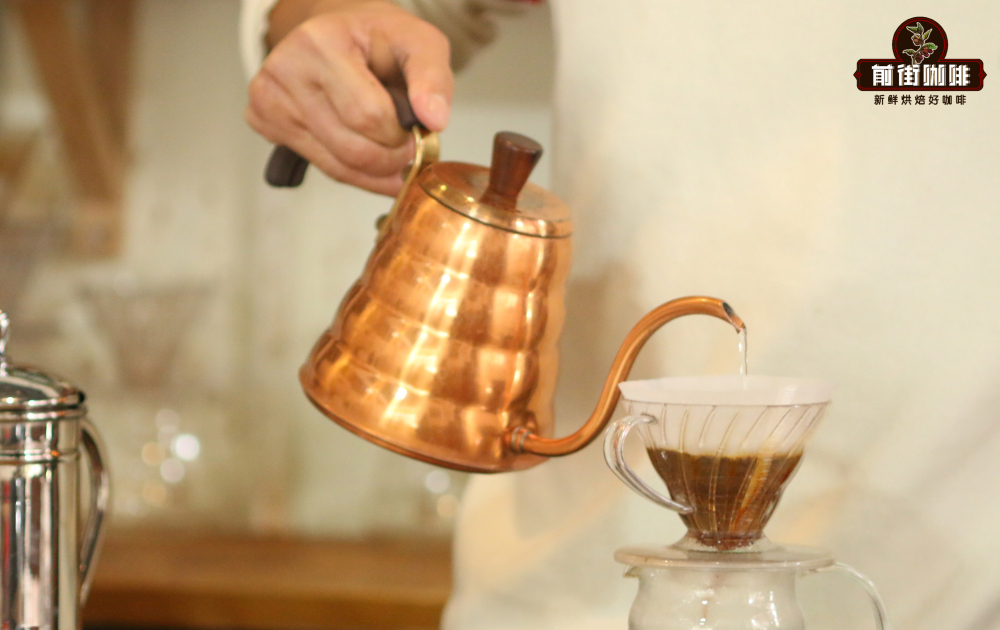
Also under the premise of correct parameters, the reason blandness occurs frequently is that when pouring water, the circling amplitude is too large, washing all the coffee grounds on the outer ring down. Once the coffee wall is washed away, water flows straight down along the guide ribs into the server without ever contacting the coffee grounds, so the overall taste feels like nothing—very bland.
So when pouring water normally, pay more attention: reduce the circling amplitude and don't pour the water level too high, letting the coffee grounds fully contact and soak in the water. Only then can the proper coffee flavor be extracted.
The above content is compiled by CoffeeHunters, a coffee news website.


