







What Is an Arabica Bean Worth When Specialty Coffee Faces Crisis?
Morgan Eckroth, runner-up at the 2022 World Barista Championship, smashed a coffee cup in front of the judges to highlight the extinction crisis facing specialty coffee. She chose the endangered Eugenioides variety and wove in kintsugi craft and Colombian national liquor. Her message: coffee service has become efficient but dull, and the loss of service experience is now unavoidable.
Eckroth already had over 7 million followers as a coffee content creator before competing. She shares home brewing content so viewers can make specialty coffee without visiting a cafe. For anyone asking what is an arabica bean in a market reshaped by climate change and industry decline, her routine raises the question of how baristas convey coffee culture, not only how they extract it.
Morgan Eckroth, runner-up in the 2022 World Barista Championship, did something shocking on stage—she smashed a coffee cup in front of the judges. This coffee influencer with 7 million followers used a performance full of metaphors to explore the extinction crisis facing specialty coffee. From choosing the endangered coffee variety Eugenioides to incorporating kintsugi craft and Colombia's national liquor into her signature beverage, every choice Morgan made pointed to the same question: when climate change, market shifts, and industry decline come one after another, is the coffee industry ready? This article will take you through this stunning competition and explore how baristas can rediscover the humanistic value and professional charm of specialty coffee in an era obsessed with efficiency.
For professional coffee knowledge exchange and more coffee bean information, please follow Coffee Workshop (WeChat public account: cafe_style)
For more specialty coffee beans, please add our private WeChat Front Street Coffee (FrontStreet Coffee), WeChat ID: qjcoffeex
"Specialty coffee came to the brink of extinction two years ago. Coffee used to be like a canvas, capable of building extraordinary connections with customers, but all of that has changed. Coffee service has become increasingly efficient, yet also incredibly dull.
Two years later, as we confidently push the coffee industry forward, the loss of service experience has become an unavoidable reality. While pursuing progress, we should also look back at what we once were."
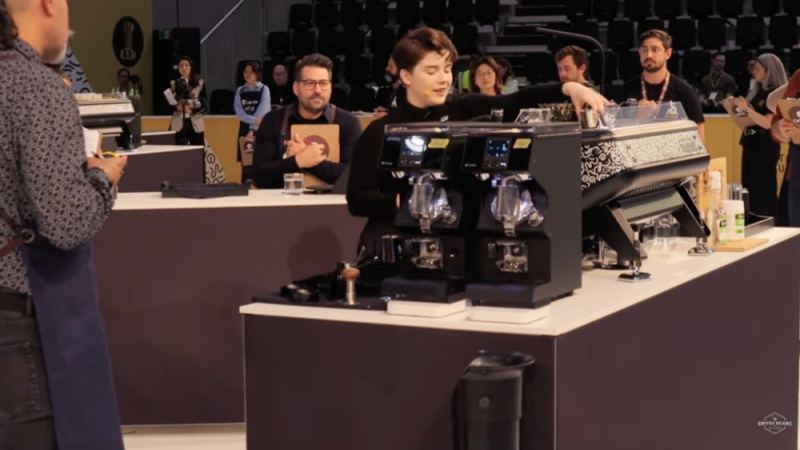
The above is the core statement of Morgan Eckroth, the 2022 WBC runner-up from the United States, during the competition.
Unlike most competitors in major barista competitions, Morgan was already a coffee content creator with over 7 million followers before stepping onto the stage.
Since the pandemic broke out, in order to let more people appreciate the appeal of specialty coffee and not lose the experience of professional service and specialty coffee even when they cannot walk into a café, Morgan often shares content on social platforms in a relaxed and concise way, so that every viewer can make a cup of specialty coffee or signature beverage at home.
To get more people to fall in love with specialty coffee and absorb more coffee knowledge, baristas must accurately convey coffee culture. This kind of professional competence is not limited to face-to-face service scenarios—daily sharing can carry it just as well. Morgan also stated this year at the World Barista Championship US regional selection that, as a coffee blogger, she regards spreading professional coffee knowledge and promoting specialty coffee as her mission.
Back to the WBC stage—
In the milk coffee round, Morgan chose an endangered coffee variety—Coffea Eugenioides from Colombia. It is the mother of Arabica, native to East Africa. The leaves and fruits of this variety are smaller than those of Arabica. Although it is not particularly difficult to grow, its yield is indeed lower than Arabica, and it is still regarded as a rare or experimental coffee variety.
"This incredibly unique coffee flavor gives us a whole new expectation for coffee. In the grand garden of coffee, people had almost forgotten it. Fortunately, a coffee lab brought this variety back to life and carefully tended and cultivated it deep in the Colombian Andes, allowing it to re-emerge." Morgan said.
Today, with the help of technology, Eugenioides has restored its astonishing coffee flavor—low acidity and complex, rich sweetness. The natural processing method also enhances the coffee's own sweetness.
In the milk coffee-espresso portion, Morgan used 23g of coffee grounds, extracted 36g of coffee liquid in 25 seconds, and paired it with freeze-distilled purified milk, freeze-distilling whole milk to 30% to give the milk an excellent creamy texture. After heating, the lactose in the milk is further activated and fully integrates with the sugars contained in Eugenioides, creating a candy-like sweetness.
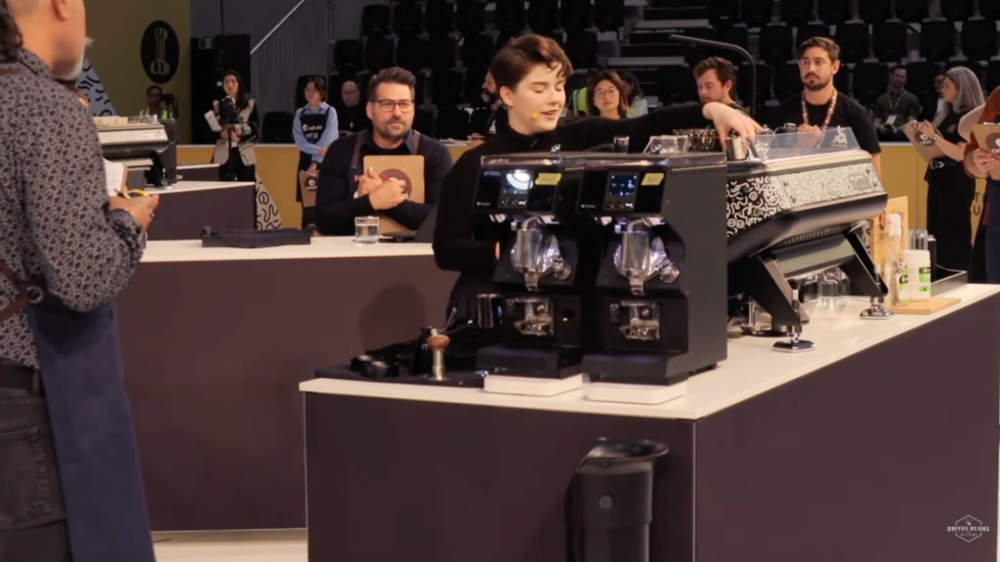
The creamy texture of the purified milk allows the coffee to express flavors of yellow cake batter, melted chocolate ice cream, caramel butter, sugar, vanilla, and salted nuts, along with a thick creamy body and buttery weight.
Eugenioides had previously experienced an extinction crisis, and in recent years, affected by climate change, its yield has declined again, putting it once more at risk of extinction. Morgan hoped that with the help of the milk's sweetness, she could bring the sweetness of Eugenioides to its fullest and let everyone feel the flavor magic of this variety again.
In the signature beverage round, Morgan chose a light-roasted natural Rume Sudan from Colombia, preserving the tropical fruit acidity characteristic of Rume Sudan.
She first used 18.2g of coffee grounds and extracted 40g of coffee liquid in 25 seconds, presenting flavors of red grapefruit, floral notes, yellow sugar, and kiwi, with a medium body, soft and smooth mouthfeel, and a lingering finish of rose and kiwi transforming into orange acidity. Each judge received two espressos—one to taste directly and one reserved for later preparation.
Then, the 80g Rume Sudan espresso Morgan used had been made and frozen at the very beginning of the competition; then she added a syrup made from Colombia's distinctive lemon-like citrus—lulo—and 25g of sugar in a 1:1 ratio. After mixing with the coffee, it produces flavors of tamarind and maple.

-Lulo
Next, she added 30g of pineapple juice with salt water. The salt water helps balance the coffee's flavor and also enhances the sweetness in the coffee, creating a spiced cocoa taste; then she added 20g of freeze-distilled milk to give the coffee a creamy texture; finally, she charged it with carbon dioxide and poured in the judges' remaining three espressos to mix.
After pouring the coffee, the cup that had held the espresso would be smashed by Morgan, symbolizing the coffee crisis we face, are facing, and will continue to face. In turbulent times, is the coffee industry really ready? Morgan hopes the answer is yes, because looking back at the past reveals this. Coffee itself has survived only through constant renewal, and so will we.
After mixing, the coffee has flavors of fruit jam, creamy sparkling water, spiced cocoa, and spicy botanical notes, with a dense foam and a light yet creamy-smooth mouthfeel. It is then poured into cups made using the ancient Japanese kintsugi technique (the art of repairing broken objects with gold, making them stronger). This symbolizes coffee, and also humanity—take a deep breath, and anticipate everything broken.
After portioning, Morgan sprayed each cup of coffee with a mixture of orange blossom water and tea, simulating Colombia's national liquor Agua Diente, symbolizing celebration and the hope that specialty coffee will fully return in the future.
It is not only Eugenioides that faces extinction. Global climate change, dramatic shifts in the consumer market, and the decline of the coffee industry have put specialty coffee itself in danger. Therefore, the inherent value of coffee must be raised.
Professional coffee knowledge and an understanding of the principles of coffee extraction are essential qualifications for baristas, but what the industry's development needs is more people who can appreciate and are willing to learn about specialty coffee.
Every trade has its own expertise, and different industries are worlds apart. Not everyone who drinks coffee has an in-depth understanding of coffee culture or knowledge. For beginners who want to know and learn about coffee, what baristas need to do is correctly simplify complex knowledge after understanding it, and then express and communicate it—only then can specialty coffee achieve better development.
From coffee novices to coffee experts, all are added value to the industry. Finding new market segments is the key to the industry moving forward.
Image sources: screenshots from YouTube (World Coffee Championships), internet
The above content is compiled by CoffeeHunters, a coffee news website.


