







Starbucks Coffee China Growth Targets Through 2025
Starbucks China unveiled its 2025 China Strategic Vision on September 14, built on six growth engines. By 2025 the company plans 9,000 stores, a workforce of 95,000, doubled net revenue, and operating profit four times the current level. The Starbucks Coffee Innovation Park starts production in summer 2023, completing local supply chain coverage.
Starbucks opened its first China store in Beijing in January 1999 and now operates more than 5,600 locations, a roughly tenfold expansion over a decade, with about 6,000 expected by the end of 2022. Like Costa Coffee, whose company information shows a similar China push, Starbucks faces competition from local chains such as Luckin.
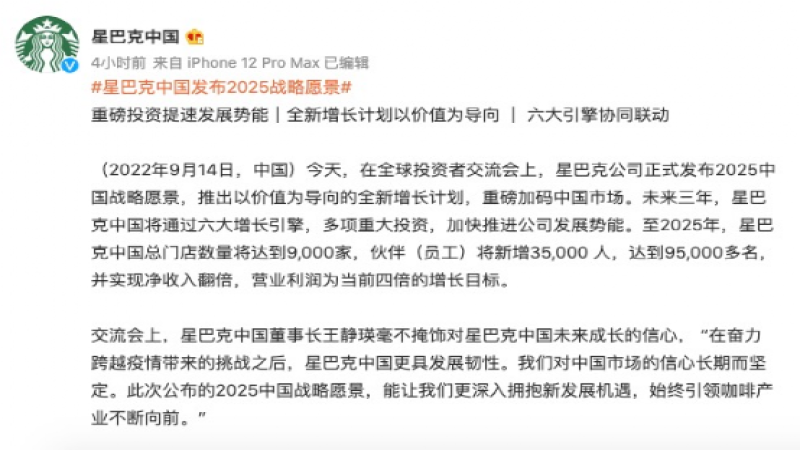
On September 14, Starbucks China officially announced its 2025 China Strategic Vision, planning to fully accelerate development over the next three years with the help of six growth engines. The blueprint covers multiple dimensions including store network expansion, promotion of the green store certification system, digital membership upgrades, localized new product development, and employee wage increases. According to the plan, by 2025 Starbucks China's total number of stores will climb to 9,000, its workforce will grow to 95,000, and both net revenue and operating profit have set doubling targets. At the same time, the Starbucks Coffee Innovation Park will also begin production in the summer of 2023, completing the localization layout of the entire industry chain. In the face of fierce competition from local brands such as Luckin, whether this strategy can help Starbucks consolidate its market position is worth continued attention.
Professional coffee knowledge exchange. For more coffee bean information, please follow Coffee Workshop (WeChat public account cafe_style).
For more specialty coffee beans, please add the private WeChat of Front Street Coffee, WeChat ID: qjcoffeex.
On September 14, Starbucks China disclosed its 2025 China Strategic Vision. Under this plan, the company will fully accelerate business development over the next three years by relying on six growth engines, while expanding store scale and accelerating the rollout of green stores.
In addition, Starbucks will continue to deepen its efforts in home consumption scenarios and out-of-home drinking scenarios, advance the iteration of its digital membership system, speed up the development pace of localized new coffee products, and raise employee salaries.
According to the targets, by 2025 Starbucks China's total number of stores will reach 9,000, its workforce will increase by 35,000 to 95,000, while achieving the growth expectations of doubling net revenue and reaching four times the current operating profit.
Starting from the opening of China's first store in Beijing in January 1999, Starbucks China currently has more than 5,600 stores.
Over the past decade, the number of Starbucks stores in mainland China has expanded nearly tenfold, and is expected to reach 6,000 by the end of 2022. This plan proposes that the number of stores reach 9,000 by 2025, meaning a net increase of 3,000, which translates to a new store opening on average every 9 hours.
Starbucks plans to use digital capabilities to optimize store layout forms and create appropriately matched store types around customers' lifestyles.
Reserve stores will continue to shoulder the mission of continuously enhancing the coffee experience, while all core stores will aim to integrate into the community and provide a convenient and warm Starbucks experience.
In terms of the rollout of green stores, it is expected that about 2,500 green stores will open nationwide by 2025. Starting last year, last year, Starbucks opened the world's "greenest" store in Taikoo Li Qiantan, Shanghai — the Starbucks Greener Store Lab — and officially opened for business.
This store is Starbucks' first environmental experiment store globally, practicing Starbucks' most cutting-edge environmental measures and exploring a recyclable green retail new model in all aspects. Its opening marked that Starbucks had entered a brand-new stage and also represented the official landing of Starbucks' "green store" certification system in China. After that, Starbucks green stores opened successively in cities such as Beijing, Shanghai, Shenzhen, Hangzhou, and Suzhou.
Every green store that passes certification will advocate a greener, recyclable lifestyle and actively invite customers to join in, starting from the little things in daily life and moving toward green together.
Starbucks' "green store" certification system was jointly developed by Starbucks and authoritative institutions. Starbucks green stores need to pass the 8 major standards of this certification system. Through this series of positive measures to improve store energy efficiency, compared with ordinary Starbucks stores of the same size, each year it is expected to reduce carbon emissions by about 10.57 tons and water use by about 301.7 tons.
At the exchange meeting, Starbucks China chairman Wang Jingying did not hide her confidence in Starbucks China's future growth: "After striving to overcome the challenges brought by the pandemic, Starbucks China has become more resilient in development.
Our confidence in the Chinese market is long-term and firm. The 2025 China Strategic Vision announced this time will allow us to more deeply embrace new development opportunities and always lead the coffee industry forward."
However, there are still many chain coffee brands holding a relatively large share of the Chinese market, such as Luckin Coffee, COSTA Coffee, Manner Coffee, and so on... According to the 2022 second-quarter financial report published by Luckin Coffee, from the trend perspective, the gap between Luckin and Starbucks is continuing to narrow.
According to data, as of the first half of this year, Luckin's number of stores in China had reached 7,195, more than 1,000 more than Starbucks. In terms of store count, Luckin is already China's largest coffee chain brand. Will surpassing Starbucks to become the chain coffee brand with the most stores in China put pressure on Starbucks' future development?
This plan also mentions that it will fully utilize the growth opportunities brought by digital platforms and continue to strengthen the Starbucks Delivers business. It is expected that by 2025, delivery business sales will reach more than twice the current performance. At present, more than 5,000 dedicated delivery riders each day can deliver Starbucks' consistently high-quality coffee to customers outside stores in an average of only 19 minutes.
In addition, Starbucks China also introduced that the Starbucks Coffee Innovation Park, with an investment of about RMB 1.1 billion ($156 million), will be officially completed and put into production in the summer of 2023. By then, Starbucks China will complete localized coverage of the entire coffee industry chain. It will have the largest coffee roasting plant outside the U.S. market and Starbucks' greenest globally.
Wang Jingying said, "The future is promising. We are ready to join hands with all partners in the Starbucks family to embrace broader opportunities and jointly create the next brilliant chapter of Starbucks China."
Image source: Internet
The above content is compiled by CoffeeHunters, a coffee news website.


