







What Is Yirgacheffe Coffee and Does Filter Fit Matter
What is Yirgacheffe coffee? It is the Ethiopian origin used in this pour-over test, where a V60 and Yirgacheffe Red Cherry beans revealed that filter paper adherence barely changes the overall flavor direction but does leave traces on sweetness, acidity, mouthfeel, and greenness. Fully adhered paper scored slightly higher in sweetness.
Four filter states were compared: fully adhered, folded edge lifted, placed crooked, and completely unadhered. Extraction times were 2:00, 2:18, 2:10, and 2:10. Brewing used 15g coffee at a 1/16 ratio, 80 percent passing a No. 20 sieve, 91°C water, and a three-pour method.
When brewing pour-over coffee, many people habitually wet the paper filter with water first, aiming to make the filter cling tightly to the dripper. But does the filter really sticking or not actually sway the taste of a cup of coffee? Front Street used a V60 and Yirgacheffe Red Cherry to run a comparative experiment, dividing the filter states into four types: fully adhered, folded edge sticking up, placed crooked, and completely unadhered, and recorded the extraction time and flavor differences for each. The results showed that although the degree of adherence does not change the overall direction, it does leave traces on sweetness, acidity, mouthfeel, and greenness. Below, we break down the reasons one by one in conjunction with the brewing process.
In the daily operation of pour-over coffee, many friends habitually wet the paper filter with water first. Besides warming the cup and removing papery taste, a large part of the reason is to make the filter sit snugly against the inner wall of the dripper. When we first started learning to brew coffee, we were also often reminded that it is important for the paper filter to adhere to the dripper. So how much impact does good or poor filter adherence actually have on the flavor of the final pour-over?
Front Street designed a simple experiment, brewing coffee with paper filters in different states of adherence and comparing the final flavor trends. The dripper was still a V60, the beans were Yirgacheffe Red Cherry, and the brewing parameters were as follows: Dose: 15g Ratio: 1/16 Grind size: 80% passing a No. 20 sieve Water temperature: 91°C Pouring method: three-pour method The degree of filter adherence was divided into four groups: Group 1 fully adhered; Group 2 had a raised fold line and did not adhere because the folding was not done well; Group 3 was not aligned when placed, so the filter was crooked overall; Group 4 was completely unadhered.
The brewing results were as follows:
- The extraction times of the four groups were 2 minutes, 2 minutes 18 seconds, 2 minutes 10 seconds, and 2 minutes 10 seconds, respectively;
- The overall flavor direction of the four pots of coffee was basically the same. With Group 1 as the reference, the other three groups all showed visible differences in taste and mouthfeel;
- Group 1 had slightly higher sweetness than the other three groups, and the other three groups showed almost no difference in sweet-sour performance;
- Group 2, after the temperature dropped slightly, revealed a fairly obvious green, astringent note, while the other three groups did not;
- Apart from being slightly more sour than Group 1, Group 3 showed no other differences;
- Group 4 was thinner in mouthfeel than the other three groups.
After seeing the results, Front Street went back to review the brewing process at the time. 1. In Group 1, the paper filter fully adhered, and the entire brewing process was very standard; 2. In Group 2, the fold was not made well, causing the paper filter to stick up and fail to adhere. During blooming, the coffee grounds near the unadhered side let out large bubbles, clearly indicating poor gas release. During the subsequent pouring, the folded part of the filter stayed raised from beginning to end, and only the bottom was adhered.
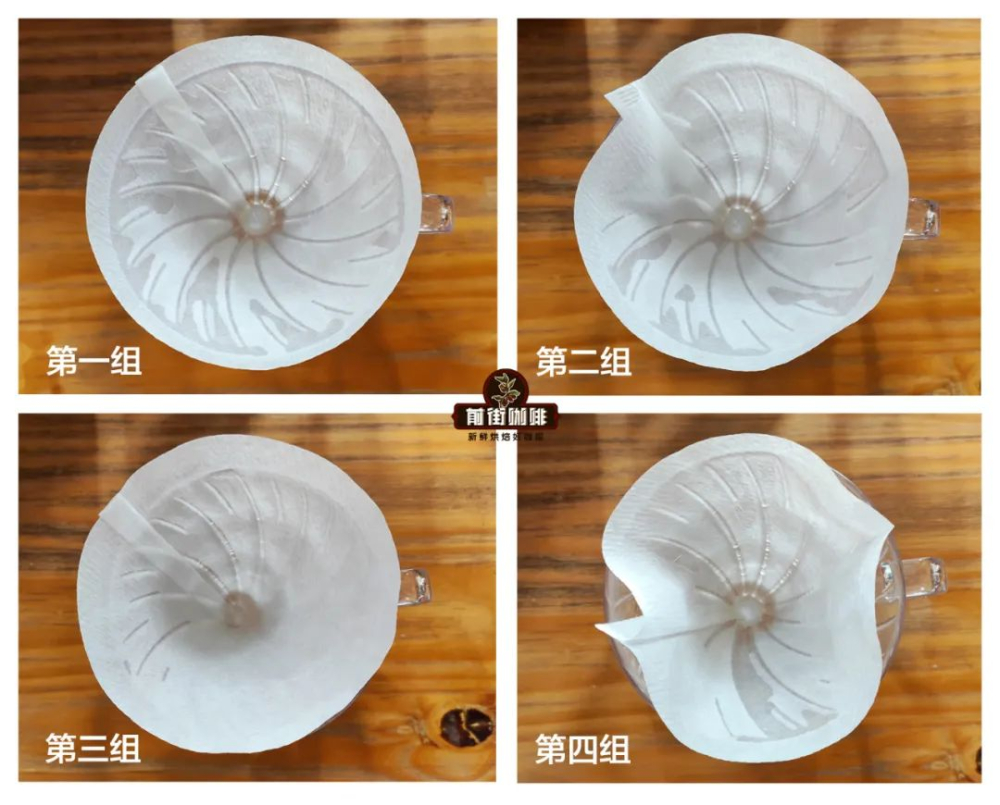
Therefore, when the water level was relatively high, the part not adhered to the dripper could not effectively channel the water flow, and the water rushed toward the other adhered areas. This creates what we often call uneven extraction, which in turn brings a green, astringent taste; if the soaking time is too long, it may also turn bitter. 3. In Group 3, the paper filter was placed crooked, showing a lopsided state from the bottom to the upper layer, which essentially meant that nearly half of the area, starting from the bottom, was not adhered to the dripper.
After the coffee grounds were added, the paper filter did not change immediately, but after the blooming pour, the unadhered part actually stuck back under the influence of gravity. After brewing ended, Front Street observed the bottom of the dripper and found that the paper filter, which had originally been unadhered because of the crooked placement, had already adhered under the effect of gravity. This also explains why Group 3 tasted very close to Group 1, and why it was slightly more sour than Group 1, possibly because the blooming degassing was not as sufficient as in Group 1.
4. In Group 4, Front Street simply opened up the paper filter and wet it, and it could be seen that the bottom was still fully adhered, but two large areas above were raised. During blooming, large bubbles also appeared because of poor gas release. Throughout the pouring stage, the paper filter was never pressed back by the force of the water flow, so the liquid surface appeared oval. During pouring, it was very easy to pour onto the paper filter, causing a “channeling effect,” and the coffee’s mouthfeel became thin.
So the degree of paper filter adherence really does matter for the taste and mouthfeel of coffee. First, one key problem when the paper filter does not adhere to the dripper is that the coffee grounds’ degassing during blooming is obstructed. Second, the guiding ribs on the dripper are originally meant to channel the water flow, but the premise is that the paper filter must cling to these ribs; if the paper filter does not adhere, those ribs in the detached areas become useless, and extraction uniformity and drainage speed will naturally be affected. Although Group 3 did not adhere because the paper filter was placed crooked, and later accidentally adhered under the influence of gravity, this does not happen 100% of the time. If the paper filter still has not adhered by the end of extraction, then the coffee’s taste will move toward the results of Group 2 or Group 4. Finally, whether the paper filter adheres or not actually has little to do with the act of wetting the filter with water itself; the key is still the method. Friends who are interested can click the portal below for reference: “Paper filter not fitting the dripper? Actually, folding the paper filter takes skill!”
The above content is compiled by CoffeeHunters, a coffee news website.


