







Why Do Shanghai Independent Coffee Shops Keep Growing?
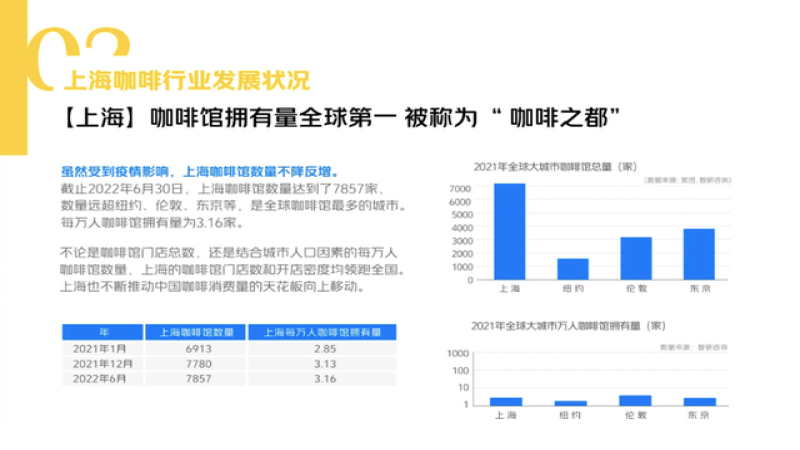
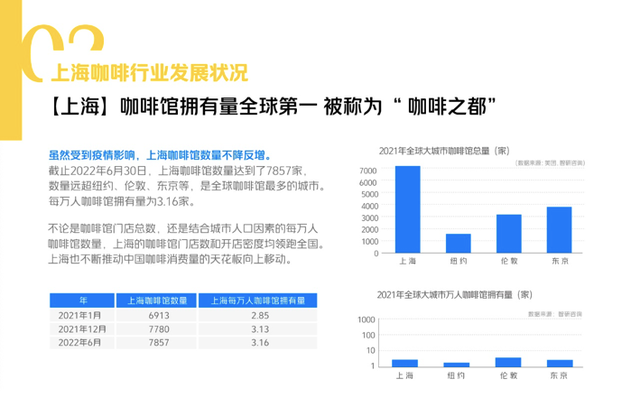
Shanghai had 7,857 coffee shops as of June 30, 2022, per Meituan's China Coffee Consumption Insights report, and independent outlets make up more than 60 percent of them. That total keeps the city ahead of New York, London, and Tokyo. Density is highest in Huangpu District at 38.5 shops per square kilometer, with Jing'an at 20.1, and both figures are still rising.
The growth rests on a coffee habit passed down across generations. A Shanghai missionary press cookbook recorded coffee brewing as early as 1866, and the first shop open to the Chinese public appeared on Fuzhou Road in 1906. Independent owners compete on style, product range, and personal experience rather than on absolute coffee volume alone, which is why new shops keep opening between chain locations.
As of June 2022, Shanghai ranks first among cities worldwide with 7,857 coffee shops, of which independent outlets account for more than 60 percent. Behind this figure lies not only a coffee-drinking tradition spanning over a century, but also the meticulous efforts of contemporary owner-operators in refining style, products, and personalized experiences. This article analyzes, from the two dimensions of historical context and business strategy, how Shanghai's independent coffee shops continue to grow in the cracks between chain brands, and explores how owner-operators, spatial style, and product uniqueness constitute the core competitiveness of independent coffee shops.
A report titled "2022 China Coffee Consumption Insights," published yesterday by Meituan, disclosed a set of data: as of June 30, the total number of coffee shops in Shanghai climbed to 7,857, with independent coffee shops holding a share of more than 60 percent. The city still maintains its position as number one in the world in the number of coffee shops, leaving international metropolises such as New York, London, and Tokyo far behind.
The report also pointed out that the coffee shop density in Huangpu District reached 38.5 per square kilometer, while that in Jing'an District was 20.1, and both figures are still rising continuously. Faced with such a huge and densely concentrated coffee market, why do new shops still keep emerging? What exactly do independent coffee shops rely on to retain customers? (I guessed someone would say: because they have money.) That is indeed one reason, but this article does not intend to elaborate on it.
The continued expansion of coffee shops in Shanghai is rooted in the fact that local residents generally maintain the habit of drinking coffee, and this habit shows a characteristic of intergenerational inheritance. Looking back at history, the "Foreign Cookbook" published by Shanghai American Presbyterian Mission Press in 1866 had already recorded the brewing method of "磕肥" (COFFEE). In newspapers, periodicals, and books of the late Qing Dynasty, various transliterated forms of COFFEE were commonly seen. In 1906, the first "Baoli Coffee Shop" open to the Chinese public appeared on Fuzhou Road, and Shanghai's celebrities and merchants gradually developed the daily habit of drinking coffee.
After 1917, coffee shops became increasingly common in Shanghai. By 1937, the coffee industry in Shanghai was already quite prosperous. If measured against the population base with consumption capacity at that time, its density and number were not necessarily inferior to those of today. From the map below, one can intuitively see that on the streets of Shanghai a hundred years ago, coffee shops were already arranged at a pace of one every few steps.
The real turning point that integrated coffee into the daily life of Shanghai residents was the advent of vacuum-packed coffee powder in the early 1960s. Pre-packaged coffee powder lowered the threshold for coffee consumption and also changed the scenarios in which people drank coffee. More and more ordinary people began to buy coffee powder and brew it at home themselves. They did not pay much attention to flavor, nor did they care about the environment. Drinking coffee was simply a ritual to remind themselves every day to perk up and start a new day, and over time it settled into a cultural inertia.
Of course, along with the progress of the times and the spread of the specialty coffee concept, even outside Shanghai, the number of coffee shops has continued to grow. Shanghai's ability to reach its current scale of densely packed coffee shops is by no means the result of short-term efforts. Every generation of independent coffee shop owner-operators has figured out its own unique business approach. This also explains why, even though chain brands are blooming everywhere, independent coffee shops still retain room to compete.
The three most precious assets of an independent coffee shop are: an owner-operator who is like its soul figure, a distinctive decorative style, and unique product characteristics.
- About style
The greatest fun of running an independent coffee shop lies in not having to hire professionals to take charge, but instead decorating and furnishing it entirely according to one's personal aesthetics, shaping a one-of-a-kind store temperament. The more casual and natural the approach, the easier it is to leave a deep impression in consumers' minds. There are countless good-looking coffee shops, but a coffee shop with personality is one of a kind.
Regardless of whether one has previous experience opening an independent shop, every independent coffee shop needs to control its initial investment well in the startup stage. At the beginning of opening, the first thing to ensure is that after customers enter the shop, there is a clean and tidy space to settle in as well as a place to make coffee. Other items can absolutely be added gradually in the course of subsequent operation. The advantage of doing this is that one does not have to force oneself to hastily purchase unsuitable decorations or cabinets within a certain period, and at the same time, through this go-with-the-flow process of adding things, the coffee shop can naturally grow into a unique style.
- About products
So-called unique product characteristics can be reflected in roasting coffee beans oneself, or in original beverages, or in having a set of distinctive brewing insights. Coffee beans are ultimately a kind of agricultural product, and the presentation of flavor depends entirely on the degree to which the roaster and the brewer understand it ~ The uniqueness of a product cannot be separated from the barista's interpretation of the coffee beans.
Whether it is a pour-over, a cold brew, or a creative coffee, all can reflect the maker's cognition and understanding of coffee. No matter what extraction or pairing method is adopted, the key lies in presenting the flavor characteristics of the coffee itself, and elevating its flavor characteristics is a kind of charm.
- About the owner-operator
An interesting owner-operator can be called the treasure that anchors an independent coffee shop! There are not many customers who return because of excellent products or a pleasant environment, but there are quite a few who keep coming back because of the owner-operator's charm. The reason independent coffee shops are always needed is precisely because here exist the interesting souls that chain coffee shops lack.
In this fast-paced city, independent coffee shops can stand firm precisely by relying on human warmth and a slow rhythm, and therefore, a hundred years later, they are still found throughout the streets and alleys.
Image source: Internet
Professional coffee knowledge exchange For more coffee bean information, please follow Coffee Workshop (WeChat public account cafe_style)
For more specialty coffee beans, please add the private WeChat Front Street Coffee (FrontStreet Coffee), WeChat ID: qjcoffeex
The above content is compiled by CoffeeHunters, a coffee news website.


