







How does osmanthus coffee blur the coffee and milk tea line?
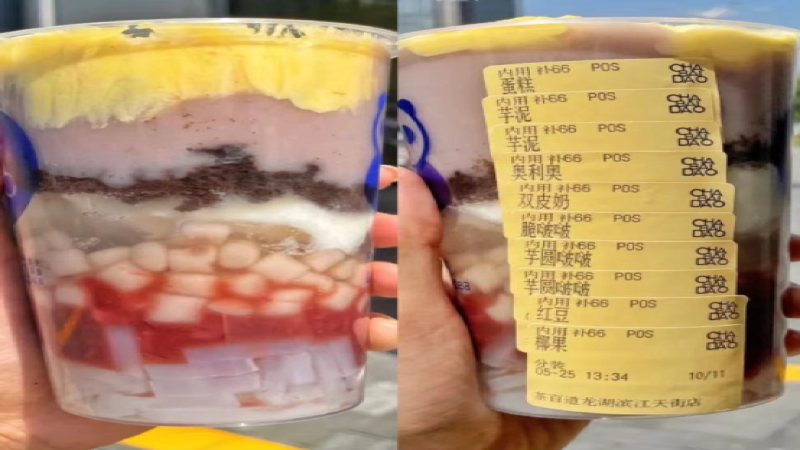
Milk tea shops now sell congee-style drinks loaded with milk cap, cheese, tapioca pearls and grass jelly, while cafes add oats, fermented rice, thick milk and osmanthus to coffee. Those additions dilute coffee's traditional bitterness and pull the flavor closer to milk tea, so the two categories increasingly overlap on the same menu.
A Weibo science blogger tested whether drinkers can still tell them apart, pairing coconut milk tea with coconut coffee, cherry blossom milk tea with cherry blossom coffee, and osmanthus milk tea with osmanthus coffee in a blind tasting scored on taste, mouthfeel and ingredients. Nearly half of the participants could not reliably distinguish the coffee from the milk tea.
These days, walking into any beverage shop, the variety on the menu is enough to make your head spin. Boba shops are selling congee, cafes have lemon tea on offer, and industry competition has long since reached a fever pitch. What's even more noteworthy is that the boundary between coffee and milk tea is being constantly broken down: oats, fermented rice, thick milk, and osmanthus are all being added to coffee, weakening the traditional bitterness and pushing the flavor closer to milk tea. A science blogger on Weibo once organized a blind taste test, asking participants to distinguish between coffee and milk tea with similar flavors—and nearly half of them couldn't tell the difference. Coffee's localization and youth-oriented strategies, the migration of childhood milk tea memories, and all sorts of novelty pairings have together driven this trend. This article takes you through the phenomenon of coffee becoming milk-tea-fied and the logic behind it.
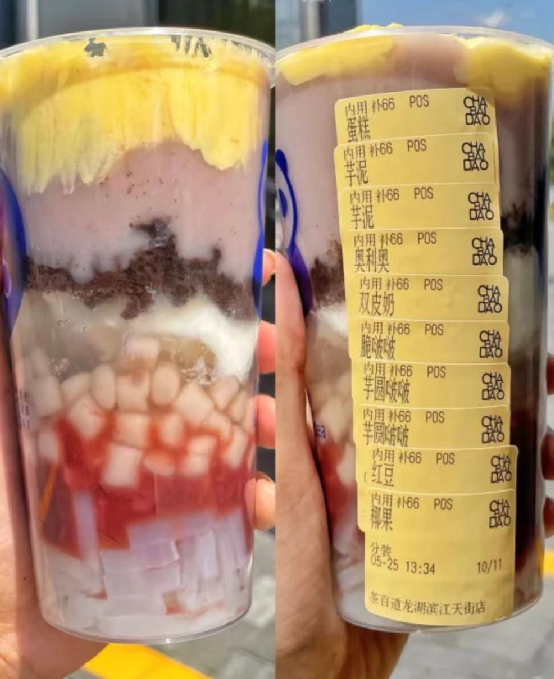
Walk into a milk tea shop and order a pure tea, then add the milk cap, cheese, tapioca pearls, and grass jelly from the menu, and what you end up with is basically a hearty bowl of eight-treasure congee. Meanwhile, cafes are no longer content with classics like Americano, latte, and cappuccino—they're adding oats, fermented rice, thick milk, osmanthus, and all manner of ingredients. Flavors blend together, the original bitterness is greatly diluted, and the overall style increasingly leans toward milk tea. This cross-industry involution in the beverage sector has long been an open secret. Open any delivery app and browse a shop's menu, and you can't help but sigh: "Why is everything getting more and more fancy?"
To find out whether people can still tell coffee and milk tea apart, a science blogger on Weibo conducted a dedicated experiment. The experiment selected three pairs of coffee and milk tea with similar flavors—coconut milk tea vs. coconut coffee, cherry blossom milk tea vs. cherry blossom coffee, and osmanthus milk tea vs. osmanthus coffee—and had tasters do a blind test, scoring them on three dimensions: taste, mouthfeel, and ingredients.
Some might think that distinguishing coffee from milk tea is no big deal—you can tell the moment coffee hits your tongue. But interestingly, the experimental results were the exact opposite of this intuition: of the collected results, nearly half of the participants failed to successfully distinguish coffee from milk tea. Some netizens also commented that they could no longer tell the difference.
Reading this, do you find it a bit surprising?
Compared with coffee, tea has a history of thousands of years of consumption in China. After coffee entered the Chinese market as a foreign beverage, it has also been undergoing localization. Compared with tea, coffee's bitterness and astringency stand out sharply, making it necessary to change this characteristic.
On the other hand, coffee brands are also constantly reaching out to younger groups. Luckin Coffee is a typical example, signing Eileen Gu, League of Legends EDG team, and others, closing the distance with young people through marketing. Novel flavors, limited editions, and cross-brand collaborations have also attracted more young consumers to a certain extent.
For many consumers, their happiest and most primal childhood impression of milk tea is a cup for one or two yuan, sitting in the shop chatting and playing games. After growing up and entering the workforce, coffee replaced that childhood cup of milk tea—chatting with colleagues over coffee evokes memories similar to those from childhood.
Some netizens put it bluntly: coffee or milk tea, who cares—tasting good is what really matters.

To get more consumers to accept coffee, the milk-tea-fication of coffee has come up with even more new tricks. Turtle jelly and goji berry latte, tofu pudding latte, put chai ko latte, fermented rice ball latte—just like congee-fied milk tea, the only worry is that you won't get full. Coffee is clearly the most important ingredient, yet in the final product's flavor, coffee ends up playing the pitiful role of an extra.
Image source: Xinzhii Lab lab Weibo, internet
For more coffee bean news, please follow Coffee Studio (WeChat public account: cafe_style)
For professional coffee knowledge exchange, please add WeChat: kaixinguoguo0925
The above content is compiled by CoffeeHunters, a coffee news website.


