








Is specialty coffee the same as pour-over or single-origin?
Loving to taste coffee and running a coffee shop are two different things. Specialty coffee is not the same as pour-over coffee, and it is not the same as single-origin coffee, even though many people in China use the terms interchangeably. A shop also needs stable brewing, roasting knowledge, quality control and operations.
Specialty Coffee means beans grown in specific climates and geographical environments that carry distinct regional flavors, and it is graded by score rather than by brewing method. Costs such as hiring staff, franchising and online sales also matter. The advice is to study coffee thoroughly first, then judge whether your own situation suits the business.
Many people, because they enjoy drinking coffee, develop the idea of opening a coffee shop. However, loving to taste coffee and running a coffee shop are completely different matters. Starting from a question raised by a netizen, this article sorts out common misconceptions: specialty coffee is not equivalent to pour-over or single-origin coffee, and opening a shop requires not only stable brewing skills but also a systematic understanding of roasting, quality control, and operations. The article also discusses cost issues such as hiring staff, franchising, and online sales, and offers practical advice—first study coffee thoroughly, then assess whether your own conditions are suitable for entering the business.
Recently I saw a question that said, "I have the idea of opening a coffee shop, I just don't know if it's feasible." Before expanding on the discussion, let me first summarize the author's core viewpoint:
Don't start thinking about opening a coffee shop just because you temporarily can't find a satisfactory job and happen to have saved a little money. The reason is simple—"liking to drink coffee" and "running a coffee shop" are two completely different things!!
Of course, this article wants to discuss more than just this point. The reason for bringing up this topic is that the questioner's thinking actually represents many people's ideas, so I want to take this opportunity to talk about the problems hidden in this kind of thinking. The original post is quite long, so here it is presented in a four-panel format.
First, a key misconception of the questioner needs to be corrected: he directly equates specialty coffee with pour-over coffee, specialty coffee with single-origin coffee, and single-origin coffee with pour-over coffee. ...This is also the problem the author found that netizens failed to point out after scrolling through the comment section. Although the questioner claims he does not look down on latte, between the lines he has already ranked coffee by brewing method into "higher and lower grades."
In fact, the two terms "specialty coffee" and "single-origin coffee," due to Chinese expression habits, have caused many friends in China to develop a deep misunderstanding.
"Specialty Coffee" originally refers to coffee beans cultivated in specific climates and geographical environments that possess unique regional flavors. It is not only high-scoring, expensive single-origin beans that deserve the name specialty coffee. If the raw materials selected for a blend meet the above conditions, they can also be classified as specialty coffee.
The English for single-origin coffee is "Single Origin Coffee," which refers to coffee beans from a single producing country, region, estate, or plot—not a single variety. Single-origin beans and blended beans are opposing concepts: a blend can mix beans from origin A with beans from origin B, but single-origin beans can only come from within the range of origin A.
For example, Ethiopia's native varieties are not actually a specific single variety, but the result of a large number of coffee varieties mixed together. But because they are planted in the same place, they still count as single-origin coffee beans~
In other words, single-origin coffee can equal specialty coffee, but specialty coffee does not equal single-origin coffee. Single-origin coffee can showcase unique regional flavors through various brewing methods, and specialty coffee is the same.
The president of the Specialty Coffee Association of America (SCAA) once said that specialty coffee cannot be defined merely by the quality and score of the coffee beans; it depends more on the production process. From selecting green beans to delivering them into the consumer's hands, every step must maintain the highest quality for it to qualify as specialty coffee.
That is to say, in addition to the green beans themselves passing the quality standard, roasters and brewers must have a sufficiently deep understanding of the coffee beans in order to extract a reasonable taste in an appropriate way and present the distinctive flavors of the region. And the methods mentioned here are not limited to drip extraction.
The questioner mentioned in the post, "I think good coffee beans can only be enjoyed in a specialty way, and cannot have their flavor profile changed by adding other things." This only shows that the questioner prefers pour-over coffee and enjoys the purity it brings, but this cannot represent all of specialty coffee. If you want to open a specialty coffee shop but do not have a correct understanding of specialty coffee, that in itself is already a major hidden risk.
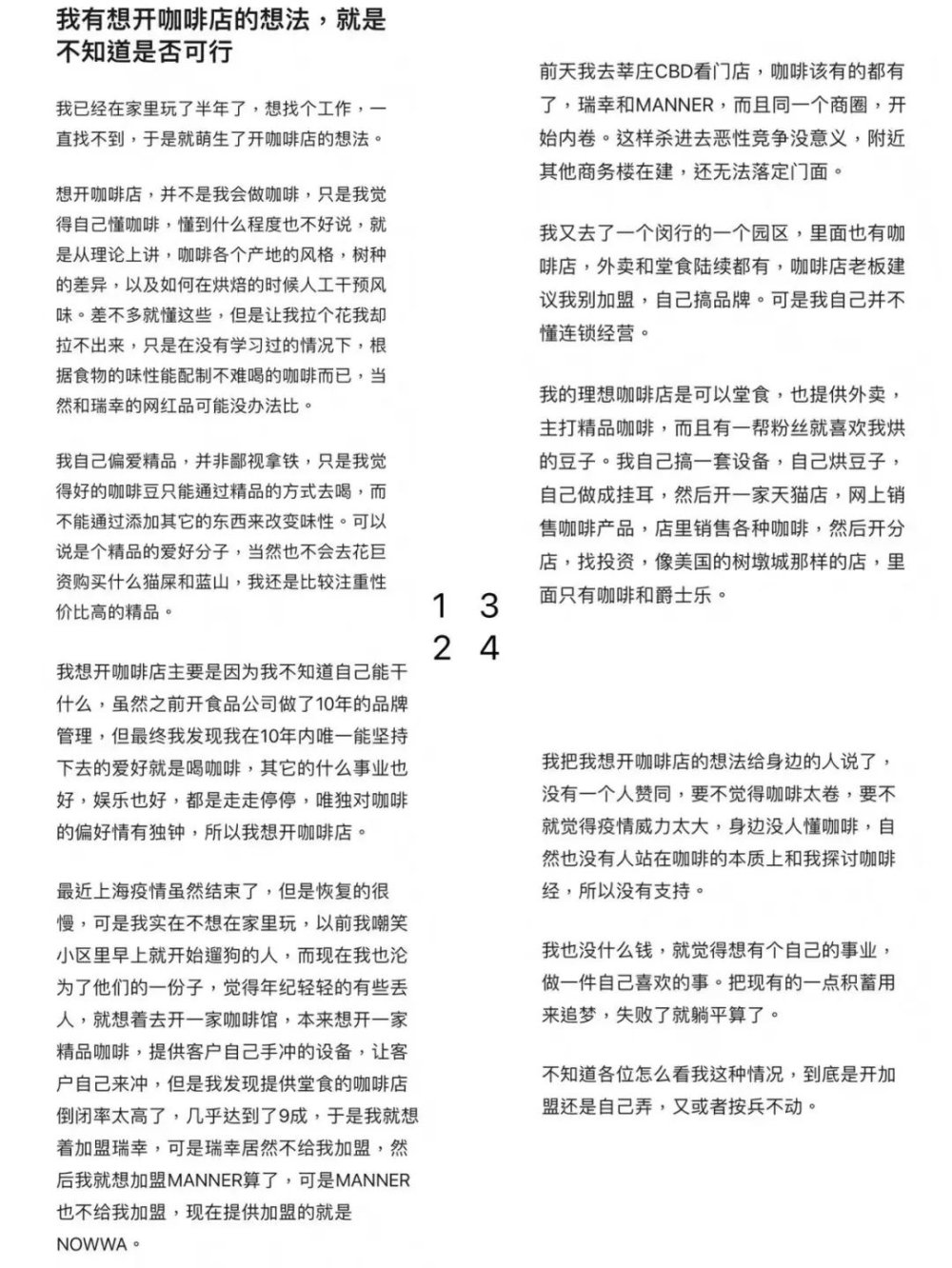
A coffee shop featuring pour-over coffee as its main offering while also selling its own roasted coffee beans is, of course, no problem. But the questioner also said that he merely likes drinking coffee, can judge the region by drinking coffee, and knows that variety and roasting differences bring different flavor expressions, yet he completely fails to mention any study he has done in brewing.
So then comes the idea of providing equipment and letting customers brew their own coffee... But as stated above, the most critical point of specialty coffee lies in the person who can bring out the characteristics of the coffee beans. As the owner of a shop, if you yourself do not have stable brewing skills and have not studied other brewing methods, then in this situation, on what basis can you get consumers to build trust in the owner and the brand~
For a dish to be delicious, it is inseparable from the chef's understanding of the ingredients and finding the right cooking method. Roasting coffee beans follows the same principle. Understanding the variety characteristics of coffee beans and knowing how roast levels affect flavor is not enough; you must also understand why the same variety can differ enormously across different regions, why the same variety grown at different altitudes in the same region can also taste different, how to formulate a suitable roasting plan based on the condition of the green beans, and how every minute and second during roasting, along with variables such as temperature and drum speed, will change the coffee beans... These are often the most important pieces of knowledge.
Roasting coffee beans looks not difficult—just roast them until cooked through; brewing coffee also looks very simple—just let water pass through the coffee grounds. But to make coffee beans show their best state through roasting, and to extract the right flavor substances when water passes through the coffee grounds, requires a great deal of knowledge, research, and practice. This process takes a long time and is by no means easy.
Therefore, if the questioner truly wants to open a specialty coffee shop, it is advisable to first take relevant courses, then continuously consult materials, expand knowledge points, and apply them in practice. A shop's greatest signature will always lie in the owner or the barista themselves.
Then what about hiring a barista? That would make costs very high! The questioner is located in Shanghai, where both rent and labor are extremely expensive. From the moment the shop opens, if income cannot balance things out, you can only keep losing money. And a coffee shop does not have customers coming to the door immediately upon opening; a new coffee brand needs time to settle. Many coffee shops we see today with booming business and famous names have either been built by throwing money at them or endured over time.
But based on the financial situation described by the questioner, it is still not advisable, due to a momentary impulse and without understanding reality, to go all in with all the hard-earned savings.
Liking to drink specialty pour-over coffee and running a coffee shop are originally two different things. Specialty coffee pursues the quality of the coffee beans, the quality of the final product, and the value of the barista themselves, but few people know how to appreciate it. Aside from enthusiasts who have some knowledge of coffee, ordinary consumers actually do not have many demands or pursuits regarding coffee flavor—a cup that is neither sour nor bitter and offers good value for money is good coffee.
If a coffee shop does not offer coffee with other ingredients added and does not make the taste broadly acceptable, then very few people will discover the shop and come to spend money, and such spending simply cannot support the operation of a coffee shop.
To join Tmall, you must first register a brand trademark, and to sell prepackaged food you also need a food business license. In addition, joining Tmall also requires paying a deposit; depending on the store type, the deposit generally needs 100,000 to 150,000. At the same time, for each completed order, Tmall deducts a commission in real time, generally ranging from 3% to 5%. So even if you do not open a physical store and only sell your own roasted coffee beans online, joining Tmall is still a considerable expense.
Finally, there is the issue of franchising. As the questioner said, competition among coffee chain brands is fierce, and the coffee brands that can be franchised are often not the mainstream chain brands that consumers mostly buy. In Shanghai, a place where coffee shops are already saturated, if it is not a mainstream chain brand, operating costs and expenses are also very high. The franchise fee alone can be several hundred thousand, and adding monthly rent, labor, and raw material costs, it is no easier than opening an independent coffee shop.
Of course, if you really want to open a coffee shop, you can consider opening in areas outside first- and second-tier cities. But no matter what model of coffee shop you open, the most important thing is still that the owner themselves has a deep understanding of coffee and a clear understanding of running a shop, because operating a coffee shop is itself a business.
Rather than "staying put" as netizens answered, it is better to first truly start studying coffee, understand what preparations are needed to open a coffee shop, and then, based on subsequent circumstances, open a coffee shop that you can support and operate.
There is no need to think about lying flat from the very beginning! This money can be used for more meaningful things~ Just because it is not recommended now does not mean it will never be suitable; nothing is absolute, and only when a dream is realized will you not regret it.
Image source: Internet (image unrelated to text)
Question source: Douban
Professional coffee knowledge exchange. For more coffee bean information, please follow Coffee Workshop (WeChat public account: cafe_style)
For more specialty coffee beans, please add the private WeChat of Front Street Coffee, WeChat ID: qjcoffeex
The above content is compiled by CoffeeHunters, a coffee news website.


