








What Does Coffee Contain That Alters Animal Behavior?
Caffeine affects animals very differently from humans. Spiders given 10 micrograms wove smaller, uneven webs; at 100 micrograms the webs became irregular. Hawkmoth larvae fed concentrated coffee or tea died within 24 hours, and purified caffeine produced the same result, pointing to nervous system damage.
Vertebrates show other reactions: heart rate and respiration can change, and horses are barred from competition when caffeine is present because it enhances endurance. Bees, by contrast, may gain pollination efficiency. The variation traces to body structure differences and how each species processes what coffee contains.
Coffee is an important beverage in human society, but caffeine's effects on other animals vary widely. This article reviews the reactions of species ranging from spiders, mosquitoes, and hawkmoth larvae to cats, dogs, horses, and bees after ingesting caffeine: invertebrates may face nervous system damage or even death, vertebrates may also experience changes in heart rate and respiration, horses are listed as prohibited substances because caffeine enhances endurance, and bees can improve pollination efficiency. Understanding these cross-species effects can help us more comprehensively understand caffeine's complex actions.
Coffee plays the role of an important productivity tool in human society, with many varieties and diverse flavors. Some people are obsessed with its unique aroma, while others simply treat it as a powerful pick-me-up.
In most people's view, after drinking coffee the central nervous system becomes more active, alertness increases, thinking becomes clearer, and attention becomes more focused. But it should be pointed out that these conclusions are based only on coffee's effects on humans. Due to differences in body structure, caffeine may have wondrous or even dangerous effects on different organisms.
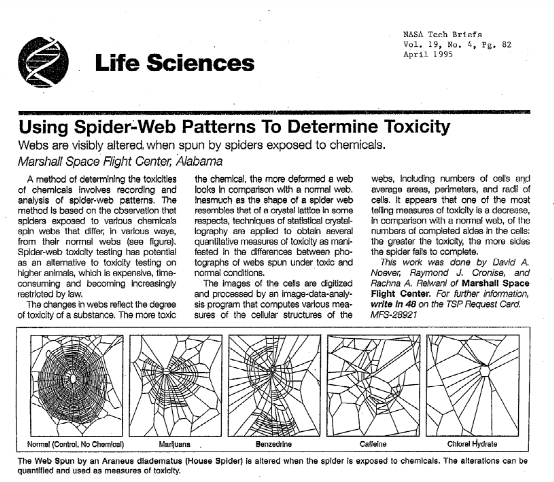
In the late 1940s, Swiss pharmacologist Peter N. Witt studied the effects of drugs on spiders, administering a variety of psychoactive drugs to spiders and observing the web patterns they wove after use.
When spiders ingested 10 micrograms of caffeine, the webs they built became smaller in size and uneven in radius, but the regularity of the circular shape was unaffected. After ingesting 100 micrograms of caffeine, the web shape changed dramatically and became extremely irregular. In 1995, a research team from NASA in the United States repeated Witt's experiment and obtained similar results.
Spiders are invertebrates, and their nervous systems are not as complex and diverse as those of vertebrates. From this it can be inferred that caffeine's effects on the nervous systems of invertebrates may be fatal, and caffeine can disrupt the activity of certain enzymes in their nervous systems. Some scientists fed concentrated tea and concentrated coffee to the larvae of a common hawkmoth, and the larvae died within 24 hours.
Researchers repeated the experiment with purified caffeine and confirmed that caffeine was indeed the cause of death. Mosquitoes, which humans detest, are also invertebrates, and caffeine's lethality to them cannot be underestimated either. After mosquito larvae ingest high doses of caffeine, they lose coordination and cannot swim to the water's surface, eventually drowning.

For vertebrates, coffee is not entirely friendly either. Many people who keep cats and dogs have their own coffee-drinking habits, but they try to keep pets away from this stimulating beverage to avoid significant changes in heart rate and respiratory rate, or even death, in cats and dogs from caffeine intake. For many animals, caffeine is difficult to metabolize and can easily endanger life.
Of course, not all animals face life-threatening danger after ingesting caffeine. Some animals, like humans, can enjoy the positive effects caffeine brings. In horse racing, caffeine once played the role of a "doping agent": after horses ingested caffeine, their heart rates increased significantly, they displayed extraordinary endurance, jumping ability, and speed, and fatigue was reduced. Therefore, caffeine is listed as a prohibited drug in horse racing.
Bees are also invertebrates, but like humans they enjoy coffee. In 2021, The Guardian reported on a study by the Natural Resources Institute at the University of Greenwich in London, finding that after bees ingested caffeine, pollination efficiency improved significantly.
Coffee is one of the world's most popular beverages, and humans have a very long history of drinking coffee. Each species' body structure is different, coffee contains thousands of chemical components, and the chemical reactions triggered after entering the body are extremely complex. At present, scientists are still continuously exploring coffee's effects on various organisms.
Even so, humans still cannot resist coffee's charm. So, have you had coffee today?
Image source: Internet
For more coffee bean information, please follow Coffee Workshop (WeChat public account cafe_style) For professional coffee knowledge exchange, please add WeChat ID kaixinguoguo0925
The above content is compiled by CoffeeHunters, a coffee news website.


