







Is coffee arabica coffee safe during pregnancy?
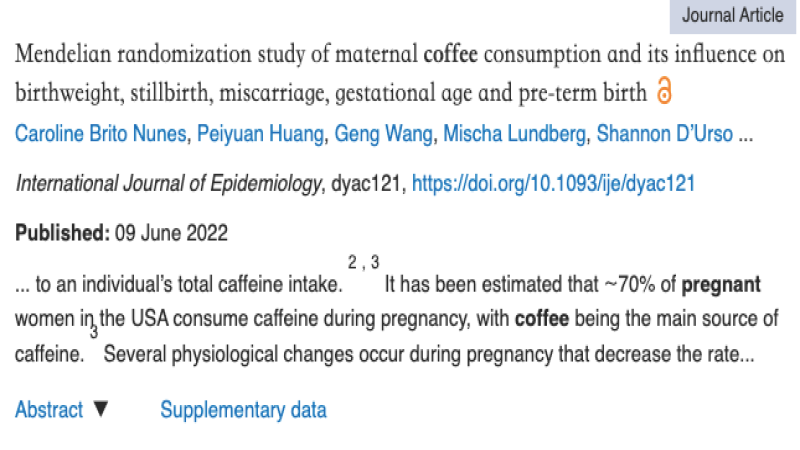
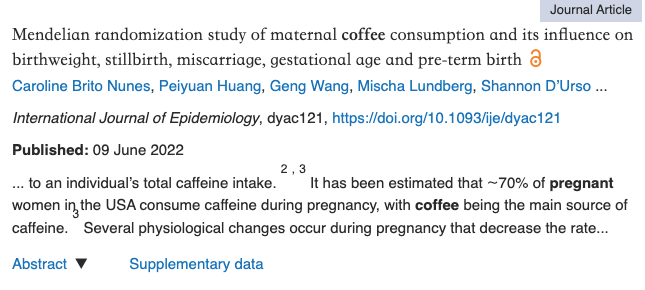
A team at the University of Queensland's Institute for Molecular Bioscience published a Mendelian randomization study in the International Journal of Epidemiology examining coffee intake during pregnancy and outcomes such as miscarriage, stillbirth, preterm birth, and low birth weight. The findings suggest that, when the body's condition allows, moderate coffee consumption may not necessarily cause these adverse outcomes, though caffeine can still affect fetal development.
Intake guidance already exists. The World Health Organization recommends keeping daily caffeine under 300 milligrams during pregnancy, while the American College of Obstetricians and Gynecologists sets a 200 milligram daily limit. Because caffeine content varies with coffee variety, roast level, and extraction method, cup counts are an unreliable measure. Caffeine also appears in tea, milk tea, and carbonated drinks.
Whether coffee can be consumed during pregnancy has long been a matter of debate. A team from the Institute for Molecular Bioscience at the University of Queensland published a Mendelian randomization study in the International Journal of Epidemiology, using genetic data to explore the causal relationship between coffee consumption during pregnancy and adverse pregnancy outcomes such as miscarriage, stillbirth, preterm birth, and low infant birth weight. The results suggest that, provided the body's condition allows it, moderate coffee consumption during pregnancy may not necessarily lead to adverse outcomes, but caffeine may still affect fetal development. This article will summarize the key findings of the study and provide practical advice on coffee consumption and caffeine intake during pregnancy, helping coffee lovers make more prudent choices.
Every person's constitution varies greatly. Even if research suggests that pregnant women can drink coffee, it does not mean every expectant mother is suited to it, nor does it mean it can be consumed without restraint. Any food should be controlled within a reasonable intake range based on one's own circumstances.
Recently, a research team from the Institute for Molecular Bioscience at the University of Queensland published a Mendelian randomization study in the International Journal of Epidemiology, focusing on coffee intake during pregnancy and whether drinking coffee affects the fetus.
The team conducted a genetic analysis of pregnant women's coffee-drinking behavior. The results showed that if the body's condition allows it during pregnancy, drinking coffee does not necessarily cause adverse outcomes such as miscarriage, stillbirth, preterm birth, or low infant birth weight.
Over the past few decades, the medical community has continuously conducted research on whether coffee can be consumed during pregnancy. Current World Health Organization guidelines recommend that daily caffeine intake during pregnancy should be less than 300 milligrams; the American College of Obstetricians and Gynecologists proposes a daily caffeine limit of 200 milligrams. However, caffeine content varies depending on coffee variety, roast level, and extraction method, so intake cannot simply be estimated by the number of cups.
At the same time, caffeine is not only found in coffee—milk tea, carbonated drinks, tea, and cigarettes also contain caffeine. The research team from the Institute for Molecular Bioscience at the University of Queensland pointed out that previous observational studies found it difficult to clearly distinguish coffee drinking from other risk factors such as milk tea, cola, and smoking, so the potential impact of these confounding factors on the fetus could not be ruled out.
-The cup in the picture clearly doesn't allow for "I'll just have one cup"-
This time, the team wanted to clarify: does coffee alone actually increase the risk of adverse pregnancy outcomes?
The researchers stated that having pregnant women drink different doses of coffee during pregnancy for research would clearly be a dangerous undertaking. Therefore, the team adopted the Mendelian randomization method, which uses genetic variants to infer causal relationships between exposures and disease outcomes.
From the coffee consumption summary data published by the Coffee and Caffeine Genetics Consortium, the researchers identified 8 subjects who drank coffee during pregnancy. Through two-sample MR and one-sample GRS analysis, they examined the genetic variants associated with pregnant women's coffee-drinking behavior and investigated whether these variants were also associated with birth outcomes.
The study integrated and compared genetic data from the Coffee and Caffeine Genetics Consortium, the UK Biobank, the Avon Longitudinal Study of Parents and Children, and 23andMe. The final results indicated that pregnant women who drank coffee did not face a higher risk of miscarriage, stillbirth, or preterm birth. However, the research team also emphasized that although drinking coffee itself does not cause adverse pregnancy outcomes, caffeine may still affect fetal development.
For this reason, the research team recommends: coffee can be consumed moderately and in small amounts during pregnancy. At the same time, besides coffee, other caffeine-containing foods should also have their intake strictly controlled, especially chocolate, cola, and tea beverages—these are precisely the foods many pregnant women favor. The team's research only addressed whether coffee drinking is safe for pregnant women; it does not mean that the intake of other caffeine-containing foods is equally safe.
-Not even one cup-
Although the research team stated that pregnant women can drink coffee in moderation, they still recommend avoiding cold brew coffee or coffee containing Robusta beans as much as possible.
Compared with Arabica coffee beans, the Robusta variety has more than twice the caffeine content. Which coffees contain Robusta beans? The common instant coffee on the market is a typical example. Besides the coffee itself, sugar and non-dairy creamer also place an extra burden on the body. In addition, the blend beans used in espresso-style coffee at some coffee shops also include a small amount of Robusta to enhance the coffee's body.
As for cold brew coffee, because of the longer extraction time, caffeine is more fully released and incorporated during the process. Therefore, when made from the same Arabica coffee beans in equal gram amounts, the caffeine content ranking is: cold brew coffee > French press > pour-over coffee > espresso.
What about decaf coffee? Although it is called decaf, it does not mean zero caffeine, so you cannot feel free to drink several more cups just because it is labeled decaf.
Image source: Internet
For more coffee bean information, please follow Coffee Workshop (WeChat public account: cafe_style) For professional coffee knowledge exchange, please add WeChat ID: kaixinguoguo0925
The above content is compiled by CoffeeHunters, a coffee news website.


