







Can the coffee cookie cup really replace disposable cups?
Edible coffee cups have gone through three generations since 2014, when a US cafe owner coated the inside of a cone with chocolate sauce. KFC's limited-edition cookie cup followed in 2015 with sturdier walls and a thinner, more heat-resistant chocolate lining, and oat cups saw an unexpected revival during the pandemic.
The problem they address is real: paper cups consume large amounts of wood, and their polyethylene inner coating makes recycling difficult, leaving at least 1 billion disposable cups as potential waste each year. Most cafe customers still buy drinks to take away, so edible formats are being tested as an alternative that asks nothing extra of the drinker.
The environmental problems of disposable paper cups are becoming increasingly severe, and the coffee industry has been searching for alternatives. From the failed attempt with cone cups in 2014, to the brief popularity of KFC's cookie cups, and then to the unexpected revival of oat cups during the pandemic, edible coffee cups have gone through three generations of technological iteration. This article will review the development history, technological breakthroughs, and market dilemmas of edible cups, and explore whether they can truly replace disposable cups and become a new environmentally friendly choice for coffee shops.
Disposable tableware—cups, plates, knives, forks, chopsticks, and so on—places a heavy burden on the environment. Take paper cups as an example: making them consumes a large amount of wood, yet their service life is often only as long as it takes to drink one beverage, after which they are thrown away. What is more troublesome is that the inner wall of paper cups is usually coated with polyethylene, making recycling extremely difficult.
Statistics show that at least 1 billion disposable cups worldwide become potential waste every year because they cannot be properly recycled, and coffee shops contribute a considerable share of that.
However, it is unrealistic to expect cafes to use fewer disposable cups. Most customers buy their drinks to take away, so requiring everyone to bring their own reusable cup is clearly not very feasible. So is there a way to reduce the consumption of disposable cups without requiring consumers to carry cups with them?
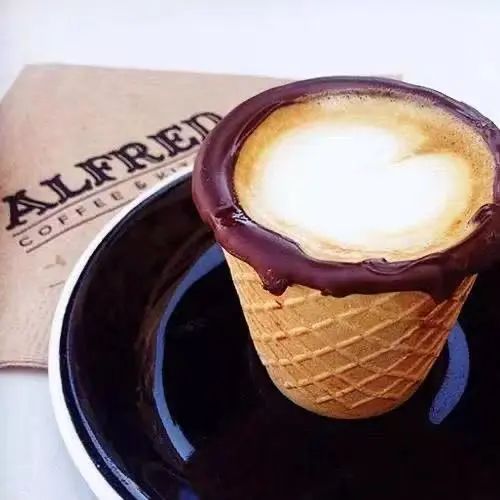
In 2014, a cafe owner in the United States came up with the idea of coating the inside of a cone with chocolate sauce, creating an edible coffee cup. But this solution had obvious flaws: once the chocolate melted, the coffee would leak, the drinking time was only a short 10 minutes, and every customer using this kind of cup had to eat the chocolate. So after the cone cup came out, it did not gain widespread acceptance.
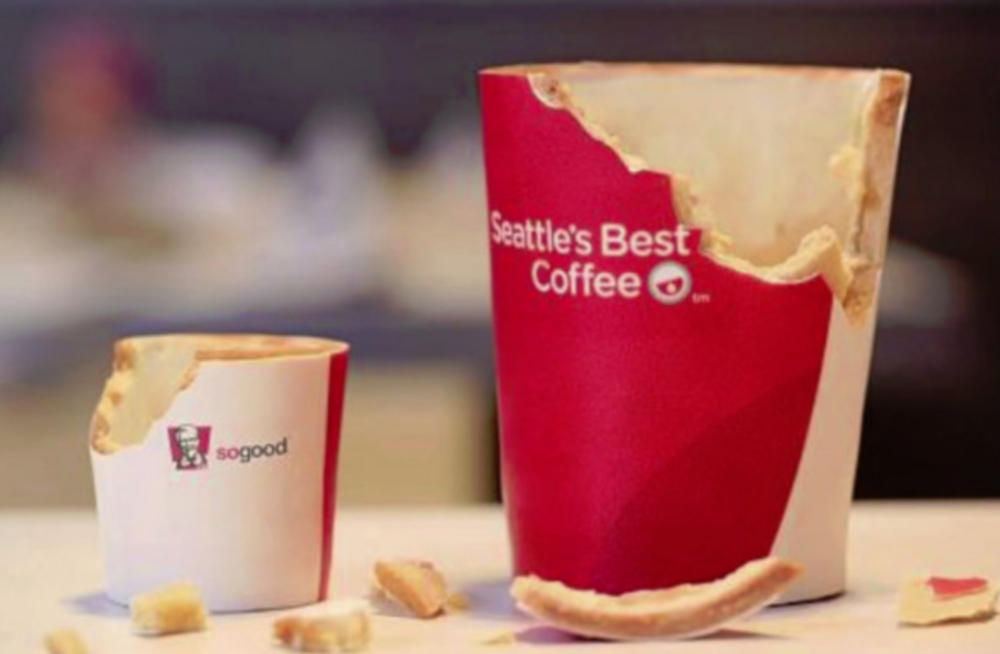
By 2015, KFC launched a limited-edition edible cookie cup. Compared with the first-generation cone cup, the cookie cup's walls were much sturdier, and the chocolate sauce spread inside was less and more heat-resistant, making it more suitable for holding coffee drinks.
At the time, KFC was still in the research and development stage and did not promote the cookie cup on a large scale, but it inspired food companies in many countries. Since 2016, cafes in many places began offering edible cookie cups.
Although some coffee shops were willing to use cookie cups for drinks, limited demand meant food companies did not mass-produce them, causing the cost of a single cookie cup to be more than a hundred times that of a disposable cup, and drink prices rose accordingly. Moreover, a cookie cup could only hold a drink for about 30 minutes. Therefore, although cookie cups were popular for a while, they ultimately did not become widespread.
Just when everyone was about to forget about cookie cups, the pandemic brought them back into view and completed an upgrade. Compared with second-generation cookie cups, third-generation oat cups are made from oat bran and eggs, pressed through a special process and then baked, and can achieve a leak-proof effect without coating with chocolate sauce.
The upgraded oat cup can hold drinks at 85 degrees Celsius and remain leak-free for 12 hours. The oat cup itself is very low in sweetness, with a texture similar to a muffin, and its ingredients are only oat bran and eggs, so the cost per cup is only one quarter that of a cookie cup.
Some things really are better to be lucky than early. In addition to rising environmental awareness, the pandemic also made it impossible for coffee shops to provide reusable glass cups, which unexpectedly boosted demand for edible cups.
Coffee shops in many regions reintroduced edible cups, and they were warmly welcomed by consumers. Some shop owners reported: although the product price is slightly higher, customers are increasingly concerned about the environmental impact of their consumption behavior, so the response has been huge and very positive. It is believed that edible cups will be widely used.
Although many countries have implemented "reusable cup rental" services, consumers often forget to bring their own cups and still rely on disposable cups when they go to coffee shops. Coffee Workshop previously reported that Starbucks in many places launched a "borrow a cup" service, where customers could borrow a cup with a 1-dollar deposit and get the deposit back plus reward points when they returned it after use.
After the cups are collected, they are uniformly sterilized, but consumers do not think this is very environmentally friendly—it wastes water, and there is no way to ensure the cups' cleanliness. It would be better to offer dine-in mugs again or restore the bring-your-own-cup service. Therefore, more than a year after the cup-borrowing service was launched, the response has been far less enthusiastic than the return of oat cups within a few months.
However, oat cups still have shortcomings: they have no lids, and many consumers are allergic to wheat bran and eggs. Therefore, food companies in many regions are stepping up research and development of gluten-free, egg-free versions of edible cups and matching lids, hoping to promote the widespread use of edible cups.
The head of an Australian food company said that the current cost of edible cups still needs to be 1.5 dollars each, but as long as major coffee shops widely adopt them, the unit price is expected to drop below 1 dollar.
The author remembers that using cookie cups to hold coffee was once popular in China as well, but in the end it failed to become widespread because of chocolate and cost issues. Now that there are new production technologies, food factories in China should hurry up and get on board!
If edible cups can really become widespread, that would actually be quite good—at least there would be no need to worry about going hungry while drinking coffee😂
Image source: Internet
For professional coffee knowledge exchange and more coffee bean information, please follow Coffee Workshop (WeChat public account: cafe_style)
For more specialty coffee beans, please add the private WeChat of Front Street Coffee (FrontStreet Coffee), WeChat ID: qjcoffeex
The above content is compiled by CoffeeHunters, a coffee news website.


