







How did geisha coffee fit into a championship routine?
Morgan Eckroth of Portland, Oregon, won the United States Barista Championship while already known as a coffee influencer with more than 7 million followers. She published her preparation through vlogs and livestreamed competition day, building her routine around the post-pandemic rise of home coffee makers rather than stage-only presentation.
Her stated philosophy is that coffee should taste good, be replicable, be transformable, and be convenient to make at home, so she shared recipes on social media before competing. That approach differs from routines that lean on unusual drink concepts, and it raises questions about how the Barista Championship connects with how people actually drink coffee now.
At the recently concluded United States Barista Championship, Morgan Eckroth from Portland, Oregon, took home the crown. Unlike most competitors, she was already a coffee influencer with over 7 million followers before the competition, and she made her entire preparation and competition process public through vlogs and livestreams. With the post-pandemic rise of the home coffee community as her theme, she shared her recipes and approach in advance, advocating that coffee should be delicious, replicable, transformative, and easy to make at home. This article will walk you through her competition journey, bean selection strategy, and creative recipes, and explore the bottlenecks facing the Barista Championship and the shift in coffee consumption patterns in the post-pandemic era.
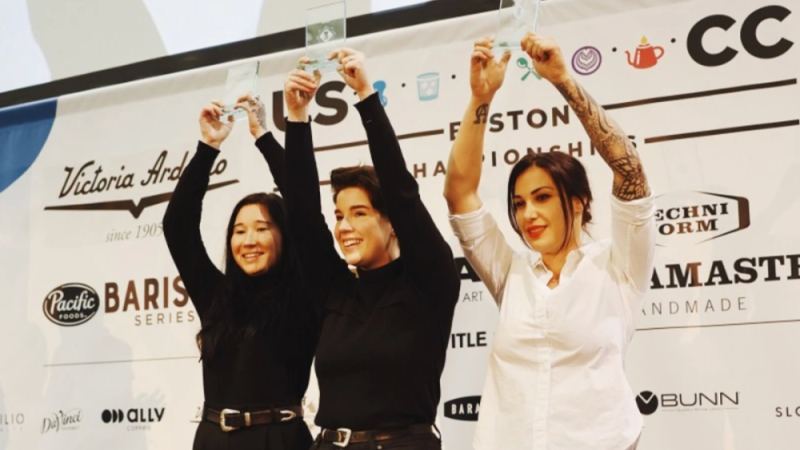
Recently, the United States Barista Championship came to a successful close, with the championship going to Morgan Eckroth from Portland, Oregon.
Unlike competitors in some past major coffee competitions, Morgan was already a coffee influencer with over 7 million followers before entering the competition.
- From left to right in the photo: Brooke Wolfe, Morgan Eckroth, Elisabeth Johnson
Because of this, from the moment she announced her participation in the United States Barista Championship, she recorded the entire preparation process in vlogs, and on competition day she even livestreamed the whole thing to all her followers online! With millions of fans watching simultaneously online, she herself wasn't nervous—one imagines the judges might have felt some pressure instead...
This time, Morgan's competition theme focused on the post-pandemic rise of home coffee makers, hoping that the coffee she created could also be easily made by everyone at home.
Unlike the approach of past competitors, Morgan shared her drink-making ideas and recipes on social media during the preparation stage.
She did this hoping that her fans could make and taste them alongside her. She said:
Coffee should be a creative coffee philosophy of good taste, replicability, transformability, and being convenient to make and enjoyable to drink at home.
In many barista competitions we've seen in the past, everyone feels the competitors are very impressive. But often quite a few competitors focus too much on the uniqueness of the drink and the performative nature of the making process, and in their choice of coffee beans, brewing or preparation methods, and other ingredients, these are hard for everyone to replicate.
At the same time, because of the exquisite flavors of the Geisha coffee variety, competitors over the years have spared no expense in selecting coffee beans, investing heavily in unbatch or custom-batch Geisha, to the point that after the competition ends, no one can find these once-outstanding coffee beans, and no other coffee varieties can offer similar coffee flavors.
The generous competition prizes, yet the competition level has not substantially improved; a competition dominated by the Geisha coffee variety; a lack of relevant competition experience, too much emphasis on origin, variety, and cultivation techniques, and a complex scoring system that causes many judges to "miss" many more promising coffee competitors (this is not to say the judges are unprofessional); creative coffee no longer creative; basic work skills being overlooked—these have all become problems in barista competitions.
Of course, with the continuous improvement in coffee variety quality, starting from 2020, we can gradually notice that many competitors have begun choosing coffee varieties other than Geisha to compete, although these are still relatively rare coffee varieties... For example, 2021 WBC champion Diego Campos and WBrC champion Matt Winton used Coffea Eugenioides, the mother species of the Arabica variety, native to East Africa.
The leaves and coffee cherries of this variety are smaller than Arabica's. Although growing it is not particularly difficult, their yield is indeed lower than Arabica's, and this variety is still considered a rare or experimental coffee cultivation. The variety itself is sweet (perhaps because there is less bitterness from caffeine), and flavor evaluations mention that this coffee has cheerful, unusual tastes such as sesame candy, toasted marshmallow, lemon, and cereal milk flavors.
Back to Morgan's topic~ This time Morgan also used this variety for the milk coffee segment. She used Eugenioides coffee beans from Finca San Jerónimo in Colombia, extracting 35g of coffee liquid from 20g of coffee grounds paired with 50% freeze-distilled milk, maximizing the sweetness of this coffee variety. The milk coffee overall exhibited flavors of cocoa, egg custard, chocolate popsicle, and salted caramel.
But for the espresso and creative coffee segments, Morgan chose the more common Rume Sudan variety, also from Finca San Jerónimo in Colombia, using anaerobic natural processing. 19g of coffee grounds extracted 40g of coffee liquid in 20 seconds. Before tasting, the judges had to stir 10 times with a frozen cup and spoon before drinking. The espresso overall exhibited flavors of rose, red grapefruit, honey syrup, papaya, and white peach.
The creative coffee also used the espresso recipe as its base. Morgan additionally stated that the espresso used this time, with its floral and tropical fruit tonality , could be recreated with other coffee beans using a similar approach, and she hoped every detail would allow fans to make creative coffee with similar effects at home.
4 shots of espresso + 30g mango purée can produce a flavor similar to orange popsicle, then add 25g of lime sugar essential oil made by mixing lime zest and white sugar at a 1:1 ratio, aged for 8 hours and then extracted, then add 30g of orange blossom water, which combines with the espresso to produce a rose water flavor, and finally add one portion of egg white to increase texture and one portion of saline solution to enhance the sweetness of all ingredients and allow the flavors to blend more evenly.
Finally, blend all the ingredients evenly in a blender, then add ice cubes and shake to chill. The creative coffee overall exhibited flavors of orange popsicle, Japanese yuzu, lemon Italian ice cream, and rose water aroma.
Actually, although this creative coffee recipe looks complicated, compared to many creative coffees in competitions, this kind of recipe has high playability—in daily life we can find similar ingredients to adjust the recipe and make coffee with similar flavors. Creative coffee is about using other ingredients to highlight the flavor characteristics of the coffee itself.
In Morgan's competition script, she said: During the pandemic, people couldn't go to stores to consume, which gave rise to a large number of home coffee makers. Everyone began to study coffee and, with their own abilities, expand the boundaries of coffee. At the same time, it also drove the emergence of more coffee influencers, and as one of them, she also takes sharing professional coffee knowledge and promoting specialty coffee as her duty.
After watching Morgan's competition process, the writer very much agrees with Morgan's understanding of the coffee industry. To get more people to fall in love with specialty coffee and learn more coffee knowledge, it is inseparable from baristas correctly spreading coffee culture.
Professional coffee knowledge and an understanding of the principles of coffee extraction are essential qualifications for a barista, and when facing beginners who want to know about/learn about coffee, what baristas need to do is to correctly simplify the complex knowledge through understanding and then express and spread it.
Every trade has its specialists, and different trades are like mountains apart—not everyone who drinks coffee has an in-depth understanding of coffee culture/knowledge. If everything must be explained and conveyed from a very professional angle, the only result will be more people giving up on it.
In the post-pandemic era, more coffee influencers have emerged on various social platforms, which means the coffee market is undergoing change. From in-store consumption to home brewing, coffee consumers' consumption patterns have also undergone great reform. Going to a coffee shop to drink coffee is about experiencing the barista's professionalism; learning to make coffee at home is about being able to easily drink delicious coffee without going out.
So does this consumption pattern have an impact on cafés? Times are changing, and business models are changing too. If you still stay in the pre-pandemic model of waiting for customers to come and experience your professionalism, then perhaps there will be an impact. But if you're willing to step out of your comfort zone and share your professionalism with everyone through other means, then perhaps there can be more business, because it allows netizens not in the same city to see you and remember you—this is a very precious thing.
In a barista competition that blindly pursues uniqueness and things others find hard to replicate, Morgan's performance more perfectly demonstrated the generosity, confidence, and love that a professional barista should have.
Image source: Internet MorganDrinksCoffee
For professional coffee knowledge exchange and more coffee bean information, please follow Coffee Workshop (WeChat public account: cafe_style)
For more specialty coffee beans, please add the private WeChat of Front Street Coffee (FrontStreet Coffee), WeChat ID: qjcoffeex
The above content is compiled by CoffeeHunters, a coffee news website.


