







Iced americano how much water does a coffee-style herbal drink use?
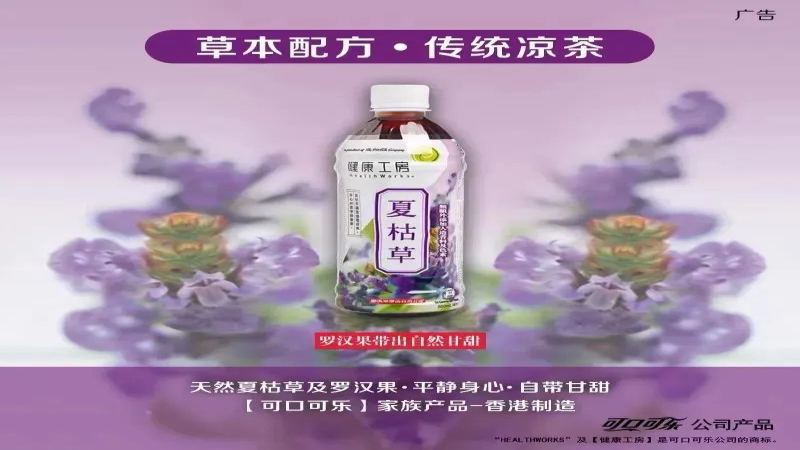
Wong Lo Kat is promoting a "Waterfall Iced Cantonese-style" drink in its stores, mixing concentrated herbal tea with fruit soda and ice to copy the look and ritual of coffee. Coca-Cola separately launched a herbal tea called "Xiaku Cao" (Prunella vulgaris) whose name and purple packaging were widely misread, many netizens first seeing the pesticide "Paraquat." Both moves show traditional herbal tea brands pushing beyond their usual drinking occasions.
The crossover borrows coffee's serving format rather than its ingredients: espresso is diluted with water and poured over ice, a drink with no fixed water ratio, while these herbal versions replace the shot with strong tea and add soda. Whether that counts as innovation or a reaction to slowing sales is the question the debate keeps returning to, since herbal tea brands rarely address it directly.
Coca-Cola recently launched an herbal tea product called "Xiaku Cao" (Prunella vulgaris), but its name and packaging color scheme sparked widespread misreading among netizens, with many associating it at first glance with the pesticide "Paraquat." Meanwhile, Wong Lo Kat is also vigorously promoting "Waterfall Iced Cantonese-style" in its physical stores, combining concentrated herbal tea with fruit soda and ice to mimic the visuals and ritual of coffee. From Coca-Cola's naming blunder to Wong Lo Kat's attempt to coffee-ify herbal tea, traditional herbal tea brands all seem anxious to break through the limitations of their consumption scenarios. Are these crossover moves genuine innovation breakthroughs, or helpless measures taken by brands under performance pressure?
Afraid of internal heat? Drink Wong... Lo Kat? No—afraid of internal heat? Drink Coca-Cola!
That's right, Coca-Cola has recently entered the herbal tea arena too! But its product name and packaging design have drawn fierce ridicule from netizens!
Unless you live in Guangdong or know something about Chinese medicinal herbs, chances are Coca-Cola's herbal tea name this time left quite a few people doing a double take...
"Xiaku Cao"
Xiaku Cao is indeed a Chinese medicinal herb with heat-clearing and detoxifying properties, and it's also one of the common ingredients in Guangdong herbal tea. However, once you leave Guangdong, this herb is quite unfamiliar to the general public.
By contrast, the pesticide name "Paraquat" is far more "deeply ingrained in people's minds"... Since two of the three characters overlap, many netizens' first reaction upon seeing the name was Paraquat... You have to admit, when it comes to Chinese character order not affecting reading comprehension, this is a textbook case.
The reason people associate it with Paraquat isn't just the similar characters—the color scheme on the packaging also easily creates an illusion. The purple on the packaging has a gradually dissolving visual effect, and paired with the three characters "Xiaku Cao," it's not unreasonable to misinterpret it at first glance...
As the saying goes, herbal tea either goes unnoticed or becomes a hot topic everyone discusses for days. Besides Coca-Cola's spectacular misstep this time, Wong Lo Kat has probably also hit a bottleneck, so it made a bold innovative attempt!
Taking a learn-and-apply approach, riding the wave of "Waterfall Iced Americano" before the hype fully dies down, and combining it with the "Iced Cantonese-style" that coffee shops everywhere were eagerly tackling recently, Wong Lo Kat began promoting "Waterfall Iced Cantonese-style" in its physical stores!
As a stubborn Guangdong coffee lover, how could you let a little damp-heat and internal heat suppress your love of coffee!? Even if there's no coffee in it, you still need the ritual of drinking coffee! So "Iced Cantonese-style" started trending online, with everyone using coffee extraction methods to make herbal tea look like coffee, and Iced Cantonese-style is the easiest one to replicate.
Because the color resembles Americano and the taste easily gets you "wired," people started pouring Banxia (a type of herbal tea) over ice, capping it, sticking in a straw, and just like that, cup after cup of Iced Cantonese-style was made... This move drew hordes of netizens to imitate it, and the "Iced Cantonese-style Challenge" stayed active on major trending lists for days.
Regarding this practice, many traditional Chinese medicine experts say that according to traditional methods, herbal tea for treating common ailments is best consumed warm. Adding ice will exacerbate the cold-natured medicinal properties and can easily cause abdominal pain and diarrhea.
Netizens did take that advice to heart! But Wong Lo Kat, as a giant in the herbal tea world, didn't take it seriously—instead, it went ahead and promoted the iced herbal tea method...
You thought it was just pouring herbal tea into a cup of ice and then placing it in water to wait for the waterfall effect? Wrong, wrong, wrong—what's added isn't plain water but fruit-flavored soda, and what's poured into the ice cup isn't herbal tea but herbal tea concentrate... no wait, it's herbal extract.
Netizens were stunned after watching! Both herbal tea drinkers and non-drinkers were left speechless! As a brand that has brought herbal tea to the whole country and even overseas, sometimes you just shouldn't force things that don't fit...
Although it shares the same color as coffee, its function is completely different, and its nature is entirely different too... Innovation must also take into account the properties of the medicinal herbs themselves.
Wong Lo Kat's move actually reflects the brand's anxiety—despite being a giant in the herbal tea sector, it's anxious about failing to capture the attention of more new-generation consumers. According to financial reports, Wong Lo Kat's revenue nearly halved in 2020. Although it grew somewhat in 2021, it's still far from recovering to pre-pandemic levels.
This is mainly because, as a traditional local beverage, herbal tea has inherent limitations in consumption scenarios, and its product characteristics don't leave much room for innovation. Even when milk tea was at its hottest in 2020, it opened physical stores and started selling healthy milk tea, but that still didn't win Wong Lo Kat the attention of the new generation of consumers.
Now it's back to selling herbal tea through a coffee-inspired model... Even Guangdong locals are trembling at the sight.
Image source: Internet
The above content is compiled by CoffeeHunters, a coffee news website.


