








How was coffee made into a Starbucks homophonic pun campaign?
Netizens used homophonic puns in online order name notes, posting names like Ms. Liu of the World on Xiaohongshu, and the jokes spread quickly. The term Starbucks homophonic puns topped Weibo's trending searches, and the brand responded with an interactive campaign that turned an ordinary cup into a talking point. Luckin missed the traffic because recipient name notes were not fully displayed.
Homophonic wordplay has deep roots in China, from upside-down fortune characters at Spring Festival to qipao worn at exams for good luck. To understand how was coffee made at the cup level, the note field simply carries the pun; the coffee bean name printed on the order is what the barista calls out, so any missing character breaks the joke.
Contemporary netizens have become incredibly skilled at using homophonic puns. From personalized name notes on online orders to trending topics on social platforms, Starbucks cleverly rode the wave of netizens' creativity, turning an ordinary cup of coffee into something full of fun and wit, and in doing so, won back some ground in its competition with Luckin. Luckin, however, missed out on this surge of traffic due to incomplete display of recipient name notes. This article will review the viral process of Starbucks' homophonic pun campaign, trace the evolution of homophonic culture from ancient times to the present, analyze the short life cycle of internet buzzwords, and bring coffee lovers relevant news about Front Street Coffee.
When it comes to playing with memes, today's netizens are all experts—"everything can be a homophonic pun" is no empty saying. The emergence of online ordering apps has not only made buying coffee more convenient for consumers, but also opened up space for product personalization. Creative names like "Ms. Liu of the World," "Mr. Liang Who Grabs a Pretty One," and "Ms. He of Stir-Fried Beef" had netizens laughing and imitating in turn, and unexpectedly brought Starbucks a wave of attention.
Surname-based homophonic puns posted by netizens on platforms like Xiaohongshu quickly went viral, sparking a flood of imitations, and the term "Starbucks homophonic puns" once shot to the top of Weibo's trending searches. Starbucks seized the moment to launch a homophonic pun interactive campaign, making an ordinary cup of coffee full of fun thanks to netizens' whimsical ideas, and bringing the brand closer to consumers.
By contrast, Starbucks' old rival in China, Luckin, lost its head start in this wave because recipient name notes were not fully displayed.
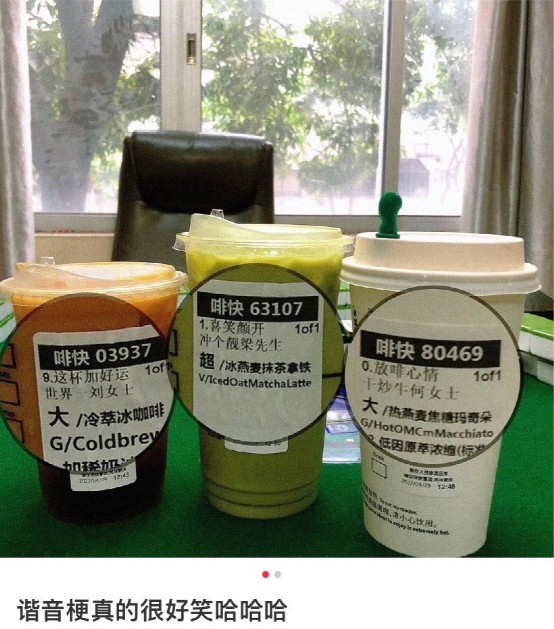
Homophonic wordplay has existed in ancient China since early times. Homophony means using words with the same or similar pronunciation to replace the original character. The ancients used homophony to create many clever couplets and also to avoid naming taboos.
Almost no one can resist the charm of homophonic puns—they are everywhere in daily life. During Spring Festival, when pasting couplets, people deliberately hang the character "福" (fortune) upside down, taking it to mean "fortune has arrived"; during major exams, parents seeing their children off wear qipao to cheer them on, symbolizing "victory at the first stroke"; candidates hang zongzi at their doors, symbolizing "passing with honors."
In modern society, homophonic words emerged to improve communication efficiency—"886" is "bye-bye," representing the end of an online chat.
Today, the popularity of homophonic puns is more about making communication seem "polite." Calling a woman you don't know well "sister" may come across as overly familiar and slightly rude, but a "jimei" is both friendly and keeps an appropriate distance—just the right sense of boundaries.
If you say "好自为之" (take care of yourself) directly, it sounds blunt and unfriendly; switching to the homophonic "耗子尾汁" retains the original meaning while adding a touch of humor—tactful yet still subtle.
Which young netizen today hasn't heard a few homophonic pun buzzwords? "蓝瘦香菇" (feeling awful, want to cry), "栓Q" (thank you)—behind every homophonic hot word lies an interesting and unique memory.
Encouraged by Starbucks' official accounts on various platforms, netizens enthusiastically joined the campaign. On multiple popular social platforms, people posted their own creations: "Ms. Thank You for Your Patronage," "Ms. Human Little Fan," "Ms. Paris Fashion Week," "Mr. I'm With You," "Ms. Grand Exhibition"—and many more.
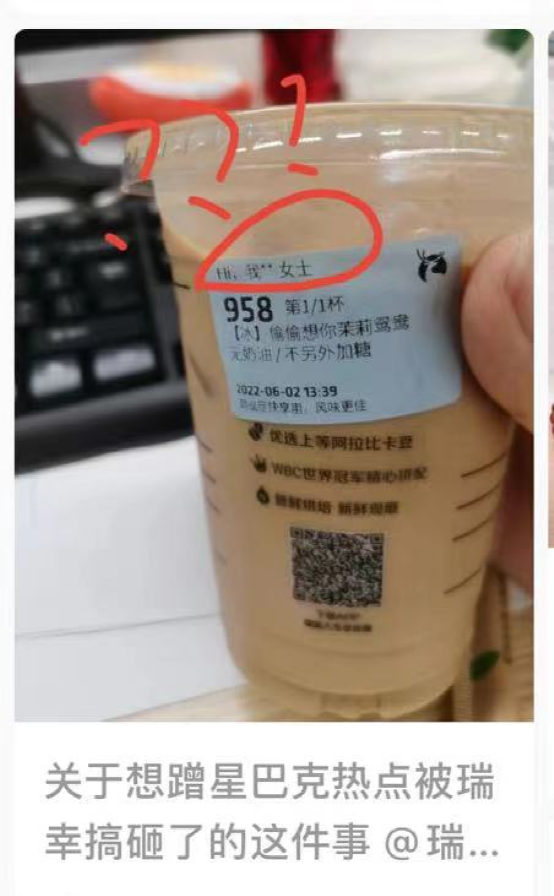
Some netizens admitted that compared with Starbucks, they prefer the taste of Luckin coffee, but because Starbucks' homophonic puns went viral, they couldn't resist going to Starbucks for a cup.
Of course, every internet buzzword has a short lifespan, and homophonic puns are no exception—popularity comes quickly and fades just as fast. When people gradually "cool off" from Starbucks' homophonic puns, the next brand and the next drink will take the baton from Starbucks.
Image sources: Xiaohongshu, Weibo, internet
For more coffee bean news, please follow Coffee Workshop (WeChat public account: cafe_style) For professional coffee knowledge exchange, please add WeChat ID: kaixinguoguo0925
The above content is compiled by CoffeeHunters, a coffee news website.


