







What Do the Tianjin Cat Cafe Rules Change for Operators?
On February 21, the Tianjin Municipal Market Supervision and Administration Commission issued guidelines for indoor pet interactive experience venues. The rules cover cat cafes and pet restaurants, prohibit dogs from being provided for viewing or contact, and bar food business operations from being run as one integrated business with pet interaction. The measure drew wide discussion online.
The guidelines define indoor pet interactive experiences as paid activities where animals such as cats, rabbits, and ducks are kept for viewing, petting, and feeding. Hygiene problems and weak animal welfare at such venues prompted the move. Some commenters support the rules, while others call for broader animal protection laws. Similar animal-themed restaurants in several Asian countries have drawn criticism.
In recent years, animal-themed experience stores such as cat cafes and pet restaurants have rapidly gained popularity in cities, becoming a go-to place for many workers to relieve stress. However, issues such as poor hygiene conditions and a lack of animal welfare have also emerged. On February 21, the Tianjin Municipal Market Supervision and Administration Commission issued the "Tianjin Guidelines for the Operation of Indoor Pet Interactive Experience," setting clear requirements for businesses such as cat cafes and pet restaurants, including prohibiting dogs from being provided for consumers to view and interact with, and prohibiting food business operations and pet interactive experiences from being operated as one integrated business. This measure sparked widespread discussion among netizens, with some expressing support and others calling for the introduction of animal protection laws. Meanwhile, special animal-themed restaurants that have appeared in multiple Asian countries have been widely criticized for being unfriendly to both animals and people. Front Street Coffee believes that standardized operations and the protection of animal welfare should go hand in hand.
In recent years, pets have become an important source of emotional comfort for many office workers. In the past, people could only watch other people's "masters" being pampered through screens, but now pet experience venues such as cat cafes have sprung up everywhere, turning "virtual cat cuddling" into the reality of offline cat petting. However, few people look deeply into the hidden risks behind such venues: poor hygiene conditions and inadequate animal care are commonplace.
Beneath the seemingly cozy scenes, there may be filth you have never noticed. On February 21, the Tianjin Municipal Market Supervision and Administration Commission issued a notice on the "Tianjin Guidelines for the Operation of Indoor Pet Interactive Experience," marking that Tianjin will regulate the business practices of internet-famous stores such as "cat cafes."
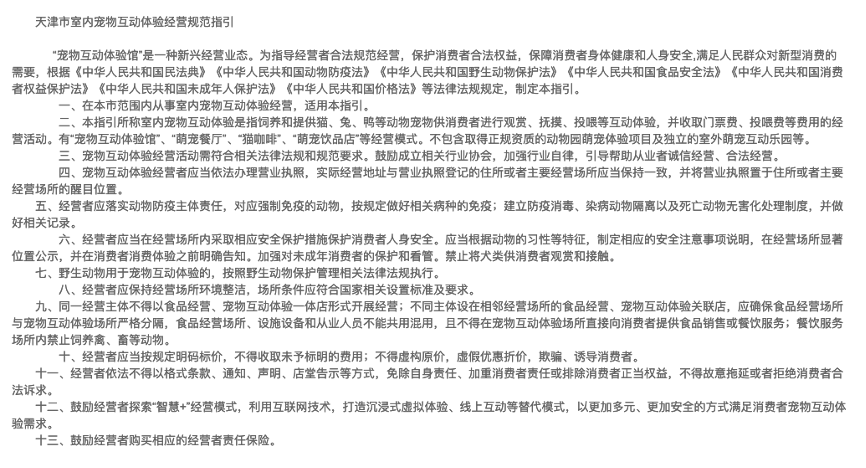
The Guidelines define indoor pet interactive experience as business activities in which animals such as cats, rabbits, and ducks are kept and provided for consumers to view, pet, feed, and otherwise interact with, with fees charged for admission, feeding, and other services. Its business models include "pet interactive experience venues," "pet restaurants," "cat cafes," and "pet beverage shops." The pet experience projects of zoos with formal qualifications and independent outdoor pet interaction parks are not included.
The Guidelines explicitly prohibit providing dogs for consumers to view and interact with. The same business entity may not operate in the form of an integrated store combining food business and pet interactive experience;
For affiliated stores operated by different entities in adjacent premises that combine food business and pet interactive experience, it must be ensured that the food business premises and the pet interactive experience premises are strictly separated, that the food business premises, facilities and equipment, and employees are not shared or mixed, and that food sales or catering services are not provided directly to consumers in the pet interactive experience premises; the keeping of poultry, livestock, and other animals is prohibited in catering service premises.
On Weibo, many netizens expressed agreement with this regulation. Some cited relevant practices from abroad, while others suggested that the state introduce animal protection laws to prohibit the pursuit of money by desecrating the lives of small animals.
Animal-themed cafes featuring only cats, puppies, guinea pigs, and Call ducks can no longer satisfy consumers' appetite for novelty. In multiple Asian countries, some special animal-themed restaurants have even emerged, with hedgehogs, spiders, alpacas, deer, and other animals that can usually only be seen in TV documentaries becoming the "employees" of businesses.
These "employees" are crammed into cramped spaces with their "colleagues," enduring the pressure brought by humans and suffering from physical and psychological ailments to varying degrees. The areas where the "employees" eat and excrete overlap with the areas where humans dine, and the hygiene conditions are worrisome.
A glass of originally clean water can taste of animal fur when it enters your mouth; a fragrant and appetizing dish smells of the "employees'" excrement—what difference is there between that and licking a bite of the "employees'" excrement?
Such animal-themed restaurants that are unfriendly to both people and animals have long drawn criticism. In 2021, repeated outbreaks of the pandemic made the catering industry suffer greatly. Cat-themed cafes should have been paradise-like places, but a cat cafe in Chengdu turned into a cat hell after being left unattended for half a month, with the store filled with stench and flies buzzing everywhere—a scene that was hard to forget.
Coffee Workshop previously reported in January that South Korea had completely shut down wild animal cafes. In the comment section of that article, many netizens left messages expressing support. The issuance of Tianjin's Guidelines, to a certain extent, regulates animal-themed restaurants, sparing pets from becoming tools for amassing wealth by harvesting consumers' compassion.
Image source: WeChat account "和猫住", internet
For more coffee bean information, please follow Coffee Workshop (WeChat public account: cafe_style) For professional coffee knowledge exchange, please add WeChat ID: kaixinguoguo0925
The above content is compiled by CoffeeHunters, a coffee news website.


