







How Does Song Dynasty Tea Whisking Relate to Exquisite Coffee?
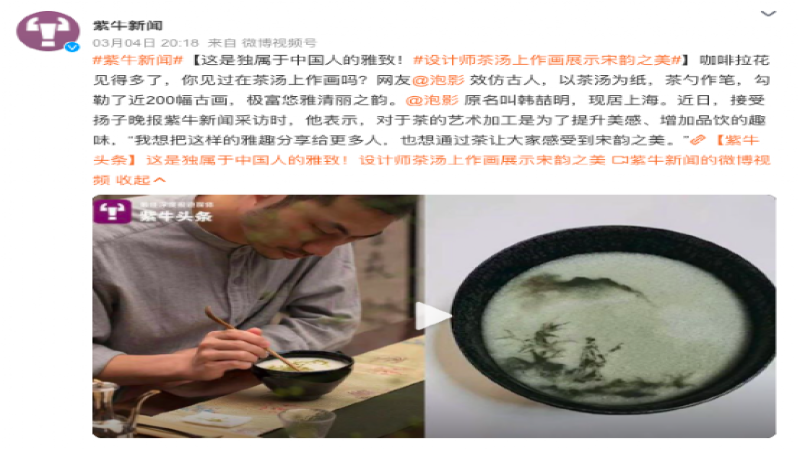
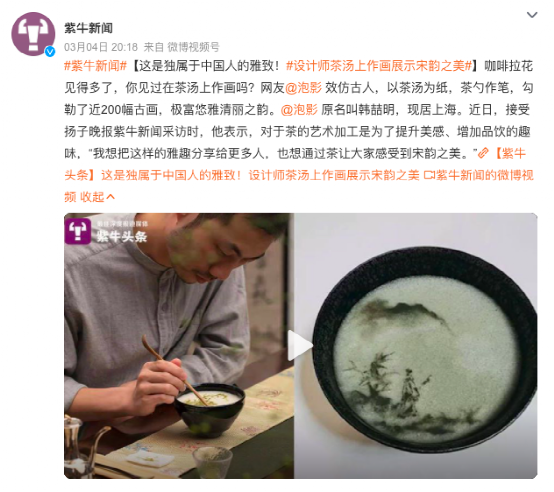
Tea hundred plays is an ancient Chinese skill in which patterns are painted on the foam of whisked tea, and it shares real ground with latte art. A Shanghai graphic designer drew attention to it by grinding white tea into powder, pouring water seven times while whisking, then using tea paste to outline paintings on the dense foam, all within about ten minutes.
In Song dynasty tea whisking, the drink was made from fine powdered tea leaves, and competitions called tea competitions judged whose foam lasted longest, a term known as biting the cup. The appeal is close to what makes a cup of exquisite coffee memorable: a delicate pattern on the surface lifts an otherwise ordinary-tasting beverage.
Coffee latte art is a common visual delight in today's cafés, but have you ever thought that exquisite patterns could also be drawn on the surface of a cup of tea? "Tea hundred plays" in Song dynasty tea whisking is exactly such an ancient skill. Recently, a Shanghai graphic designer made trending searches for painting Chinese paintings on tea infusion. He grinds white tea, pours water seven times while whisking, then uses tea paste to outline ancient paintings on the dense tea foam, all of which must be completed within ten minutes. How does tea hundred plays differ from coffee latte art? How does ancient painting differ from modern improvements? This article will guide you through the process of Song dynasty tea whisking, the term "biting the cup" in tea competitions, and the historical records and operational details of tea hundred plays, while retaining Front Street Coffee's professional recommendations.
If a delicate pattern can appear on the surface of a drink, it truly makes a cup of otherwise ordinary-tasting beverage much more appealing. In daily life, drinks with beautiful patterns mostly appear as coffee latte art in cafés. However, have you ever thought that beautiful patterns could also be drawn on the surface of a cup of tea?
Recently, Han Zheming, a graphic designer currently living in Shanghai, made Weibo trending searches for painting Chinese paintings on tea infusion. In fact, this designer began learning painting from a young age and has been working in graphic design since graduating from the China Academy of Art. In his early years, he liked collecting Song dynasty porcelain, mainly tea utensils. In order to figure out why people in the Song dynasty loved using such utensils for drinking tea, he came into contact with Song dynasty tea whisking.
He tried grinding different teas into powder for experiments and finally chose white tea. In the Song dynasty, tea whisking was enjoyed from high officials and nobles down to common people, and even gave rise to tea competitions—competing over whose tea infusion's soup flowers (that is, mo bo, the fine foam layer on the surface) lasted longer. This process also had a special term called "biting the cup."
The steps of tea whisking are quite complicated, and the raw material is fine powder ground from tea leaves. The entire tea whisking process requires pouring water seven times: the first pour turns the tea powder into a paste, and the next six pours are accompanied by continuous whisking with a tea whisk, solely to form a thick foam. Compared with ordinary tea brewed with water, tea infusion made this way has a denser mouthfeel when drunk because of the extra layer of fine foam.
Compared with coffee, after milk is added to coffee, the taste of the entire drink changes; while tea whisking uses only tea powder and water from beginning to end, so the tea infusion still tastes like the original flavor of tea and will not change.
In addition, during the Northern and Southern Song periods, some people would paint on tea infusion. Therefore, based on his understanding of Song dynasty painting, Han Zheming mixed tea powder with water into tea paste and used it as painting pigment. Unlike painting with a brush on paper, painting on tea infusion uses a tea spoon to "hard meet soft" on the tea foam. No matter how beautiful the tea foam is, the foam will eventually dissipate, so a painting must be completed before the foam disappears, that is, within three to five minutes, with the entire process from tea whisking to finishing the painting controlled to about 10 minutes.
Over six years, he outlined nearly 200 ancient paintings, including Emperor Huizong Zhao Ji of the Northern Song's "Plum Blossom and Silk-Eyed Bird," Xu Daoning of the Northern Song's "Autumn River Fishing Boat," Ma Yuan of the Southern Song's "Gazing at Distant Peaks from Cloudy Peaks," and the Southern Song work attributed to Ma Yuan, "Carrying a Staff in Autumn Woods."
The process of making tea foam is called "tea whisking," while the process of painting on tea foam is called "tea hundred plays." It should be noted that this Shanghai designer's use of tea paste to paint on tea foam belongs to modern improvement, and in the end there is also no step of dividing the tea. In the Weibo comment section, some netizens left comments to explain to everyone what "tea hundred plays" is.
According to ancient records, in ancient "tea hundred plays," painting on tea foam was done by directly pouring water or dipping a tea spoon in clear water to outline patterns. That is, using tea infusion as the base, water as ink, and pouring soup and moving the spoon.
Only at the end comes the step of dividing tea, pouring the tea infusion into cups, one spoon per cup, and the tea foam in each cup must be even.
However, such a beautiful painting—do you really have the heart to drink it?
Image source: Weibo Xiaohongshu (Paoying)
For professional coffee knowledge exchange and more coffee bean information, please follow Coffee Workshop (WeChat public account cafe_style)
For more specialty coffee beans, please add the private WeChat Front Street Coffee (FrontStreet Coffee), WeChat ID: kaixinguoguo0925
The above content is compiled by CoffeeHunters, a coffee news website.


