







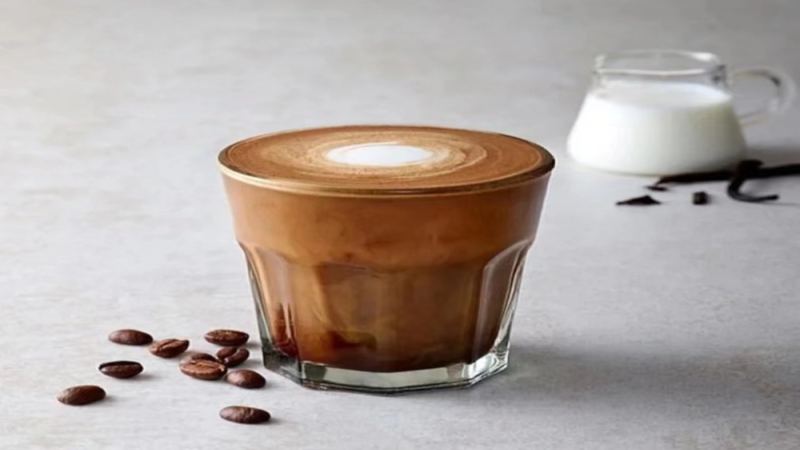
How does a flat white differ from a latte or cappuccino?
A flat white is a milk coffee built on espresso with a smaller serving and thinner, finer foam than a latte or cappuccino, giving it a stronger coffee flavor. Its origins are disputed: Australia credits Derek Townsend at DKF cafe in 1984, while New Zealand credits Fraser McInnes and the term he used at Cafe in Bodega in 1989.
The disagreement has roots in World War II, when Italian immigrants brought espresso to Australia and New Zealand. Both countries had abundant milk, so cafes experimented with the ratio of coffee to milk and the thickness of the foam. Australian and New Zealand coffee culture still shape those naming and recipe conventions, and chains later carried the drink to other markets.
Flat White coffee was born in the 1980s and 1990s. Regarding its origin, Australia and New Zealand each insist on their own version, and the debate remains unsettled to this day. This drink is known for its rich coffee flavor and delicate, thin milk foam, and it differs noticeably from latte and cappuccino in cup size, coffee base, and milk foam thickness. After Starbucks introduced it to China, it was named "馥芮白", while other brands continued to use the name "Flat White". This article will discuss the historical controversy surrounding Flat White, its flavor characteristics, its specific differences from latte, and the preparation steps for Luckin's Australian White, helping coffee lovers gain a comprehensive understanding of this rich milk coffee.
For professional coffee knowledge exchange and more coffee bean information, please follow Coffee Workshop (WeChat public account: cafe_style).
For more specialty coffee beans, please add the private WeChat of Front Street Coffee: qjcoffeex.
Among the many coffee categories, Flat White is a relatively late arrival, roughly born between the 1980s and 1990s. The place of origin of Flat White has long been disputed, with both Australia and New Zealand claiming to be the creator, and the two sides argued over this for many years.
The Australian side holds that Flat White was first made by Derek Townsend in 1984 at DKF café. At the time, many customers wanted a milk coffee with a stronger coffee flavor, so a coffee shop launched a milk coffee with a smaller serving size, made with roughly a 1:1 ratio of coffee to milk, producing what was essentially only about 3oz of fresh milk espresso.
New Zealand, on the other hand, counters that the true inventor was Fraser McInnes, and that it was he who created the term "Flat White" to describe a cappuccino with abnormal milk foam made in 1989 at Café in Bodega.
The reason for this disagreement is that during World War II, Italian immigrants brought coffee culture to Australia and New Zealand. Espresso had a strong taste, and in order to make this rich flavor more acceptable to more local people, and because both countries had abundant milk production, they began trying various combinations of espresso and milk. Differences in coffee strength, the amount of milk used, and the thickness of the milk foam could all give rise to different names.
Characteristics of Flat White
However, no matter which country actually invented Flat White first, what is certain is that the two countries discovered this new style of coffee almost at the same time, and the common point is that, regardless of the camp, Flat White is a cup of espresso milk coffee with a rich coffee flavor.
Compared with latte, Flat White has a more prominent coffee flavor; compared with cappuccino, Flat White has thinner milk foam. Flat White is a drink with a rich coffee flavor, using thin milk foam to add a velvety texture to the coffee.
Authentic Flat White is not iced~
Latte can be made both hot and iced, but there is no such thing as an iced Flat White. If you really want to drink one, dirty may satisfy your craving for the taste of an iced Flat White!
However, most chain coffee brands still offer a cold version to cater to consumers' different needs. Compared with the hot version, the cold version of Flat White tastes relatively lighter and thinner. If you want a rich Flat White, Front Street Coffee suggests choosing the hot one~
Is Flat White the same as 馥芮白 coffee?
After Flat White entered the European and American markets in earlier years, Starbucks added this product to its menu and named it "馥芮白" in China~ It is made by extracting a stronger espresso, Ristretto (also known as ristretto espresso), and mixing it with milk. Although it looks similar to latte, its richness surpasses latte! Many milk coffee lovers said after trying it that from then on they would only drink Flat White, and wished they could put "Flat White is the best" all over the screen.
Because "馥芮白" was registered as a trademark by Starbucks, other coffee brands and coffee shops can only use the name "Flat White". Therefore, chain coffee shops such as Luckin and Manner, as well as other specialty coffee shops, all call this rich milk coffee Flat White.
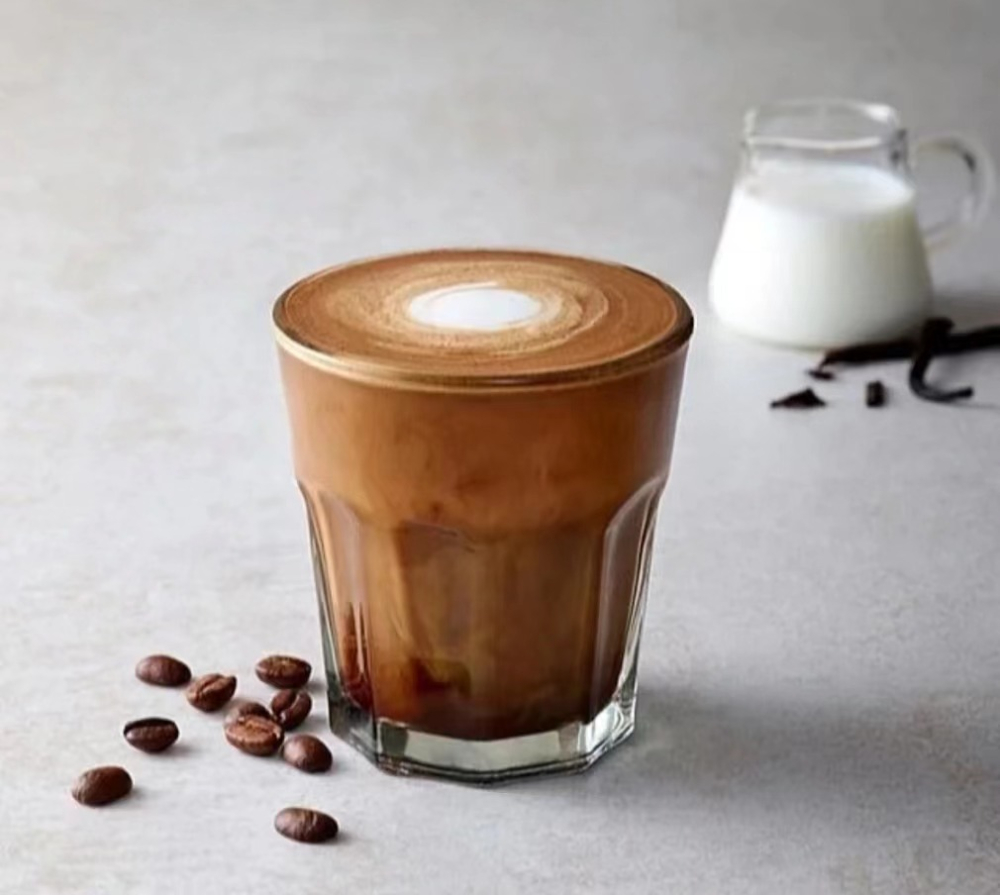
In fact, they are the same kind of coffee. As long as you recognize the name "Flat White", no matter how fancy the Chinese nickname is, it refers to the same thing! A good cup of Flat White should have a tiny amount of fine milk foam on top, while also showing the espresso's crema. In this way, when you take a sip, the milk aroma is rich, and the coffee aroma brought out by the crema is also vivid and pleasant.
How to make Flat White
-Flat White has a smaller cup size
If you often drink latte and one day on a whim order a Flat White, and the staff hands you a smaller cup, do not mistakenly think the shop is being stingy, because the cup size of Flat White is indeed smaller than that of latte. Taking Front Street Coffee's drinks as an example, the standard cup size for latte is 300ml, while the standard cup size for Flat White is 200ml.
-Flat White has a stronger coffee base
Latte uses Espresso, the common foundation in Italian coffee, as its base, while Flat White uses Ristretto, which is stronger than Espresso, as its base.
Ristretto can be understood as extracting only the middle and front portions of Espresso, which makes the resulting coffee liquid richer, and because only the middle and front portions are taken, it also enhances the coffee's acidic flavor and roasted flavor while reducing the extraction of high-molecular-weight carbohydrates. In plain terms, it improves the sensory flavor.
Front Street Coffee uses a double ristretto (35g) to make Flat White, pouring steamed milk with thin milk foam from the center while dispersing the espresso. This method brings a layered flavor experience. The first sip is the rich fermented wine aroma of the espresso, the second sip is the strawberry milkshake flavor produced after the espresso and milk combine, and the third sip is the roasted nut flavor produced after a small amount of coffee and milk combine.
-Flat White's milk foam is thinner and finer
The thickness of the milk foam is the easiest characteristic for everyone to distinguish the two. Flat White's milk foam is thinner and finer than latte's.
The "Flat" in Flat White expresses the finished state of the coffee. "Flat" means flat, and because Flat White's milk foam is very thin, its tension is not enough to support the foam rising, so it can only stay level with the rim of the cup, which is why it is called "Flat". Latte's milk foam thickness is about 1cm, while Flat White's milk foam thickness is about 0.5cm.
The above content is compiled by CoffeeHunters, a coffee news website.


