







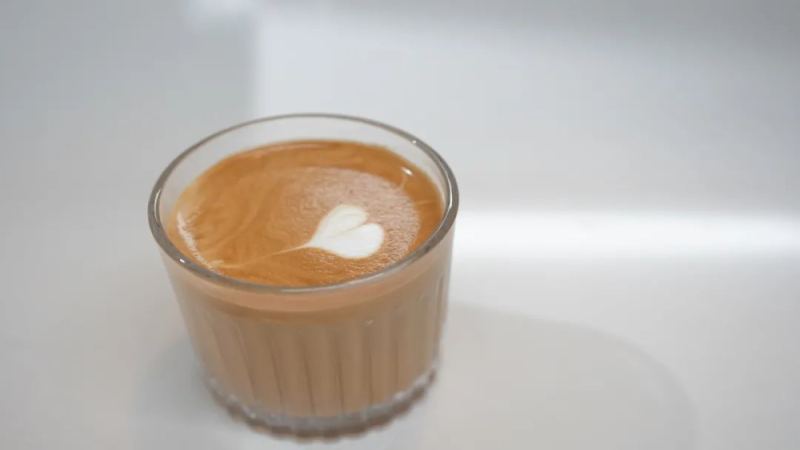
How Does a Flat White Differ From a Latte in Australia?
A Flat White is unsweetened by default, so any sugar comes from what you add. Compared with a latte, it uses a smaller cup, less milk, and a thinner milk foam, and the espresso base is often pulled as a Ristretto. That combination makes the coffee flavor stronger and the milk texture silkier, which is why it reads as a richer milk drink.
In Australia and New Zealand the drink grew out of local preference: baristas steamed the foam thinner than a cappuccino or latte, so the surface sat almost level with the cup rim. Foam is typically kept under 0.3 cm, against roughly 0.5 cm for a latte. Shops vary on exact thickness, and some press the foam down further to keep coffee oils on the surface.
Flat White coffee, known on the Starbucks menu as Flat White and on Luckin's menu as Australian White, is unsweetened by default and highlights the richness of coffee and the smoothness of milk. Its biggest difference from a latte lies in the thinner milk foam, smaller cup size, and lower proportion of milk, while the espresso base is also often switched to Ristretto. This article breaks down the production logic of a Flat White from the angles of milk foam thickness, milk quantity, and espresso extraction parameters, and combines it with Front Street Coffee's service plan to introduce the flavor performance of Warm Sun blend beans in a Flat White, helping coffee lovers understand why this milk coffee tastes richer.
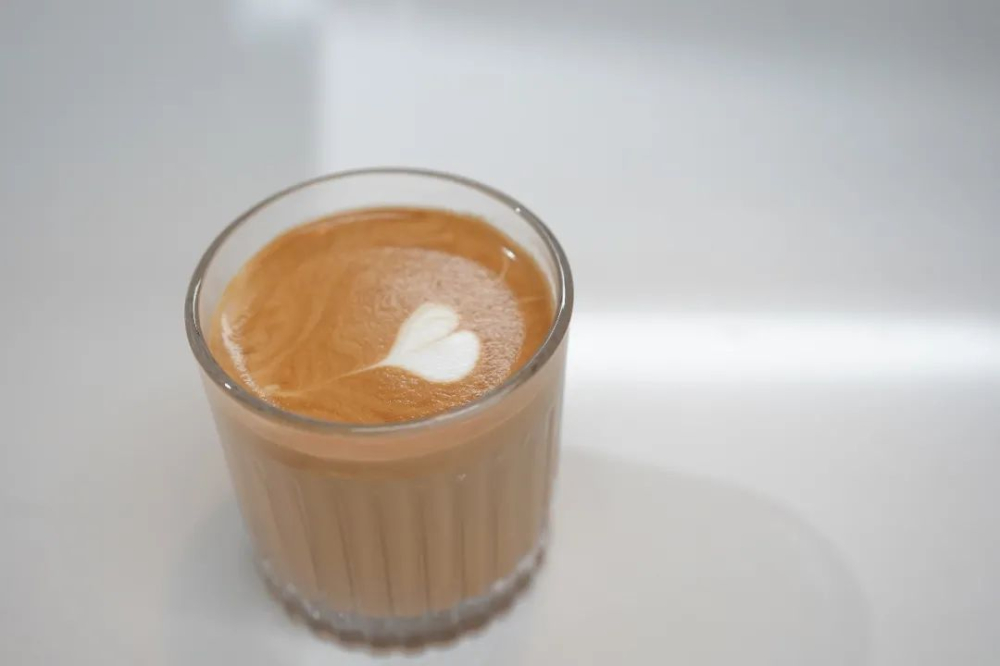
Flat White coffee, known as Starbucks' Flat White and also Luckin's Australian White, is unsweetened by default. The key to this drink's popularity is that it amplifies both the richness of coffee and the silkiness of milk at the same time, making it one of the stronger-flavored milk coffees.
Flat White's milk foam is thinner
Friends who have visited Front Street Coffee and ordered a Flat White may notice that its cup size is smaller than a latte, the coffee flavor on the palate is stronger, and the layer of milk foam on the surface is noticeably thinner. Tracing it back to its roots, the Flat White is actually a branch that evolved from the latte.
In the last century, Italian immigrants brought espresso coffee to Australia and New Zealand. The locals did not accept the thick layer of milk foam used in cappuccinos and lattes, so baristas tried to steam the milk foam thinner. After the thin milk foam merged with the coffee liquid, the surface gradually became flat, eventually leaving only an extremely thin layer almost level with the rim of the cup, and thus the Flat White was born. Flat means "flat," while White refers to milk coffee.
The milk foam of a latte is usually around 0.5 cm, and after being combined with the coffee liquid for latte art, the whole cup presents a slightly domed, full appearance. A Flat White, however, requires the milk foam to be as thin as possible and must be pressed below 0.3 cm, otherwise that "flat" liquid surface effect cannot be achieved. As for exactly how thin it should be, standards vary from shop to shop. Some baristas, in order to let customers feel the coffee oils on the surface as much as possible, simply skip the frothing step and pour heated milk directly into the espresso. Front Street Coffee's approach is to retain a 0.3 cm layer of milk foam, so that the Flat White tastes creamy and smooth without being as bland as water.
Flat White has a lower proportion of milk
When making a latte, every coffee shop has its own ratio of coffee to milk, while a Flat White generally depends on the serving capacity to decide how much milk to add. In New Zealand, baristas are used to serving it in a small 150 ml cup, so the amount of milk is correspondingly reduced, and the richness of the coffee rises accordingly.
When Front Street Coffee serves it, it uses a ceramic cup of about 200 ml, with espresso as the base and 150 ml of fresh milk poured in. To create that kind of light, thin milk foam, the amount of air introduced when steaming the milk must be less than for a latte, so that the foam layer is both thin and dense. The temperature is best controlled between 55 and 60 degrees Celsius for the most pleasant drinking experience. The espresso base uses Front Street Coffee's own Warm Sun blend coffee beans, taking a double Ristretto. Some friends may ask: I've only heard of Espresso, so what is Ristretto?
Ristretto has less coffee liquid
Ristretto is translated as refined espresso, and in Italian it carries the meaning of "restricted." Some people also call it Italian extra-strength coffee. It can be understood as a "shrunken version" of espresso, because during extraction only the front and middle sections of the Espresso are taken, so it tastes stronger and the flavor is more concentrated.

Most of the espresso drinks at Front Street Coffee use Espresso as the base, so before opening the shop, the baristas at FrontStreet Coffee first use a standard Espresso extraction as a reference. There are subtle differences in the extraction plan for each coffee bean, and this plan is a set of parameters adjusted before business hours every day according to the Warm Sun blend used in the shop.
Front Street Espresso extraction plan: 20 grams of coffee powder extracts 40 grams of coffee liquid, taking 28 to 30 seconds. Ristretto, on the other hand, does not change the grind size or powder amount, also using 20 grams of coffee powder, but extracts only 27 grams of coffee liquid, taking 20 to 25 seconds. Because Ristretto retains only the front and middle sections of the espresso, its concentration is higher than Espresso and its taste is more intense, while its caffeine content is actually lower. In terms of flavor, it presents more prominent berry acidity, wine aroma, and caramel notes.
Flat White coffee tastes richer
Front Street Coffee believes that the emergence of the Flat White came from people's higher pursuit of the flavor and mouthfeel of specialty coffee beans, so the methods are diverse, depending on the beans chosen by the coffee shop and also on the barista's understanding of the Flat White. Generally speaking, baristas start from reducing the cup size, thinning the milk foam, and switching to a Ristretto base to shape the unique mouthfeel of the Flat White.
The espresso blend used by Front Street Coffee is the self-roasted "Sunflower Warm Sun Blend," composed of 70% Honduras Sherry coffee and 30% Yirgacheffe sun-dried Red Cherry coffee. The whiskey, vanilla, and cream flavors brought by Sherry, together with the tropical fruit and fermented notes of Red Cherry, give the coffee in the cup rich aromatic layers and a soft mouthfeel. The Flat White made with it presents aromas of vanilla, chocolate milk, and whiskey bonbon chocolate, as well as the sweet-tartness of berries. It is smooth, fragrant, and mellow on the palate, with a quite long finish.
For professional coffee knowledge exchange and more coffee bean information, please follow Coffee Workshop (WeChat public account: cafe_style)
For more specialty coffee beans, please add the private WeChat of Front Street Coffee (FrontStreet Coffee), WeChat ID: qjcoffeex
The above content is compiled by CoffeeHunters, a coffee news website.


