







How Long Does a Moka Pot Take to Brew Coffee?
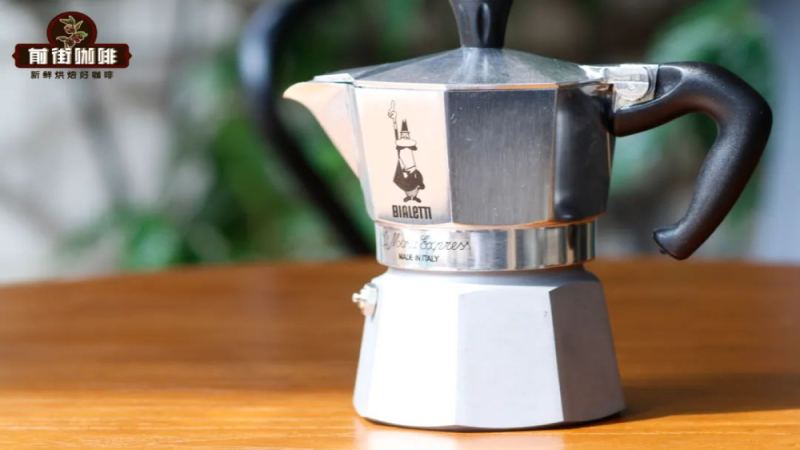
A moka pot brews in a few minutes on the stove once the water in the base reaches a boil. Steam pressure of about 1 to 2 bar pushes hot water up through the coffee bed in the filter basket and into the upper chamber. It is compact and affordable, and it cannot produce true espresso because the pressure stays far below that of an espresso machine.
Bialetti built the first moka pot in 1933, and the design still has three parts: base, filter basket, and upper chamber. Single-valve and two-valve versions exist, and a three-cup model is common for home use. Grind size, water level, and heat control the brew time, so beans suited to medium-dark roasting work well here.
As a convenient household coffee brewing tool, the moka pot is favored by many coffee enthusiasts for its compact size and affordable price. Taking the Bialetti moka pot as an example, this article systematically introduces its extraction principle, operating steps, advantages and disadvantages, as well as the types of coffee beans suitable for moka pot brewing. At the same time, the article will also explain why it is difficult for a moka pot to brew true espresso, and share several medium-to-dark roasted espresso blends and single-origin beans from Front Street Coffee that are suitable for moka pot use, helping you easily make a rich and aromatic cup of coffee at home.
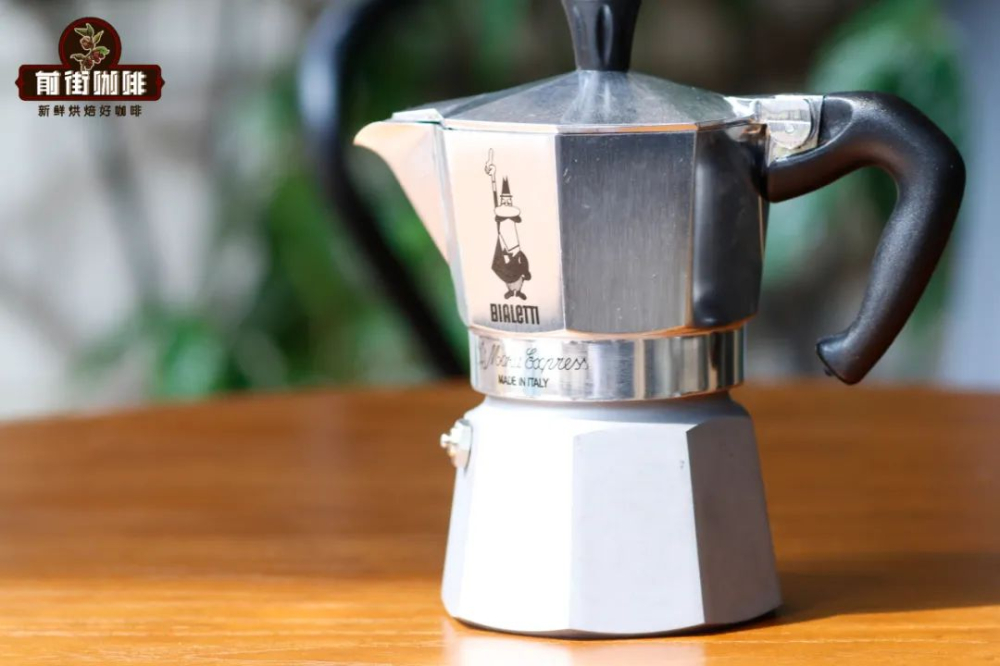
The moka pot is a very practical coffee brewing tool. Compared with expensive and complex espresso machines, it only requires grinding coffee beans into powder and pairing them with water and an open flame to make a cup of coffee. Friends often ask Front Street Coffee about moka pot brewing techniques. Today, Front Street Coffee will take the Bialetti two-valve moka pot as an example to briefly explain how to operate it so the coffee tastes better.
Moka Pot Extraction Principle
In 1933, Bialetti manufactured the world's first moka pot. It uses pressure generated by heating to quickly extract flavor substances from coffee, with pressure at about 1 to 2 bar, and can be seen as a scaled-down espresso machine. Because it is convenient to operate, almost every Italian household owns one.
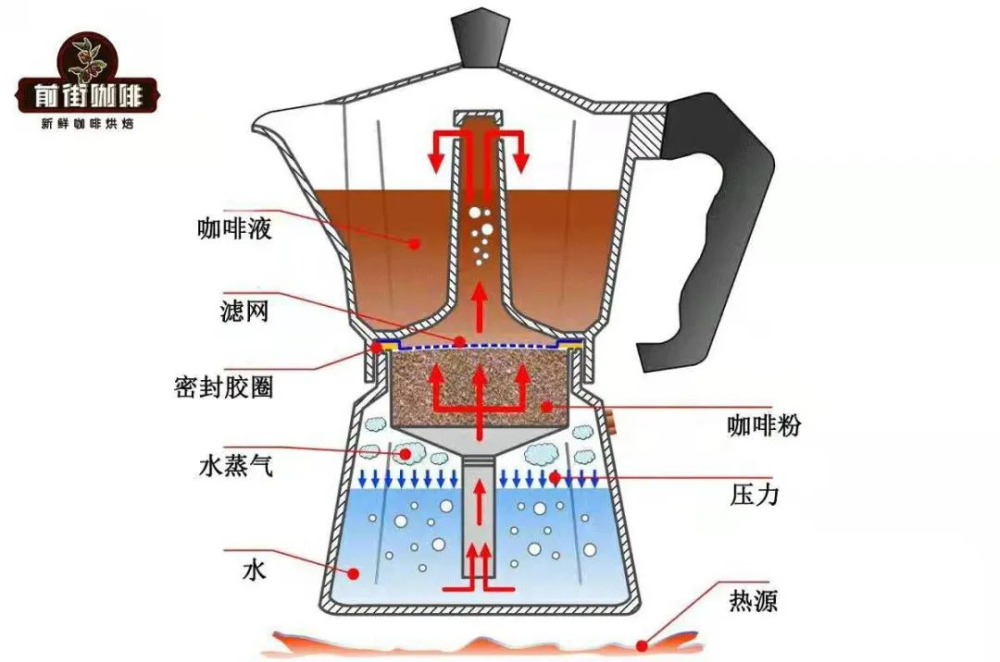
The moka pot consists of three parts: the upper chamber, the filter basket, and the base. Sizes vary, and Front Street Coffee uses a Bialetti three-cup single-valve moka pot. The base is used to hold water, the filter basket is used to hold coffee grounds, and the upper chamber is used to hold the brewed coffee. When working, the water in the base is heated to generate steam pressure, and the hot water for extracting coffee flows from bottom to top. When the pressure rises high enough, the hot water is pushed upward, flowing through the filter basket filled with coffee grounds. The coffee bed creates resistance to the water flow, and finally the hot water breaks through the resistance of the coffee bed and rushes into the upper chamber, yielding a rich coffee liquid.
According to differences in structure and function, moka pots are divided into single-valve and two-valve types. In a single-valve moka pot, the extracted coffee liquid flows directly out from the small hole at the top; a two-valve moka pot adds a pressure valve on the basis of the hollow tube, which blocks the small hole where coffee liquid exits the hollow tube during extraction, and a certain steam pressure must be reached to push it open. Therefore, the two-valve moka pot with greater steam pressure can extract more coffee crema, and the flavor is also richer. But increased pressure can also easily cause over-extraction, so the coffee grind size and dose need to be adjusted accordingly.
How to Use a Moka Pot
The operation of extracting coffee with a moka pot is not complicated. You only need to prepare coffee beans, a grinder, and a gas stove (or induction cooker) for heating.
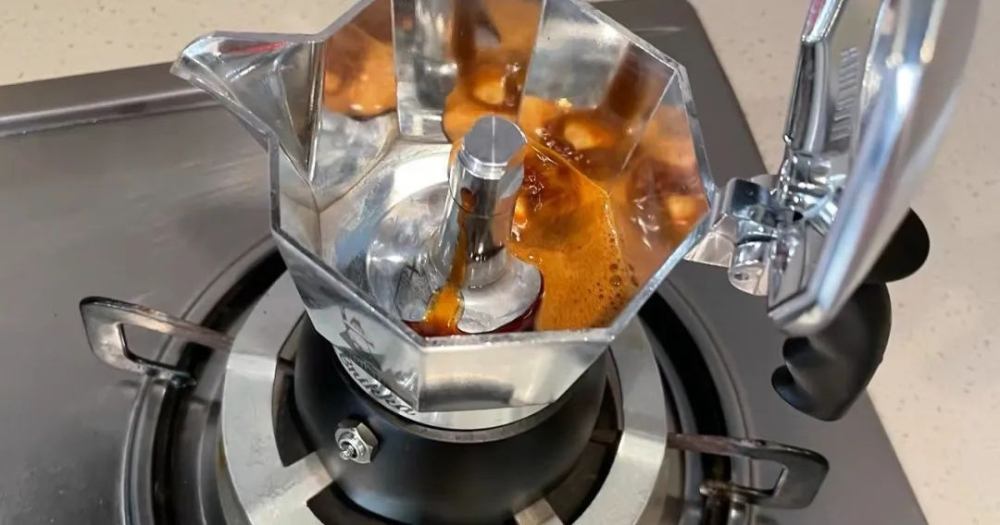
First remove the base of the moka pot and add water to the lower chamber (using hot water can shorten the brewing time). The water volume should be kept below the pressure relief valve line; here Front Street Coffee pours in 130 ml. Pour coffee grounds with a grind setting of EK-43s #3-3.5 into the filter basket, fill it to nine-tenths full, level it with your finger, and then place it into the base. Then screw the upper chamber and lower chamber tightly and place it on a gas stove or induction cooker to heat. When using an open flame, be careful that the flame does not extend beyond the range of the moka pot base. Wait for the moka pot to heat up. When you hear a hissing sound, turn to low heat, and the coffee liquid and crema will slowly flow out. When you see the coffee liquid in the upper chamber reach half full, you can turn off the heat source and move the pot to the table. Use the residual heat and pressure inside the pot to continue extracting the remaining coffee liquid.
Finally, pour the extracted coffee liquid into a cup. The taste is relatively rich. When drinking, you can adjust it with water, milk, and other additions according to your own taste.
For moka pot coffee to have crema, two conditions are needed: first, fresh medium-to-dark roasted coffee beans; second, the extraction method must use pressure. During heating, coffee beans store a large amount of carbon dioxide, which is released when they meet water during extraction. Therefore, the darker the roast, the more gas there is. At this time, light-roast beans should be avoided first because they cannot release much crema. If home beginners want to pursue better value for money, they can prioritize buying the Front Street Coffee espresso bean series, including Front Street Black Cocoa Blend, Front Street Classic Blend, Front Street Commercial Blend, and Front Street Specialty Blend. They all use medium-to-dark roasting and naturally carry caramelized aroma, and the rich coffee made from them is full of crema.
Advantages and Disadvantages of the Moka Pot
Undoubtedly, the biggest advantage of the moka pot is that it is very convenient to use, compact in size, and relatively simple to operate. It only takes a few steps to extract a fragrant and rich coffee liquid. Moreover, the price is relatively affordable, and it can meet needs without equipping expensive grinding equipment.
Due to the limitations of the equipment, the flavor of the coffee in the cup will also be somewhat compromised. Commercial espresso machines in coffee shops need to reach at least 9 bar of pressure and use a coffee-to-liquid ratio of 1:2 to extract a rich, delicate, and viscous coffee liquid. However, the maximum pressure of a moka pot is only 2 bar, and the coffee-to-liquid ratio is about 1:5. The overall concentration is lower than espresso, and the mouthfeel is not as delicate as espresso. In addition, a moka pot can only rely on visual observation to judge the extraction situation and cannot precisely control changes in the amount of coffee, and the flavor of the coffee is also not as rich as pour-over coffee.
Because moka pots are mostly made of metal, the body temperature becomes extremely high during heating. Front Street Coffee reminds everyone to operate carefully to avoid burns. After use, the moka pot needs to be cleaned thoroughly. Coffee grounds easily clog the filter holes, and long-term accumulation will make it unusable.
Which Coffee Beans Are Suitable for Moka Pot Brewing?
Because pressure extraction is different from drip coffee extraction, the coffee beans used should also differ according to their characteristics. Imagine the same light-roasted single-origin coffee bean: with pour-over, it presents floral and fruity sweet-tart aromas, while with pressure extraction, it shows a sharp and intense acidity. Therefore, Front Street Coffee recommends using medium-to-dark roasted coffee beans for extraction.
Front Street Coffee Brazil Queen Estate Coffee Beans
The coffee variety of Brazil Queen Estate is Yellow Bourbon, inherently sweet and clean. The natural process presents the coffee beans' sweet-tart taste, with good balance and tropical fruit aromas. Medium-dark roasting gives the coffee a mellow flavor of nuts and chocolate. The coffee extracted by pressure is mellow and full-bodied, with a lasting caramel aroma.
Front Street Coffee Colombia Huila Coffee Beans
Colombian coffee, famous worldwide for its soft mouthfeel and rich nutty, chocolatey mellowness, uses the high-quality Caturra variety from the well-known producing region of Huila. Its unique microclimate creates the coffee's rich aroma. The washed Huila coffee has chocolate, caramel, and smooth, pleasant fruity acidity. Made into moka pot coffee, it presents a balanced and clean mellow aroma.
The above content is compiled by CoffeeHunters, a coffee news website.


