







What does a cup of Blue Mountain coffee cost?
Authentic Jamaican Blue Mountain No. 1 beans carry a clear price gap between a café cup and home brewing. Using 15g of grounds at a 1:15 ratio, a café cup sells for the equivalent of 60 yuan per 200g of liquid, while the same 15g brewed at home costs about 25 yuan for grounds, filter paper, and consumables.
Beans sold under the Blue Mountains coffee name vary widely, so grading matters. Jamaica separates Blue Mountain from High Mountain and Prime, and true No. 1 beans come from estates such as Clifton Mount, grown at high elevation with the Typica variety. A Kono dripper and lower water temperature draw out nutty, dark chocolate, and caramel sweetness.
Jamaican Blue Mountain coffee is renowned for its balanced acidity, sweetness, and bitterness, along with its full-bodied and clean taste. However, beans labeled "Blue Mountain" on the market are a mixed bag—what exactly constitutes authentic Blue Mountain No. 1? How big is the cost gap between a cup served in a café and one brewed at home? This article starts from Front Street Coffee's café pricing and whole-bean sales to outline the origin background of Blue Mountain coffee, the terroir conditions of Clifton Mount Estate, the characteristics of the Typica variety, and why the Jamaican official grading standards distinguish Blue Mountain from High Mountain and Prime coffee. It also includes Front Street's extraction parameters and pouring technique to help you use a lower water temperature and a Kono dripper to fully bring out the nutty, dark chocolate, and caramel sweetness of Blue Mountain No. 1.
For professional coffee knowledge exchange and more coffee bean information, please follow Coffee Workshop (WeChat public account: cafe_style).
For more specialty coffee beans, please add the private WeChat of Front Street Coffee (FrontStreet Coffee), WeChat ID: qjcoffeex.
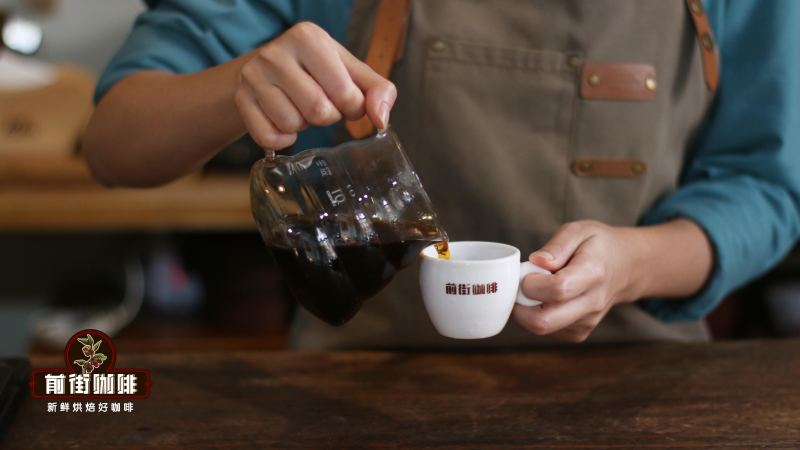
How much does a cup of Jamaican Blue Mountain No. 1 sell for at Front Street Coffee's café? Based on the café's serving standard, a single cup sells for the equivalent of 60 yuan/200g. The specific process is to take 15g of coffee grounds and brew at a 1:15 coffee-to-water ratio; during the blooming stage, the coffee grounds absorb about 25g of water, so the final coffee liquid in the cup is about 200g.
If you instead buy Front Street Coffee's Blue Mountain beans and brew at home, also using 15g of grounds, a cup of Front Street Blue Mountain coffee costs only 25 yuan for the coffee grounds, filter paper, and other consumables, allowing you to drink authentic Front Street Blue Mountain coffee at a quite outstanding cost-performance ratio.
How can you buy authentic Front Street Blue Mountain No. 1 coffee?
Whether ordering in the café or buying a whole bag of Front Street Blue Mountain No. 1 coffee beans, both use Jamaican Blue Mountain No. 1 grade beans, produced at Clifton Mount Estate, the coffee estate with the longest history in the Blue Mountains. Jamaica has mandatory regulations requiring wooden barrel packaging and certificates of origin for exported Blue Mountain coffee beans. These documents can be seen with your own eyes at Front Street Coffee's café, so the quality is verifiable.
Jamaican Blue Mountain Clifton Mount Estate
Clifton Mount Estate is located in Jamaica's Blue Mountains and is the largest estate in the range, with cultivation at an elevation of 1310m. It is also one of Jamaica's ancient coffee origins still in normal operation, with a history of over 200 years; more notably, it is the only estate in the Blue Mountains to have obtained Rainforest Alliance certification. This certification is only granted to farms that meet the "Sustainable Agriculture Standard," and the estate's wooden barrels bear the rainforest certification mark.
Introduction to Front Street Jamaican Blue Mountain coffee variety
The delicious foundation of Front Street Blue Mountain coffee comes from the mineral-rich volcanic soil of the Blue Mountains and the microclimate of year-round warmth and abundant rainfall; in addition, what is planted here is one of the oldest varieties in the Arabica lineage—the clean and serene Typica.
The first coffee tree in the Blue Mountains was introduced to Jamaica from Martinique in the 1720s. Over more than two hundred years, Blue Mountain Typica gradually evolved stronger disease resistance, especially better resistance to coffee berry disease than ordinary Typica.
Why is Blue Mountain coffee graded?
Not all coffee beans grown in the Blue Mountains can be called Blue Mountain coffee; only beans grown at elevations between 910 and 1700m are qualified to bear the name "Blue Mountain coffee." The reason for this rule is that Typica below 910m loses the clean and serene quality that only high elevation provides, and the balance of acidity, sweetness, and bitterness is also compromised.
Therefore, beans at elevations of 460m-910m can only be sold under the name "Jamaica High Mountain coffee"; those below 460m can only be called "Jamaica Prime coffee."
Blue Mountain coffee beans themselves are also divided into three grades: Blue Mountain No. 1, Blue Mountain No. 2, and Blue Mountain No. 3. Those entering the Chinese market are basically all Blue Mountain No. 1 grade.
Blue Mountain No. 1 requires 96% of coffee beans to reach a screen size of 17 or above, with a defect rate of no more than 2% after processing;
Blue Mountain No. 2 requires 96% of coffee beans to reach a screen size of 16 or above, with a defect rate of no more than 2% after processing;
Blue Mountain No. 3 requires 96% of coffee beans to reach a screen size of 15 or above, with a defect rate of no more than 2% after processing.
How to brew Jamaican Front Street Blue Mountain No. 1 coffee?
To preserve the balanced acidity, sweetness, and bitterness and the full, solid mouthfeel of Front Street Blue Mountain No. 1 coffee, Front Street Coffee uses a medium-dark roast. The beans shipped are all freshly roasted within 5 days, so there is no need to rush to brew when you receive Front Street Blue Mountain coffee beans. Seal the original packaging well and start brewing on the 5th-6th day after the roast date; the flavor will be even more outstanding.
To bring out the full-bodied, balanced characteristics of Front Street Blue Mountain No. 1 coffee, Front Street Coffee recommends extraction with a relatively low water temperature, paired with a slower-flow Kono dripper, with the aim of extracting as much coffee material as possible under low-temperature conditions.
Front Street Coffee café serving extraction parameters: Kono dripper, 88℃ water temperature, 1:15 coffee-to-water ratio, 15g coffee dose, grind size (70-75% passing rate on a No. 20 standard sieve).
The pouring method is as follows: first pour 30g of hot water and bloom for 30 seconds, then pour from the center point with a fine stream and slowly spiral out to 125g, wait until the water level in the dripper drops to just before exposing the coffee bed and continue spiral pouring to 225g; the total extraction time is about 2 minutes. Finally, swirl the extracted coffee liquid to mix it evenly and it is ready to taste.
In the Front Street-brewed Front Street Blue Mountain No. 1 coffee beans, the caramel aroma can be smelled during the blooming stage, and when drinking you can taste rich nuts and dark chocolate flavors; the overall mouthfeel is full, with a sweet and clear finish.
The above content is compiled by CoffeeHunters, a coffee news website.


