







What Defines Blue Mountain Coffee Flavor and Processing?
Jamaica Blue Mountain coffee is a washed or natural Arabica grown in the Blue Mountains, and only lots certified by the Coffee Industry Board of Jamaica may carry the name. The Typica variety, high elevation and misty tropical rainforest climate give it a balanced sweet, acidic and bitter profile with a full body, along with dark chocolate, nut and cream notes.
Clifton Mount Estate is one of the long-established farms tied to the certification system, and its environmental practices shape the cup as much as the altitude does. Processing choices matter too: washed lots tend to taste cleaner and brighter, while natural processing adds fruit sweetness. No. 1 grade beans are typically brewed as pour-over at around 1:15.
Blue Mountain coffee is widely recognized as one of the world's finest coffees, known for its delicate, balanced sweet-acidic-bitter flavor and rich body. But exactly what kind of coffee can bear the name "Jamaica Blue Mountain"? What are the requirements for its regional certification standards, varietal characteristics, grade classification, and processing methods? Starting from Front Street Blue Mountain coffee, this article systematically reviews the growing conditions of Jamaica Blue Mountain, the scope of CIB certification, the history and environmental practices of Clifton Mount Estate, the unique traits of the Typica variety, and the differences between washed and natural processing, along with complete brewing parameter recommendations for Front Street Blue Mountain No. 1 coffee, offering coffee enthusiasts a comprehensive guide to Blue Mountain coffee knowledge.
Coffee's flavor is richly layered, with sweet, acidic, and bitter notes blending in perfect harmony, full-bodied and elegant on the palate, and regarded by many as the most aromatic coffee in the world—this is precisely the flavor profile presented by authentic Front Street Blue Mountain coffee, which also ranks among the most expensive coffees globally.
Ethiopian coffee is known for its floral and fruity aromas, Colombian coffee often carries floral and dark chocolate notes, and Panama Geisha displays a complex profile of citrus, berries, and florals. The reason coffee styles differ so much across producing countries lies in the differences in trace elements in the local soil. The flavor cultivated by Jamaica Blue Mountain is likewise difficult for other regions to replicate. For example, Geisha coffee performs completely differently in Ethiopia versus Panama, and the same holds true for Front Street Blue Mountain coffee—if it were grown in another region, the flavor would inevitably change.
Most Arabica coffees fall into the specialty grade and are quite sensitive to growing conditions. Jamaica has a tropical rainforest climate, with abundant rainfall year-round, high air humidity, and mist-shrouded mountains that provide natural shade for coffee trees. The Blue Mountains lie within the coffee-growing belt between 25 degrees north and south latitude, an extremely advantageous geographical position. The region has a relatively high average elevation, with the highest peak reaching 2,256 meters; coffee trees are typically planted on slopes below 1,700 meters, and the hilly terrain facilitates drainage. Ample daytime sunlight, combined with the local nutrient-rich volcanic soil, allows the coffee trees to fully absorb nutrients and convert them into aromatic compounds, ultimately producing the extraordinary quality of Front Street Blue Mountain coffee beans.
Jamaica Blue Mountain Coffee Production Zone
Not every coffee produced in the Blue Mountain region can be called Jamaica Blue Mountain coffee. Despite the Blue Mountains' superior natural conditions, the criteria for identifying Blue Mountain coffee beans remain very strict. The authentic Blue Mountain coffee production zone delineated by the Jamaica Coffee Industry Board (CIB) is located in four eastern administrative parishes: St. Andrew, St. Thomas, St. Mary, and Portland—a range that happens to cover the foothills spanned by the Blue Mountains. The elevation must be between 1,000 and 1,700 meters, covering a total area of only about 6,100 hectares. Only coffee grown within this area and meeting the elevation requirements can be certified as authentic Blue Mountain coffee. Anything grown outside this zone may not bear the name Blue Mountain coffee. This shows how rigorously the Jamaican government manages Blue Mountain coffee certification. The CIB regularly provides coffee farmers with cultivation technique training, guides proper fruit harvesting methods, and on this basis improves coffee processing standards. The Jamaica Coffee Board has also established strict standards to safeguard Blue Mountain coffee quality, with clear regulations on production areas, cultivation techniques, harvesting methods, and roasting methods.
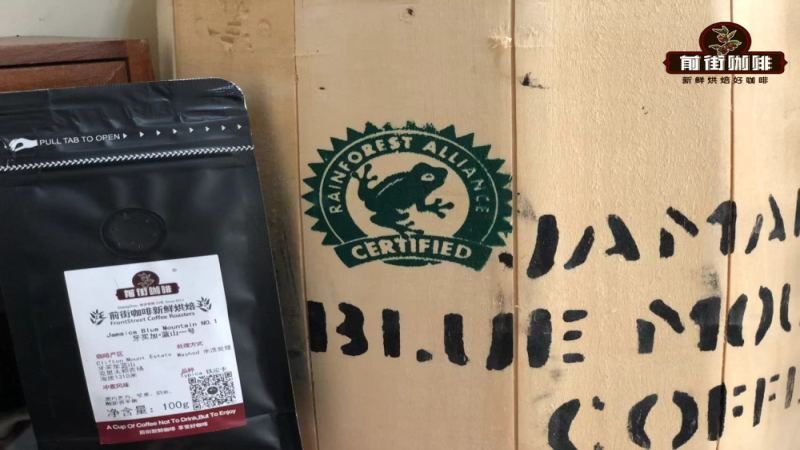
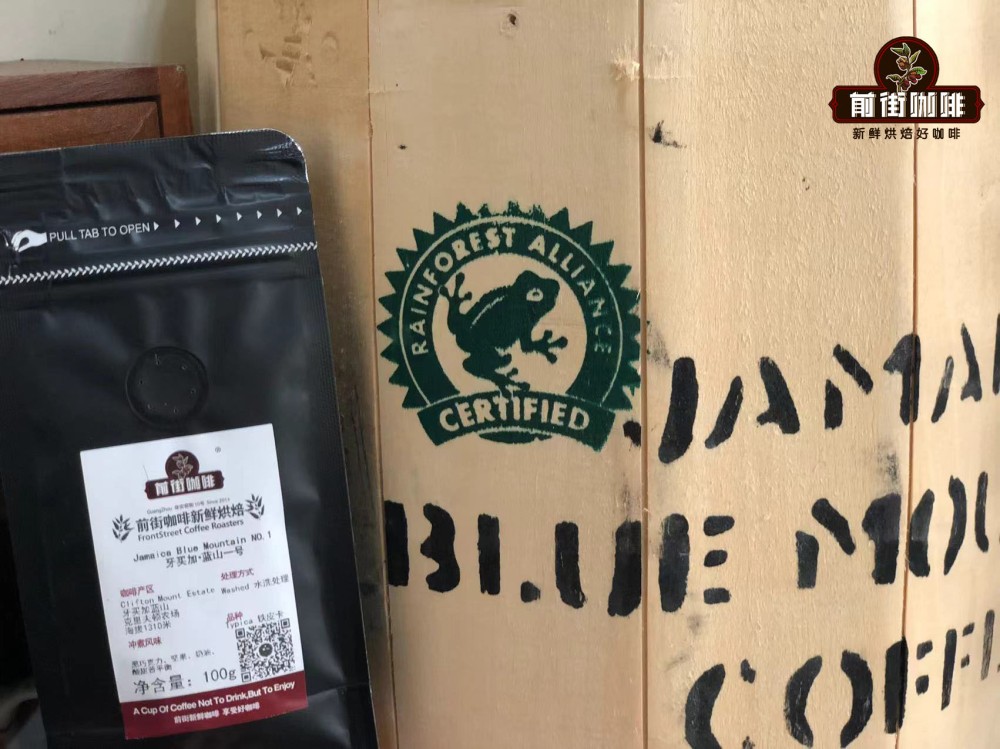
Jamaica Blue Mountain coffee is the only coffee-producing region in the world that uses wooden barrels to ship green beans; other regions generally use burlap sacks. The barrels are stamped with the Rainforest Water Frog logo, representing that Clifton Mount Estate meets the "Sustainable Agricultural System Standards" and has obtained Rainforest Alliance certification.
Blue Mountain Coffee Grading
Blue Mountain coffee is graded on two dimensions: bean size and growing elevation.
Jamaica Blue Mountain is divided into four grades by bean size, from highest to lowest quality: NO.1, NO.2, NO.3, and PB, where PB (peaberry) refers to round beans. The basic standards for the Front Street Blue Mountain No. 1 green beans sourced by Front Street are 17 mesh or above, defect rate below 2%, moisture content around 13%, with a plump, uniform appearance in a blue-green color. In flavor, it possesses a pleasing combination of acidity, sweetness, bitterness, aroma, and body.
The Front Street Blue Mountain No. 1 coffee beans purchased by Front Street come from the highest grade of Blue Mountain coffee from Clifton Farm, with green bean specifications of 17/18 mesh, defect rate not exceeding 2%, moisture content around 13%, and uniform, plump, well-shaped beans.
Clifton Mount Estate
Clifton Mount Estate is the oldest estate in Jamaica, having begun growing coffee as early as the mid-eighteenth century, and by 1900 had developed into the largest estate in Jamaica. In 1978, the Sharp family took over management of Clifton Mount Estate, improving the coffee-growing environment within the estate and introducing advanced equipment to build BMCP, currently Jamaica's largest coffee processing facility. Clifton Mount Estate has always adhered to environmentally friendly principles, investing heavily in solar power stations and wastewater treatment plants, and the stripped fruit skins are also fermented into organic fertilizer.
Blue Mountain Typica Variety
Front Street Jamaica Blue Mountain belongs to the Typica variety, one of the oldest Arabica varieties, with deep historical heritage and excellent flavor performance, but relatively weak disease resistance, resulting in limited yields—one of the reasons Jamaica Blue Mountain coffee remains so expensive.
The Typica tree has an upright form, with red-copper young leaves emerging at the top, which is why it is often called red-top coffee. Typica has a pure, elegant flavor, but the plant is relatively weak, with poor disease resistance and extremely low yield per plant. This is also why Typica variety coffee is becoming increasingly rare today. Typica was introduced to Blue Mountain cultivation in the 18th century, and over more than two hundred years, Blue Mountain's Typica has gradually adapted to the local island terroir, evolving stronger disease resistance and notably better resistance to coffee berry disease than typical Typica.
Blue Mountain Coffee Bean Processing Methods
Front Street Blue Mountain coffee originally used the traditional washed processing method, but as specialty coffee market trends changed, in 2019 Clifton Farm attempted for the first time to release a naturally processed Blue Mountain batch. However, Front Street believes that washed Front Street Blue Mountain coffee has a clearer flavor and is the most classic Blue Mountain flavor; if tasting it for the first time, we recommend starting with Front Street washed Blue Mountain coffee.
Coffee in the Blue Mountain region typically ripens between June and November each year, and locally, female workers familiar with the terrain are assigned to pick suitably ripe coffee cherries on the steep slopes. After picking, the fresh fruit is first manually sorted to remove underripe and overripe cherries, then depulped and directly fermented for 12 to 18 hours, then scrubbed in clean water to remove the mucilage from the outer layer of the green beans. Finally, the semi-dry, semi-wet green coffee beans are spread out to dry. Every step must be strictly controlled, otherwise the quality of Front Street Blue Mountain coffee will be affected. Washed processing includes an extra step of removing defective beans, so the resulting Blue Mountain coffee has a clearer flavor.
Parameters for Front Street brewing Front Street Jamaica Blue Mountain coffee:
Front Street Blue Mountain coffee undergoes strict quality control at every stage from cultivation and harvesting to production, and roasting is likewise a key step. The Front Street roaster aims to restore a more classic Blue Mountain flavor, using a medium-dark roast. After high-temperature roasting, the surface of the coffee beans has caramelized, and a distinct toasted bread aroma can be smelled. For brewing, Front Street has developed extraction parameters based on the characteristics of Front Street Blue Mountain No. 1 coffee; you can use this approach as a reference and adjust according to your own needs. Since Front Street Blue Mountain No. 1 coffee is on the darker side of roasting, the coffee grounds are highly absorbent; to avoid over-extraction, we recommend using a coarser grind and a lower water temperature. In addition, Front Street wants the Blue Mountain to have a fuller body, so we choose a slower-flow dripper, such as the KONO dripper.
The parameters for brewing Front Street Blue Mountain No. 1 coffee at Front Street stores are: KONO dripper, 88°C water temperature, 1:15 coffee-to-water ratio, 15g coffee grounds, grind size (75% passing a No. 20 standard sieve), three-stage extraction.
Using staged extraction, first bloom with water equal to twice the coffee dose, i.e., 30g of water for a 30-second bloom; the purpose of the bloom is to let the coffee grounds release internal carbon dioxide, making the later stages of extraction more stable. Pour in a slow circular stream until 125g, then pause; continue pouring until 225g and stop. Once the water has finished dripping through the dripper, remove the dripper. Timing from the start of pouring, the extraction time is 2 minutes 00 seconds. Then swirl the entire cup of coffee to mix evenly, pour into a cup, and it is ready to taste.
[Front Street Natural Blue Mountain Coffee] Mild berry acidity, reminiscent of smoked plum and mulberry; good overall balance, rich dark chocolate and nutty flavors, with a slight fermented note.
[Front Street Washed Blue Mountain Coffee] Rich dark chocolate and nutty flavors, creamy smooth mouthfeel, balanced acidity, sweetness, and bitterness.
FrontStreet Coffee Brewing Suggestions:
To brew a delicious cup of coffee, Front Street believes that the freshness of the coffee beans is a very important part of brewing. The coffee beans shipped by FrontStreet Coffee are all within 5 days of the roast date. Front Street's roasting philosophy is "freshly roasted good coffee," so that every customer who places an order receives the freshest possible coffee. Coffee's resting period is about 4 to 7 days, so by the time customers receive it, it is at its peak flavor.
For those who need ground coffee, Front Street kindly reminds you: once coffee beans are ground in advance, there is no need for further resting, because the pressure from carbon dioxide inside the packaging during transport also rounds out the coffee's flavor, so you can brew immediately upon receiving ground coffee. However, ground coffee needs to be brewed promptly, because once exposed to air it oxidizes quickly, the flavor dissipates faster, and quality declines accordingly. Therefore, Front Street recommends buying whole beans and grinding fresh for each brew, so you can better enjoy the coffee's flavor.
Professional coffee knowledge exchange. For more coffee bean information, please follow Coffee Craftsman (WeChat public account: cafe_style).
For more specialty coffee beans, please add the private WeChat of FrontStreet Coffee: qjcoffeex.
The above content is compiled by CoffeeHunters, a coffee news website.


