







What does the coffee production process share with black tea
Lapsang Souchong and Zhenghe Souchong are made through withering, fermentation, pan-firing, re-rolling and smoking. In the Wuyi Mountain area, pine wood is burned to warm the withering room to around 30°C while leaves rest on bamboo trays at a thickness of 3 to 7 centimeters. Leaves are turned every 20 minutes until soft and dull, then cooled before rolling.
The same logic of controlled heat and oxidation runs through the coffee production process. Rolled leaves are packed into wooden barrels, covered with cloth and left to ferment, since the high altitude keeps indoor temperatures low and the leaves need piling to hold warmth. Pan-firing halts oxidation, re-rolling shapes the leaf, and slow roasting over a gentle fire builds the longan and smoky aromas.
Lapsang Souchong and Zhenghe Souchong, as distinctive black teas from the Wuyi Mountain region, are crafted with exceptional ingenuity. From natural withering to enzymatic oxidative fermentation, then to pan-firing to halt oxidation, re-rolling to shape, and finally slow roasting over a gentle fire to impart the unique longan and smoky aromas, every step embodies traditional wisdom. This article provides a detailed analysis of the temperature control, techniques, and flavor formation principles at each stage, while also comparing the differences in the application of Zhenghe Souchong in Keemun black tea, guiding you to a deeper understanding of the flavor code of Souchong black tea.
Withering — Using Natural Conditions and Heat to Promote Leaf Softening In the Wuyi Mountain area, spring daylight is relatively weak, so when withering tea leaves, pine wood is burned to raise the temperature in the withering room. This step is quite similar to the withering method for Wuyi rock tea. It is worth noting that burning pine wood itself does not directly impart a reed-pipe-like aroma to the tea leaves.
In the production of other tea types, wood is also typically burned to utilize its heat for raising temperatures. The wood is burned with a large fire, and since the tea leaves are still in a fresh state, they do not absorb the essential oils from the wood.
The tea leaves are spread flat on bamboo trays to a thickness of about 3 to 7 centimeters, then placed on wooden racks. The fire source is set beneath the racks. The withering room temperature is maintained at around 30°C, and the tea leaves are turned every 20 minutes.
When the leaves become soft and lose their surface luster, the trays are removed from the racks and placed on the floor to cool. After thorough cooling, the tea leaves enter the rolling stage, where they are rolled until well curled, forming a tightly twisted appearance.
Fermentation — Oxidation — Formation of Aroma and Color After rolling is completed, the tea leaves are placed into wooden barrels and covered with a layer of cloth to maintain an appropriate temperature and promote fermentation (i.e., enzymatic oxidation).
The Wuyi Mountain area is at a relatively high altitude, and the outdoor temperature is rather low, so the indoor temperature is likewise not high. Therefore, the tea leaves need to be piled and pressed together to maintain the heat required for the oxidation reaction.
If adverse weather causes the outdoor temperature to drop sharply, the wooden barrels need to be moved near a stove to keep warm.
When about 80% of the tea leaves turn copper-colored and begin to release a distinctive aroma, the fermentation process (oxidation reaction) is considered complete.
Pan-firing — Killing the Green — Halting Enzyme Activity The most significant difference between Lapsang Souchong and other black teas lies in halting fermentation through pan-firing.
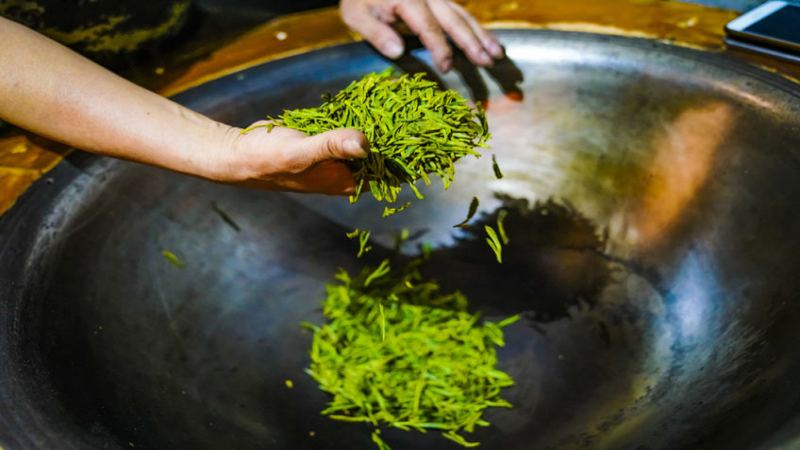
First, when the wok temperature rises to 200°C, the tea leaves are added to begin firing. After stirring for 2 to 3 minutes, the tea leaves emit a grassy odor, which then gradually disappears and turns into a pleasant fragrance.
Because the firing process involves localized high-temperature treatment, it generates more volatile compounds compared to conventional drying methods. These volatile compounds are the source of the "rich aroma," and the unique fragrance of Lapsang Souchong would be impossible without the pan-firing step.
Re-rolling — Second Rolling While the tea leaves are still warm after pan-firing, a second rolling is immediately carried out. Through vigorous rolling and pressing, tea juice exudes and adheres to and condenses on the surface of the tea leaves. This thin film formed by the tea juice allows the pine wood essential oil components to be better absorbed by the tea leaves during the subsequent drying stage. In addition, when brewed, the essence layer on the surface of the tea leaves dissolves in hot water, helping to enhance the concentration of flavor (i.e., increasing the total amount of soluble components in the tea liquor).
Smoke Roasting — Slow Drying over a Gentle Fire In China, whether for green tea, black tea, or yellow tea, the drying of high-grade teas generally uses a bamboo implement called a "baking cage." The bamboo cage is placed over a burning wood fire, and the tea leaves are spread on the cage to complete the drying.
Lapsang Souchong is no exception and also uses a baking cage for drying.
However, there are two key differences that give it its unique dried longan and smoky aromas.
First, the fuel used for drying is burning pine wood. The essential oils from the pine wood penetrate the tea leaves, imparting their signature aroma.
Second, while other high-grade teas use what is called "open fire" — a fierce flame — for drying, Lapsang Souchong uses "gentle fire," meaning a weak, low-burning flame. In practice, a large fire is first used to reduce the tea's moisture content to about 20%, after which the fire is lowered as much as possible, and slow drying over a gentle fire continues until the moisture drops below 5%.
An overly strong flame would destroy the essential oil components. The weak flame produced by the gentle fire causes the pine wood essential oil components to volatilize mildly and then be absorbed by the tea leaves, thereby forming the distinctive fragrance.
After 8 to 10 hours of drying, not only is the aroma fixed, but the moisture in the tea leaves is also completely evaporated.
During the slow drying over a gentle fire, the amber-colored essential oil components of the pine wood penetrate the tea leaves, giving the leaves their distinctive black-red color.
There is a saying that the dried longan-like aroma originates from the tea variety (Souchong), but this is merely folk legend.
Zhenghe Souchong, a sub-variety of Xingcun Souchong, is used not only for Lapsang Souchong but also in the production of Keemun black tea. However, only the Luohan pine (i.e., the pine wood used for Lapsang Souchong) can bring about the dried longan-like aroma, and Keemun black tea does not possess the same aroma profile.
The above content is compiled by CoffeeHunters, a coffee news website.


