







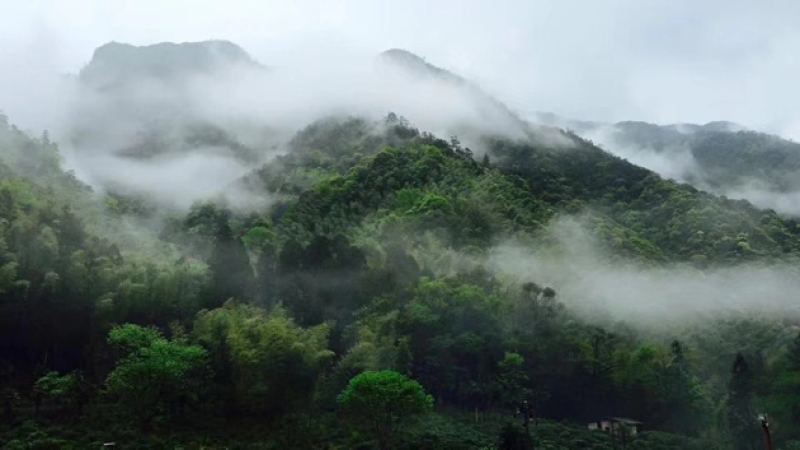
Where Does the Story Behind Souchong Black Tea Begin?
Authentic Lapsang Souchong comes from Tongmu Village in Xingcun Town, Wuyi, and is recognized as the world's earliest black tea. It carries a pine smoke aroma and a sweet dried longan note. Market names such as Waishan Souchong, Smoked Souchong, Xingcun Souchong and Tongmu Souchong are frequently confused but do not all describe the same tea.
The Souchong name was documented by 1734, and the tea was traded by Dutch merchants from around 1604, first as a high-priced medicine. As a parallel, the question of where does coffee originate from points to Ethiopian highlands and the Congo Basin, showing how origin and trade history define a drink's identity.
Lapsang Souchong is widely recognized as the world's earliest black tea. With its distinctive pine smoke aroma and sweet, dried longan-like fruity notes, it profoundly influenced the historical course of European tea culture. However, names related to "Souchong" abound on the market—Wai Shan Souchong, Smoked Souchong, Xingcun Souchong, Tongmu Souchong. Are they actually the same tea? And how should one distinguish authentic Lapsang Souchong from Wai Shan Souchong? This article will examine these easily confused concepts from three dimensions—historical origins, production area classification, and naming evolution—to restore the true identity of Lapsang Souchong, while also introducing you to the unique flavors of the core production area in Tongmu Village, Wuyi.
【Lapsang Souchong】 As the acknowledged ancestor of black tea, how many people have truly experienced the charm of Lapsang Souchong? Have you ever been deterred by its heavy smoky aroma? Looking back at history, was it this very smoky black tea that once captivated Princess Catherine at first encounter?
Authentic Lapsang Souchong possesses an extremely rich dried longan aroma. That sweet, exotic fruity fragrance is completely unlike what is conventionally associated with tea—and it was precisely this that sparked a wave of change in European tea culture.
In search of genuine Lapsang Souchong, we traveled to China multiple times. What we ultimately found was the authentic product from Tongmu Village in Xingcun Town—now nearly impossible to purchase on the market.
It was once highly prized as an imperial tea, continuing the same Lapsang Souchong flavor as in days past. Whether enjoyed plain, blended, or made into milk tea, the choice is left to the drinker.
Why is Lapsang Souchong made as a black tea using the fresh leaves of Wuyi rock tea tea trees?
The name Wuyi rock tea originates from Wuyi Mountain. The local native wild variety is called "Xiao-zhong" (small variety), which serves as the raw material for producing high-quality Wuyi rock tea (oolong tea). According to documented records, the name "Suchong" had already appeared by 1734.
Note: Wuyi rock tea is a representative category of Chinese oolong tea, and it continues to produce various famous teas to this day.
Around 1604, Lapsang Souchong was traded by Dutch merchants as a high-priced medicine, and they once monopolized the European tea trade. In 1669, England imported Lapsang Souchong on a commercial scale for the first time. As trade was exclusively controlled by the East India Company, tea as an expensive beverage circulated mainly in the English royal court.
In 1662, Charles II married Princess Catherine of Portugal, who brought her most beloved Lapsang Souchong from her homeland. It was her enthusiasm for this tea that propelled its rapid rise in popularity in England. Thereafter, Lapsang Souchong, as a luxury beverage representing China, remained favored by the British royal family for a long time.
Why is Lapsang Souchong made as a black tea using the fresh leaves of Wuyi rock tea tea trees?
During the Qing Dynasty (1850–1864), China's domestic situation was turbulent. As troops advanced toward Xingcun Town, they were stationed in tea factories. In Xingcun Town, a large number of farmers made their living by cultivating and processing oolong tea, and thus tea houses were everywhere.
At that time, farmers followed the process of natural withering → shaking (semi-fermentation) → rolling, with the drying step completed at tea houses in the town. After the troops broke in, the tea house workers abandoned the tea and fled into the mountains, leaving behind moist, undried tea leaves in the bags.
After the troops withdrew, people returned to find that the tea had turned dark brown and emitted a unique aroma. (Tea left in a warm, humid environment gradually oxidizes and browns.) However, the tea house workers could not dry it immediately. That day, farmers continued to deliver fresh tea leaves, and the drying equipment simply could not keep up.
Unwilling to waste the tea, people resorted to pan-firing while burning pine wood to raise the indoor temperature and shorten drying time. In this region, pine was the most common firewood.
In the end, the tea absorbed the smoke aroma and the fragrance of pine oils, and the finished product gave off an unprecedentedly wonderful aroma—truly a groundbreaking tea.
When this tea was promoted in Fuzhou, it caught the attention of foreign traders. It subsequently caused a great sensation in Europe as well, ultimately becoming a tribute tea for the British royal family, with its popularity continuing to climb.
At the time, those encountering black tea for the first time were astonished by the dark glossy appearance of Lapsang tea and called it "Wu-Cha" (black tea). This is precisely the origin of the English name Black Tea. Additionally, because the liquor turns reddish after brewing, it is called red tea (hongcha) in China. Japan also adopted this naming convention.
However, in the production area, this black tea used fresh leaves from the Xiao-zhong tea tree, and was therefore called Souchong black tea. At the time, Fujianese people—who were engaged in tea production and trade and conversant in Minnan dialect—first promoted Souchong black tea in Fuzhou (the main trading port of Fujian Province), calling it Suchong. Because it was produced in the Tongmu area, it was also called Tongmu Souchong; and since Xingcun Town was the tea distribution center, the name Xingcun Souchong was derived as well.
However, as Souchong black tea rose to fame, some people brought "aged tea" or "tea made from other varieties" to Xingcun Town and, through reprocessing, imparted a "smoke aroma" to it, selling inferior tea under the name of Souchong black tea. These teas had only smoke flavor and poor quality, and were therefore called Smoked Souchong. "Smoked" means smoke-cured.
Meanwhile, similar black tea production emerged in other regions. To distinguish their products, makers of high-quality Souchong black tea called their own tea Nei Shan Souchong (Inner Mountain Souchong), as Tongmu Village is located in the deepest part of Wuyi Mountain—that is, in the direction of "within the mountains."
During the Qing Dynasty, in Fujian dialect (Minnan), "inner" was pronounced as Lap, so Nei Shan Souchong was also called Lapsang Souchong. Tea produced in other regions was called Wai Shan Souchong (Outer Mountain Souchong).
Producers of genuine Nei Shan Souchong, in order to distinguish their "true tea" from other products, replaced the character "inner" (nei) with the character "authentic" (zheng). In other words, Nei Shan Souchong evolved into Zheng Shan Souchong (Authentic Mountain Souchong).
Thus was born the name Lapsang Souchong.
The above content is compiled by CoffeeHunters, a coffee news website.


