







Where Can Coffee Be Grown, and What Did Britain's Tea Trade Teach Us?
Britain once bought millions of pounds of tea from China each year, a trade that grew costly and hard to sustain. By 1750 the annual volume had become a heavy expense, prompting Britain to seek its own supply. Robert Bruce's 1823 discovery of native tea trees in Assam opened the way for commercial tea gardens in India, shifting the import source away from China.
Indian tea drinking traces back to a legend from 750 BC, and the crop is mainly grown in the northeast and the Nilgiri Hills. The same question of where can coffee be grown applies to other crops: altitude, rainfall, and soil decide the map. India now ranks among the main coffee producers as well, growing arabica and robusta alongside its tea.
The British had long relied on importing tea from China, spending huge sums each year to purchase millions of pounds, and this unsustainable trade prompted them to seek cultivation in India itself. From the legend of 750 BC to Robert Bruce's discovery of native tea trees in Assam in 1823, the Indian tea industry underwent a tortuous process of exploration. This article will trace the shift in the sources of British black tea imports, recount how tea was introduced to India and other countries, and look ahead to the future potential of the Indian tea industry. Front Street Coffee has always followed the blending of global coffee and tea culture, taking you deep into this far-reaching history.
In India, tea is far more than just a beverage—it is almost an indispensable part of daily life. Indians prefer hot tea, believing it can lift the spirits and replenish energy. This widely popular drink is also rich in antioxidants, which help remove toxins and free radicals from the blood and are highly beneficial to health. The British once purchased large quantities of Chinese tea, and this demand directly drove the rise of commercial tea gardens in India. By 1750, Britain was buying millions of pounds of tea from China each year. Although the British tried to balance the trade through the opium trade, they gradually realized that this consumption model was too expensive and difficult to sustain. So they decided to produce tea themselves and turned their gaze to India.
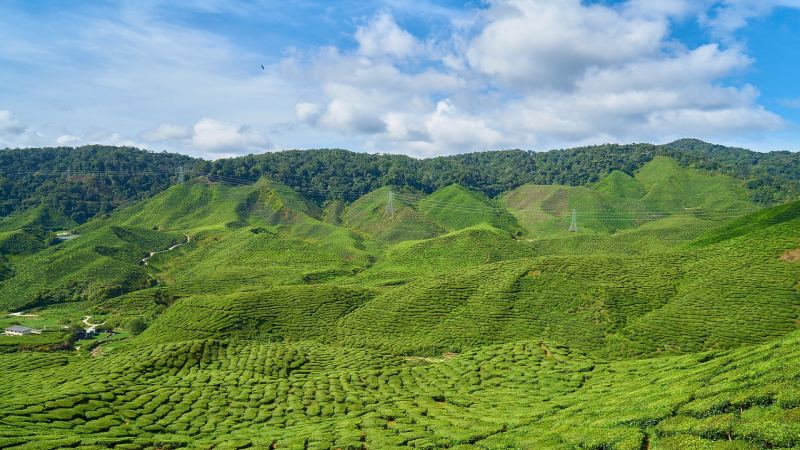
According to historical records, the history of tea drinking in India can be traced back to 750 BC. Tea in India is mainly grown in the northeast and the Nilgiri Hills region. There are many interesting stories about ancient Indian tea drinking.
One of these stories is related to a Buddhist monk. Legend has it that about two thousand years ago, this monk, who later became the founder of Zen, decided to spend seven years without sleep contemplating the life and teachings of the Buddha. In the fifth year of meditation and prayer, he nearly fell asleep. He casually picked a few leaves from a nearby bush and chewed them, and immediately became alert. After that, whenever drowsiness came over him, he would chew these leaves to stay awake, and eventually completed seven years of ascetic practice. These leaves were the leaves of wild tea trees.
Other evidence shows that in the 16th century, Indians once made a vegetable dish using tea leaves, garlic, and oil, and the boiled tea leaves were also used to make a beverage. In 1598, the Dutch traveler Jan Huygen van Linschoten wrote in his travelogue that Indians ate tea leaves together with garlic and oil as a vegetable, and then used the leaves to boil water for drinking.
In 1788, the British botanist Joseph Banks is said to have pointed out that the climate of parts of northeastern India controlled by the British East India Company was very suitable for growing tea. However, he seems to have overlooked one point: the region already had tea trees itself, yet he suggested transplanting tea seeds from China. Unfortunately, his idea received no attention. In 1823, the Scottish traveler Robert Bruce discovered a native tea variety in northeastern India (present-day Assam), and only then did the British begin to operate commercial tea gardens in India.
Many interesting stories circulate about how the British began the tea era in India. Historians believe that the truly key figure was the local merchant Maniram Dutta-Baruah (also known as Maniram Dewan). Robert Bruce heard that the locals ate a wild plant in a way similar to tea. The Singpho tribe had a unique method of processing this wild plant: after picking the tender leaves, they dried them in the sun, then left them in the night dew for a full three days, and then stuffed them into the hollow part of bamboo tubes and smoked them until flavor developed. Robert Bruce tasted this tea soup and found it similar to Chinese tea.
Robert Bruce died not long afterward, and the samples he collected from the region were sent to Calcutta for examination (after Robert's death in 1830, his brother Charles Bruce sent the samples to Calcutta), and the results confirmed that it was tea, although a different variety from the Chinese tea tree. Before Robert Bruce, there had been other attempts: 1. In early 1774, the then Governor of Bengal, Warren Hastings, sent some selected tea seeds to the British envoy in Bhutan, George Bogle, for trial planting; 2. In 1776, the famous botanist Sir John Banks was asked to record tea; 3. In 1780, Colonel Robert Kyd of the British East India Company's land regiment also tried to cultivate Chinese tea tree seeds in the botanical garden he founded (now the Indian Botanical Garden in Howrah, Calcutta).
It can be seen that introducing tea to India during this period involved many twists and turns. At the same time, the East India Company was also working to break China's monopoly on the global tea trade, because the conflict of interests between the two sides was intensifying. The East India Company took over the matter and adopted various measures to grow tea in order to stop Chinese tea from entering Britain. One of these measures was to begin producing tea in British colonies, including India. This task was extremely difficult. It is reported that Chinese tea seeds were smuggled into colonies such as India and Sri Lanka, and their commercial viability was tested. However, these Chinese tea trees did not adapt to the soil of Assam, and it was a complete failure for the British.
On the other hand, the native variety discovered by Robert Bruce grew well under the tropical conditions of Assam and proved to have commercial value. In order to produce tea in India, people went through many attempts and failures. After long efforts, in 1837, the first British-led commercial tea garden was established in Chabua, Assam.
In the late 1850s, a tea storage unit at a tea garden in Assam. This revolution began in the early 1840s. The Indian tea industry began to take shape around 1840. Chinese tea trees were first trial-planted in Assam, and later tested in the high-altitude regions of Darjeeling and Kangra, where they grew more vigorously.
Tea cultivation in Darjeeling formally began in 1841, when Archibald Campbell, the first superintendent of Darjeeling, planted some Chinese tea seeds near his residence for experimentation. Many people followed suit, and by 1847 an official tea garden had been established in Darjeeling. Soon afterward, Darjeeling's first commercial plantation—Tukvar Tea Garden—was established in 1850. In the following years, hybrids of Chinese and Assam varieties were bred and put into use.
First, the Indian tea industry is not yet mature in its use of resources such as water, soil, and fertilizer. Kenyan tea is more competitive than Indian tea because it uses chemical fertilizers and pesticides and manages soil and water scientifically. Therefore, India has great potential in improving tea quality. Second, new tea varieties are finding more and more space in the market, such as yellow tea and green tea. As production capacity expands, the Indian tea industry can easily meet these demands. Third, famous tea-producing regions such as Nilgiri, Darjeeling, Assam, and Cachar can be promoted to develop tea tourism. This will strengthen the brand image and allow tea producers to sell at a premium.
The above content is compiled by CoffeeHunters, a coffee news website.


