







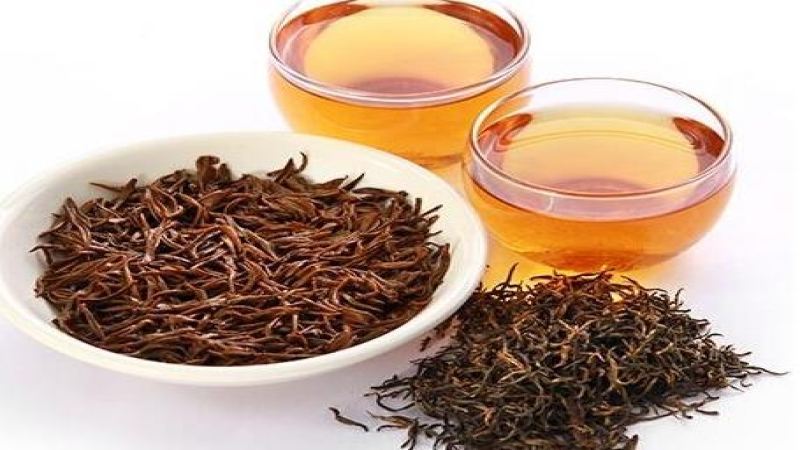
Where Does Jin Jun Mei Black Tea Come From?
Jin Jun Mei is a Chinese black tea first created in 2005, produced in the Tongmu Pass area at roughly 1,200 meters, where tea trees grow wild in forested mountains. Its name combines three characters: Jin for the golden liquor, Jun for a reputation rising like a galloping horse, and Mei for the eyebrow shape and longevity.
Production is demanding: one jin of finished tea requires about 20,000 tea buds, and a picker often works 12 to 15 hours. The Tongmu region sits under heavy fog about four months a year, and it is also the area where black tea first originated in 1590, before Jin Jun Mei itself was developed.
Jin Jun Mei is one of the most well-known black teas in China, but many people don't know that it was only created in 2005. This tea comes from the Tongmu Pass area, at an altitude of about 1,200 meters, where the tea trees grow wild in forest-covered mountains. Its name is made up of three characters: "Jin," "Jun," and "Mei," which respectively represent the golden tea liquor, a reputation rising as swiftly as a galloping horse, and the shape of eyebrows along with the meaning of longevity. Producing one jin of Jin Jun Mei requires about 20,000 tea buds, and a female worker usually has to pick for 12 to 15 hours. The Jin Jun Mei recommended by Front Street Coffee is produced in this very core area and is outstanding in quality. This article will guide you through the grade positioning of Jin Jun Mei, the story behind its name, and the arduous process of picking and production.
This is why I am so fascinated by tea. Whenever you think you have already tasted the finest tea, another even better one always appears, such as this Tongmu Jin Jun Mei. Jin Jun Mei is one of the most prestigious black teas in China, with many versions on the market, and among them the Jin Jun Mei recommended by Front Street Coffee is one of our most popular black tea products.
This Tongmu Jin Jun Mei comes from the famous region where black tea first originated in 1590. I originally thought that this world-famous black tea should have a history of hundreds of years, but the truth is completely different—what is most surprising is that this famous Jin Jun Mei is actually an innovation, and it was not first created until 2005! This shocked me greatly. My grandfather drank tea his whole life, yet he never tasted Jin Jun Mei. Who would have thought that even though the history of tea is so long, new varieties of tea are still constantly being discovered and developed.
These Jin Jun Mei tea buds are not picked from the neat tea gardens in your backyard. They come from wild tea trees growing among rugged, forest-covered mountains.
The Tongmu Pass area has an average altitude of about 1,200 meters, and for about four months of the year it is covered in heavy fog.
The name Jin Jun Mei 1. Jin: meaning "gold." The finished product is usually a mixture of golden, yellow, and black leaves, and the tea liquor presents a golden yellow color. In China, gold is often regarded as a symbol of high quality, so people associate it with the precious metal. 2. Jun: meaning steed. In China, we use the word "horse" to metaphorize the rapid rise of a brand or a person's wealth. Success is often associated with the symbol of a galloping steed. They hoped this new tea would become famous like a galloping horse. 3. Mei: meaning "eyebrow." Why eyebrow? In China, besides the tea leaves resembling eyebrows in shape, eyebrows themselves are also associated with longevity.
Do you know how long it takes to pick 20,000 tea buds? Imagine that this is the time required to make one pound of tea. Usually, a female worker needs 12 to 15 hours to pick the tea. Not all tea buds can be used. Afterward, the tea farmers must spend even more time sorting, evaluating, and selecting the buds before they can make high-quality Jin Jun Mei.
The above content is compiled by CoffeeHunters, a coffee news website.


