







Where Does Coffee Originate From and Why Does It Matter?
Coffee originated in Ethiopia, where the Coffea plant grew wild in the forests of the Kaffa region. From there it spread to Yemen and the Arabian Peninsula, then to Europe, Asia, and the Americas. The drink's journey explains why brewing methods differ so widely, from espresso in Italy to the gongfu-style tea brewing that some coffee drinkers now explore.
This article focuses on Chaoshan Gongfu tea, a traditional brewing technique from Chaozhou, Guangdong, not a coffee origin story. It uses oolong tea, especially Phoenix Dancong, with short infusions of 3 to 10 seconds. The method has three regional styles: Chaoshan, Fujian, and Taiwan.
Chaoshan Gongfu tea is not a specific type of tea, but a traditional brewing technique originating from Chaozhou, Guangdong. Oolong tea is the most commonly used, and it is especially suitable for brewing Phoenix Dancong. It emphasizes short, repeated infusions, with each steep lasting only 3 to 10 seconds, allowing the tea leaves to gradually unfurl and release layered aromas and flavors. Gongfu tea has developed into three styles: Chaoshan, Fujian, and Taiwan. Among them, the Chaoshan style uses a tea boat, a gaiwan or clay pot, and three teacups arranged in a triangular formation, symbolizing the Chinese character "pin." This article will also introduce how to brew Phoenix Dancong with a gaiwan and recommend related products from the Front Street brand, helping coffee lovers experience the subtlety of tea culture across boundaries.
What Exactly Does Gongfu Tea Mean?
In short, Gongfu tea is a uniquely distinctive brewing technique in Chinese tea culture. As the name suggests, to brew Gongfu tea well, one must put in "gongfu," that is, master skill; like traditional martial arts gongfu, it also emphasizes a spiritual level of commitment. Compared with clay pots, gaiwans are more common in the Chaoshan region, and this brewing method originated in Chaozhou, Guangdong. Gongfu tea is suitable for any pure tea, but it is most famous for brewing oolong tea.
How Is It Different from Other Brewing Methods?
Once you try it, you will feel as if you have stepped into a whole new world of tea and experienced flavors like never before! First, when brewing tea this way, the duration of each infusion is usually controlled between 3 and 10 seconds. This not only prevents the tea leaves from being exhausted too quickly, but also gives them room to recover after each infusion. At the same time, the leaves are able to slowly unfurl, presenting ever-changing aromas and tastes as the number of infusions increases. As a result, the drinker can perceive the taste and fragrance of the tea more comprehensively and delicately. Although compared with English-style large-pot brewing, the yield of a single pour in Gongfu tea is not large, it is precisely by using these brief moments to savor the tea that one reaches an almost meditative mental state. Second, because the steeping time is short, the tea leaves have room to recover, and except for green tea, most tea types, such as oolong, white, pu'er, and black tea, can be brewed at least six times. Gongfu tea is not merely a unique brewing method, but also a cultural and mindful experience.
What Is the Gongfu Tea Ceremony?
Many people are familiar with the Japanese matcha ceremony, but may not necessarily understand the Chinese Gongfu tea ceremony. Today, Gongfu tea is mainly divided into three styles. The "Chaoshan style" mentioned earlier belongs to Chaozhou, the second is Fujian's, and the third is Taiwan's. Each has its own minor details that make them slightly different from one another, but in essence they are the same. Below we explain them one by one.
Chaoshan Gongfu Tea Style
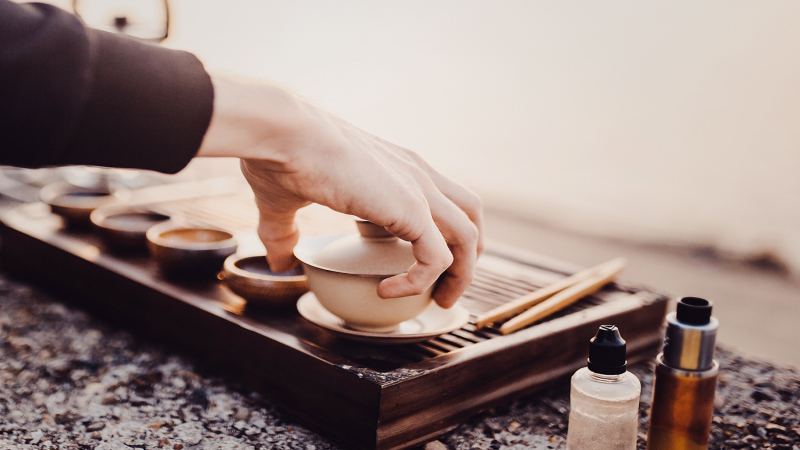
The traditional Chaoshan Gongfu tea set includes a "tea boat," a "ji'ou" (similar to a gaiwan, but smaller in size and fixed) or a clay pot fired from a specific local clay (different from a Yixing purple clay teapot), and three teacups (also of a fixed size). The three teacups are usually arranged in a pyramid shape, symbolizing the Chinese character "pin," meaning to taste. The most difficult part is pouring the tea liquor directly from the gaiwan evenly into the three cups, so that each portion is equal and the concentration is the same. This is exactly where "gongfu" is required. If you travel to Chaozhou, you may even see such tea sets in local hotels, because from the perspective of cultural heritage, this style is still widely used and highly recognized by local people. The local Phoenix Dancong oolong tea is mainly brewed in this way, and this is another local cultural calling card.
How to Brew Phoenix Dancong with a Gaiwan?
For Phoenix Dancong, the Front Street brand recommends a white porcelain gaiwan with a capacity of about 120 ml. The amount of tea used is about 7 to 8 grams, and the tea-to-water ratio can be controlled at around 1:15. Be sure to use boiling water at 100°C to bring out the high aroma of Dancong. Before brewing, first rinse the bowl and warm the cups with boiling water, then add the dry tea and gently shake the gaiwan to smell the aroma. After pouring water for the first infusion, pour it out quickly, in about 3 to 5 seconds; afterward, each infusion can be gradually extended by 2 to 3 seconds. Front Street's Phoenix Dancong series, such as Duck Shit Aroma and Honey Orchid Aroma, are all suitable for this brewing method and can fully display their floral fragrance and mountain charm. Note that after each infusion, the tea liquor should be drained completely to avoid affecting the taste of the next infusion.
The above content is compiled by CoffeeHunters, a coffee news website.


