







What makes Geisha coffee beans from Sidamo taste different?
Geisha coffee beans from Ethiopia's Hambela sub-region in Sidamo have drawn wide attention since Luckin Coffee promoted the series, and each annual batch brings flavor changes. The 2017 TOH championship put the variety on the map, and the arrival of Geisha 7.0 continues that yearly shift in the cup.
Sidamo's red volcanic soil and local heirloom varieties give the region its range, and Hambela sits at high altitude. Comparing Huakui 6.0 with 7.0 comes down to how each lot is roasted and brewed; a medium-light roast with V60 three-pour parameters supports the strawberry-cream character the beans are known for.
As a representative of Ethiopian natural beans, Geisha coffee has attracted much attention in recent years due to Luckin Coffee's promotion. From winning the TOH championship in 2017 to the current arrival of Geisha 7.0 at port, the flavor changes of each new batch each year tug at people's hearts. This article reviews Geisha's production region background and the origin of its name, compares the differences between Geisha 6.0 and 7.0, and introduces the Geisha 5.0 and Small-Bean Geisha currently sold by Front Street Coffee. It also shares medium-light roasting ideas and V60 three-pour brewing parameters to help enthusiasts understand this coffee bean with a prominent strawberry-cream flavor.
For friends just getting into specialty coffee, the origin they remember first is usually Ethiopia. Among them, two beans appear extremely often on pour-over menus: washed Yirgacheffe and natural Sidamo.
There are really too many good beans in Ethiopia. These two categories alone are enough to make customers choosing beans at FrontStreet Coffee agonize for quite a while. When Front Street's baristas encounter this situation, they usually first ask: would you like a crisp mouthfeel, or something leaning toward a juicy feel?
If the customer answers that they want coffee that drinks like juice, Front Street will recommend Geisha. Recently, Luckin Coffee launched the Geisha 5.0 series, which has made many people who previously did not drink specialty coffee become interested in this bean. Next, Front Street will talk about information related to Geisha coffee.
Geisha is produced in the Hambela sub-region under the Sidamo production area. Sidamo is located in southern Ethiopia, with rich soil types including fertile red volcanic soil, and diverse coffee varieties, usually labeled as local heirloom varieties. These conditions together create the diversity of Sidamo coffee flavors.
Relying on its superior growing environment, coffee beans from the Sidamo production area frequently appear on the list at the Taste of Harvest (TOH) in East Africa. The washed group champion of the 2020 TOH competition came from the Guji production area of Sidamo, and Front Street's bean list also includes this one as an option.
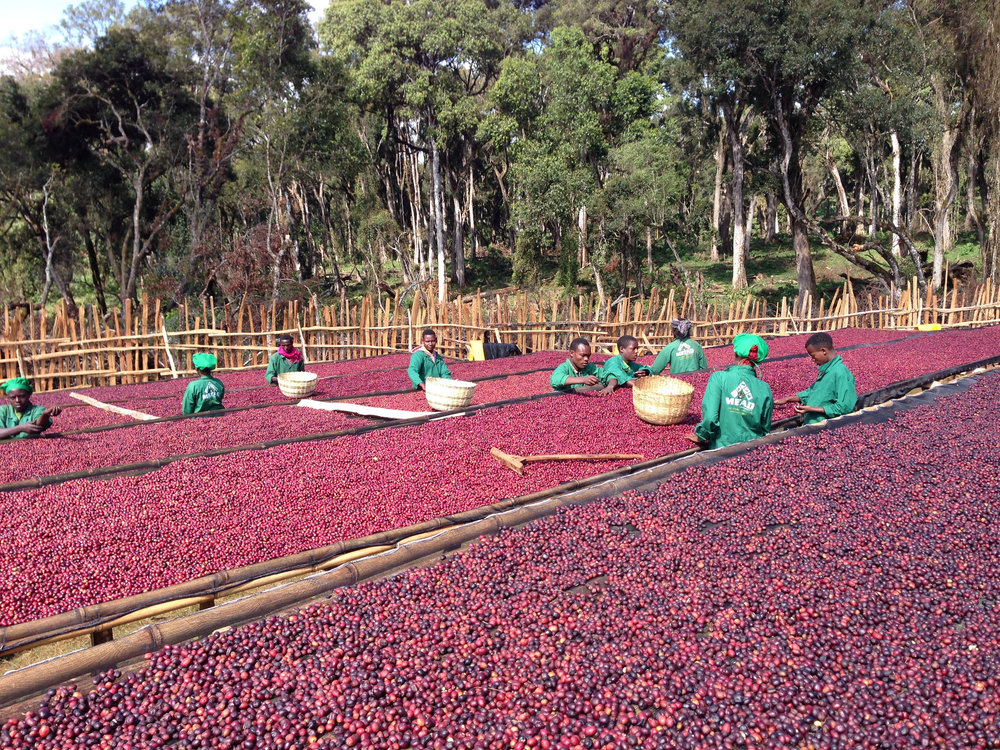
The natural Sidamo that Front Street is introducing this time comes from the Hambela sub-region. This is the highest-altitude coffee farm in Ethiopia, separated from Kochere in the Yirgacheffe production area by only one mountain. Hambela is actually a coffee farm belonging to the well-known local METAD Agricultural Development PLC. It is both an independent farm and the main processing station for the surrounding growing area, responsible for processing nearby coffee and selling it as separate lots.

Hambela Farm covers 200 hectares and is about 75 kilometers from Yirgacheffe. Located in Ethiopia's core coffee belt, the processing station's equipment, management, and scale are all quite professional. Fertile volcanic soil, natural organic farming, and relatively mature post-processing methods have together contributed to this sub-region's surge in popularity in recent years. Geisha coffee beans are produced at a processing station near Buku village in the Hambela production area, namely the "Buku Abel processing station." Local coffee farmers plant bananas and other cash crops around the coffee trees, and the fallen branches and leaves rot to become natural fertilizer for the coffee trees.
Since Geisha comes from the Hambela sub-region, why is it not called Hambela coffee beans? This goes back to 2017. At that time, DW Company sent the natural beans processed at Buku Abel to compete in the TOH competition. Their rich strawberry-cream flavor impressed the international judges and won the championship in the natural group of that year's TOH Ethiopia region. After Beijing green bean merchant Hongshun obtained the same batch of champion beans, they were shocked by this wild berry-cream flavor and decided to name it "Geisha," meaning the foremost among a hundred flowers, placing high hopes on this bean. In the same year, at the World Coffee Brewing Championship China competition, the Gesha variety swept the field, but contestant Li Jianfei used the same batch of Geisha to win second place, and Geisha thus became famous.
Friends who pay attention to Geisha will notice that the name of Geisha is different every year, and the number after "Geisha" increases year by year. The naming method is "Geisha X.0." 2018 was Geisha 2.0, and 2021 was naturally Geisha 5.0. The 2022 beans were named Geisha 6.0; on April 17, 2023, the first batch of Geisha 7.0 arrived at Shanghai port, and it was expected that the latest harvest season could be tasted in late April.
Like everyone else, Front Street really wants to know how the flavors of Geisha 6.0 differ from Geisha 5.0 and even the award-winning batch from back then. However, the beans from the latest harvest season are still being processed at origin and are expected to arrive at port in April 2022. Front Street has already reserved a batch as soon as possible. Once the new-season Geisha arrives, Front Street will launch this deeply loved bean.
For now, everyone can only first taste the only two Geisha options on Front Street's bean list: Geisha 5.0 and Small-Bean Geisha.
Some people may be curious about the difference between Small-Bean Geisha and Geisha 5.0. In fact, as early as 2017, FrontStreet Coffee noticed that there were some small-particle beans among the Geisha. In the Geisha of the following two years, Front Street also found similar small particles. Later, through cupping, it was confirmed that these small particles were precisely the source of Geisha's aroma. In 2020, DW Company's Buku Abel processing plant processed these small-particle beans separately, distinguishing them as the product Small-Bean Geisha.
Front Street cupped Geisha 5.0 and Small-Bean Geisha, both from the 2021 harvest season, and found that Geisha 5.0's flavor was closer to the Guji production area: faint floral notes, integrated berry acidity, and a full juicy feel. Small-Bean Geisha was closer to the 2017 award-winning batch: obvious strawberry flavor, a full and solid juicy mouthfeel, and a long creamy finish.
Front Street's roasters use medium-light roasting for both Geisha coffees to retain more high-quality acidity and make the mouthfeel brighter. For brewing, Front Street recommends using a Hario V60 dripper, 91 degrees Celsius water temperature, and medium-fine grinding.
Dripper: Hario V60
Water temperature: 91 degrees Celsius
Dose: 15 grams
Coffee-to-water ratio: 1:15
Grind level: 80% passing through a China standard No. 20 sieve
Front Street mostly uses a three-pour method when brewing to increase layering. First pour 30 grams of hot water and let it bloom for 30 seconds, then slowly pour in a small stream in circles from the center point to 125 grams as the first stage; when the water level in the dripper is about to expose the coffee bed, continue pouring in circles to 225 grams. The total extraction time is about 2 minutes.
For more coffee bean information, please follow Coffee Workshop (WeChat public account cafe_style) For professional coffee knowledge exchange, please add WeChat ID kaixinguoguo0925
The above content is compiled by CoffeeHunters, a coffee news website.


