







How Do SCAA and COE Coffee Certification Systems Differ?
SCAA and COE are separate systems that often get grouped together. SCAA, now part of the Specialty Coffee Association after a 2017 merger with SCAE, sets industry-wide standards for green bean grading, cupping protocols, water quality, and extraction. The Cup of Excellence (COE) is a competition that selects top green coffees through juried cupping. Neither is the same as SOE coffee, which simply means single-origin espresso.
The Coffee Quality Institute split from SCAA in 1996 and runs the Q Program, which certifies Q-Graders who evaluate coffee quality. CQI's executive director, Ted Lingle, helped found SCAA and created the earlier flavor wheel. COE scoring and SCAA cupping sheets use different criteria, so a high COE rank reflects competition placement, not an SCA score, and SOE coffee refers to how beans are served.
In the world of specialty coffee, SCAA and COE are two authoritative systems that cannot be bypassed. The former established industry standards and cupping protocols, while the latter selects top-grade green beans through rigorous competitions. What are the differences in their scoring logic? Why are COE and SOE often confused? This article will sort out the development trajectories and operating mechanisms of SCAA, CQI, and COE, explain in detail the differences in cupping score sheets, and use the example of the 22nd-place sun-dried Typica that Front Street Coffee bid for in Ethiopia's first COE competition in 2020 to present the complete story from origin to cup.
In the coffee field, what do SCAA and COE each mean? What differences exist between them? If you want to taste top-level coffee, it is necessary to first understand today's most internationally renowned and credible specialty coffee competition systems.
For those entering the coffee industry, the first authoritative institution they often encounter is SCAA (Specialty Coffee Association of America), the American specialty coffee association. In 2017, this organization completed a merger with SCAE (Specialty Coffee Association of Europe), forming SCA (Specialty Coffee Association), and一跃 became the world's largest and most influential industry organization. SCA is a non-profit membership-based institution dedicated to spreading coffee knowledge and promoting education. It has established many standards and norms followed by most practitioners worldwide, covering green bean grading, cupping procedures, water quality requirements, and golden cup extraction guidelines.
When it comes to coffee quality evaluation, another institution that must be mentioned is CQI (Coffee Quality Institute). In 1996, SCAA established a special committee to resolve the contradiction between coffee quality and coffee farmers' income. This committee later evolved into the Specialty Coffee Institute and eventually became independent from SCAA, becoming today's CQI. At present, the two institutions still maintain a close cooperative relationship. CQI's current executive director, Ted Lingle, is one of the founders of SCAA and the creator of the old flavor wheel. He also served as SCAA's executive director in his early years. CQI's importance lies in its development of an evaluator certification system—the Q Program—specifically for training coffee quality assessment professionals. After completing CQI's courses and passing the assessments, students can obtain coffee evaluator qualifications, commonly known as Q-Grader. The value of this training lies in enabling evaluators worldwide to describe coffee quality through a common language, thereby exchanging views more efficiently. When conducting evaluations, Q-Graders follow SCA's standard cupping procedures.
CQI's scoring target is green bean quality, so the first step is screening based on the appearance of green beans. Once defective beans are found, points are deducted or the beans are eliminated according to the type and number of defects. If you wish to apply for CQI certification for your green coffee beans, you can send samples to the ICP (In-Country Partner) in your region. The ICP will convene three evaluators with Q-GRADER qualifications to score the green beans. If the green beans reach specialty level (above 80 points), CQI will issue certification and include the green bean information on its official website; if they fail to meet the standard, a technical report will be sent back.
What is COE
If the wine world has the AOC rating, the coffee world's equivalent is the COE rating. We often hear that a certain bean is COE grade or comes from a COE competition estate. At present, specialty coffee competitions in various countries either adopt the CoE model or the SCAA model, and as many as 10 major coffee-producing countries use CoE cupping as the template for their national competitions.
When coffee packaging bears the words "CoE competition bean," it means the bean has undergone multiple rounds of selection in the CoE competition. CoE stands for Cup of Excellence, often translated into Chinese as "卓越杯," and is a coffee rating competition with extremely high international prestige.
The CoE competition consists of 6 rounds, with two groups of experienced and highly professional judges responsible for evaluation. If defective flavors are tasted in any round, the coffee is immediately eliminated. Competing coffees must score above 86 to advance to the next round, and must pass through three stages in sequence: PreSelection, National Jury week, and International Jury week. Only coffees scoring above 87 and ranking in the top 30 are eligible to participate in the CoE auction.
The national jury is composed of local cuppers in the producing country and is responsible for scoring preselected coffees. Coffees that pass the screening enter the next week's evaluation, where the national jury conducts two more rounds of screening. The latter three rounds are mainly handled by the international jury, which consists of importers, buyers, and cuppers from coffee-consuming countries. In the final three rounds of cupping, two national jurors join the international jury for joint evaluation. The coffees that ultimately win will receive the Cup of Excellence award and be eligible to participate in the auction.
It can thus be seen that coffee beans bearing the CoE mark have undergone multiple rounds of rigorous screening, must rank at least in the top 30 to enter the auction stage, and must score at least 87 points.
Overall, with an international jury of cuppers, coffee farmers must participate in at least 5 cupping evaluations during the three-week competition period, and the top 10 winning coffees will undergo one more round. For coffee farmers selected as COE winners, in addition to gaining recognition for their coffee quality, the greatest reward is the considerable income brought by the auction. Good auction returns give coffee farmers more means to improve quality, and consumers thereby have more opportunities to drink good coffee, forming a virtuous cycle.
The difference between COE and SOE
Friends often confuse the abbreviations COE coffee and SOE coffee. In fact, apart from similar abbreviations, the two are completely unrelated. COE, as introduced above by Front Street, is the abbreviation of the internationally renowned green bean competition "Cup of Excellence." COE coffee beans refer to coffee beans that placed in the COE competition and were sold through auction. SOE stands for "Single Origin Espresso." SOE coffee beans refer to single-origin coffee beans used to make espresso.
This concept follows the trend of specialty coffee. In the espresso field, there has been a rising trend of using single-origin coffee beans to make espresso in pursuit of better quality and more distinctive origin flavors. So do not confuse SOE with COE.
The scoring standards of SCA and COE are different
It is especially important to note that the CoE and SCA systems do not use the same scoring method, and their score sheets look different, so scores from the two cannot be compared with each other. SCA has 10 scoring items, each worth 6 to 10 points, for a maximum of 100 points.
CoE has 8 scoring items, each worth 6 to 8 points, plus 36 base points, also for a maximum of 100 points. In the CoE system, aroma is not scored and is only described; aroma performance is incorporated into the flavor item for scoring. CoE has等级 divisions for sweetness, such as sweetness intensity, persistence, and what type of sweetness it is, all of which can be noted; while sweetness in the SCA system only distinguishes "present" and "absent." Cleanliness is crucial to the CoE system because it is the basic threshold for elimination. As long as defective flavors are tasted, the coffee is basically eliminated.
The SCA cupping form can also make relatively detailed distinctions for beans below 80 points, but its ability to distinguish top-tier beans is less obvious, and high scores easily hit a ceiling; CoE mainly targets high-quality beans and pays less attention to commercial-grade coffee beans below 80 points.
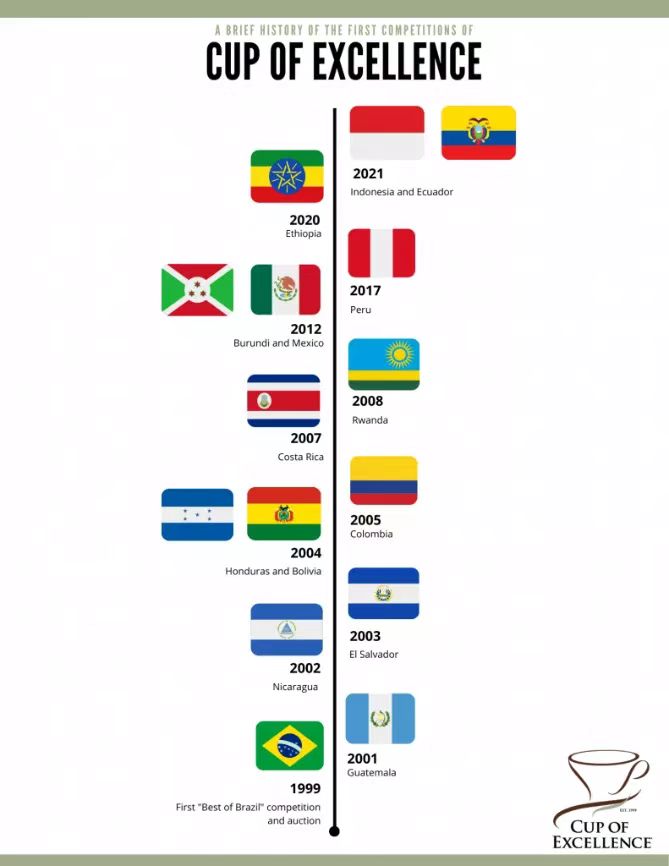
Therefore, whether SCA or COE, both are authoritative green coffee bean evaluation institutions, and both are committed to developing a supporting system from cultivation to cup. In Ethiopia's first COE green bean competition in 2020, FrontStreet Coffee also bid for the 22nd place, a sun-dried Typica from the West Arsi region, grown by Adem Banta Sute, with a score of 87.64.
Adem Banta Sute, 60 years old, has grown coffee all his life. He is also the father of 28 children. They live in Refisa village, Nensebo district, West Arsi, Oromia.
Adem Banta Sute produced 4,500 kilograms of coffee on his 6 hectares of land. Before winning the award this year, he would sell the coffee to local merchants.
The official information for this COE #22 coffee bean grown by Adem Banta Sute shows the variety is Typica. In the top 28 of Ethiopia's first COE in 2020, Typica occupied the main portion, followed by 74110, 74158, and Kurme.
It is worth noting that in the official award information of this Ethiopia COE Cup of Excellence, the Heirloom native variety does not appear. Instead, Typica, 74100, 74158, or Kurme appear. Why? In fact, Heirloom is not an accurate name for a coffee variety.
As the birthplace of coffee, Ethiopia possesses an unimaginable number of native varieties. These complex and diverse varieties are grown and processed in mixed ways, making it more difficult to trace varieties. Therefore, "Heirloom" is used as a catch-all term for unidentified coffee varieties.
Ethiopian varieties can be broadly divided into landraces and research varieties released by the Jimma Agricultural Research Center (JARC).
Both 74110 and 74158 are research varieties released by JARC. In the 1970s, Coffee Cherry Disease (CBD) ravaged Ethiopia and caused a large-scale reduction in coffee production. In order to find varieties with natural disease resistance genes, JARC collected 639 sample varieties between 1973 and 1975, and ultimately selected 13 disease-resistant varieties, including 74110 and 74158, with 74 being the year they were collected.
The processing method of this COE #22 is sun-dried. In Ethiopia, more than 70% of coffee cherries are processed by the sun-dried method. The traditional method is for smallholder coffee farmers to dry them in their own courtyards, on rooftops, or even by the roadside, because this costs much less than washed processing. This rough processing method is also one of the reasons for the inconsistent quality of Ethiopia's early sun-dried beans.
The quality of sun-dried coffee beans processed in cooperation with cooperatives and washing station processing plants is more stable, but doing a good job with sun-dried processing still requires more effort. Before the moisture content drops to 25%, manual even turning is required, and they must be turned once every 30 to 60 minutes to avoid unpleasant over-fermentation flavors. This also leads to higher labor costs for sun-dried processing.
In addition, due to weather risk factors, the sun-dried processing period is longer. Obtaining better-quality sun-dried coffee beans requires more labor costs and resources. However, judging from the sun-dried scores in the top 28, good sun-dried processing is indeed a processing method where risk and reward coexist.
Roasting curve
Charge at a drum temperature of 170°C, heat power 130, damper set to 3; turning point at 1'32", when the drum temperature is 100.2°C, heat remains unchanged; at 3 minutes adjust the damper to 4, at 4 minutes increase heat to 140. When the drum temperature is 150.5°C, the bean surface turns yellow, the grassy smell completely disappears, and the coffee enters the dehydration stage. At 8'36", the bean surface shows ugly wrinkles and dark spots, and the toast aroma clearly turns into coffee aroma, which can be defined as the prelude to first crack. At this time, it is necessary to listen clearly for the sound of first crack. At 9'10", first crack begins. After first crack, develop for 1 minute 30 seconds and drop the beans at 192.5°C.
Cupping report
Brewing recommendation
Dripper: V60#01
Water temperature: 90-91°C
Dose: 15g
Coffee-to-water ratio: 1:15
Grind size: medium-fine grind (80% passing through a Chinese standard No. 20 sieve)
Brewing method: three-stage extraction. Use 30 grams of water for blooming for 30 seconds, then pour in a small stream in circles until 125 grams for the first stage. When the water level is about to expose the coffee bed, continue pouring until 225 grams and stop. When the water level is about to expose the coffee bed again, remove the dripper. (Start timing from the beginning of blooming.) Extraction time is 2'00".
For professional coffee knowledge exchange and more coffee bean consultation, please follow Coffee Workshop (WeChat public account: cafe_style)
For more specialty coffee beans, please add the private WeChat of FrontStreet Coffee: kaixinguoguo0925
The above content is compiled by CoffeeHunters, a coffee news website.


