







How Do Colombian Coffee Beans Differ by Growing Region?
Colombian coffee works as a blend base, as a single origin, and in a French press. The central region, known for Medellin, Armenia and Manizales, or MAM, grows on volcanic ash soil that yields bright fruit acidity and rich aroma, with two rainy seasons from April to May and September to December. Southern regions plant at the country's highest altitudes.
Soil shapes the cup: volcanic ash tends toward higher acidity, while sedimentary rock areas in the central region produce more body and restrained acidity. Green bean grading follows three main export classifications used in the Chinese market. The coffee green bean itself, before roasting, carries the terroir of these zones, which is why origin and grade matter when comparing lots.
Colombian coffee beans can serve as a blending base, stand alone as a single origin, and even adapt to French press extraction—truly a versatile player in the coffee world. This article will guide you through a systematic understanding of the development of Colombian coffee, the terroir characteristics of its main producing regions, the green bean grading system, and complete knowledge from flavor profile to growing conditions. The volcanic ash soil in the central region imparts bright fruit acidity and rich aroma to the coffee, while the high-altitude southern producing areas cultivate specialty-grade beans. The article also compiles the three major export grade classification standards currently circulating in the Chinese market, along with specific product recommendations from Front Street Coffee, making it suitable for coffee enthusiasts who want to gain an in-depth understanding of the Colombian producing regions.
The Development History of Colombian Coffee
The scope of application for Colombian coffee is quite broad, a point that has long been common consensus in coffee circles. It can serve as an important piece in a coffee blend, be presented alone as a single-origin bean, and even handle French press extraction thanks to its own body—truly inclusive and able to satisfy the taste preferences of different groups. So, what kind of development process has this highly adaptable coffee bean actually gone through? Today, let Front Street accompany you in sorting out the rise of Colombian coffee.
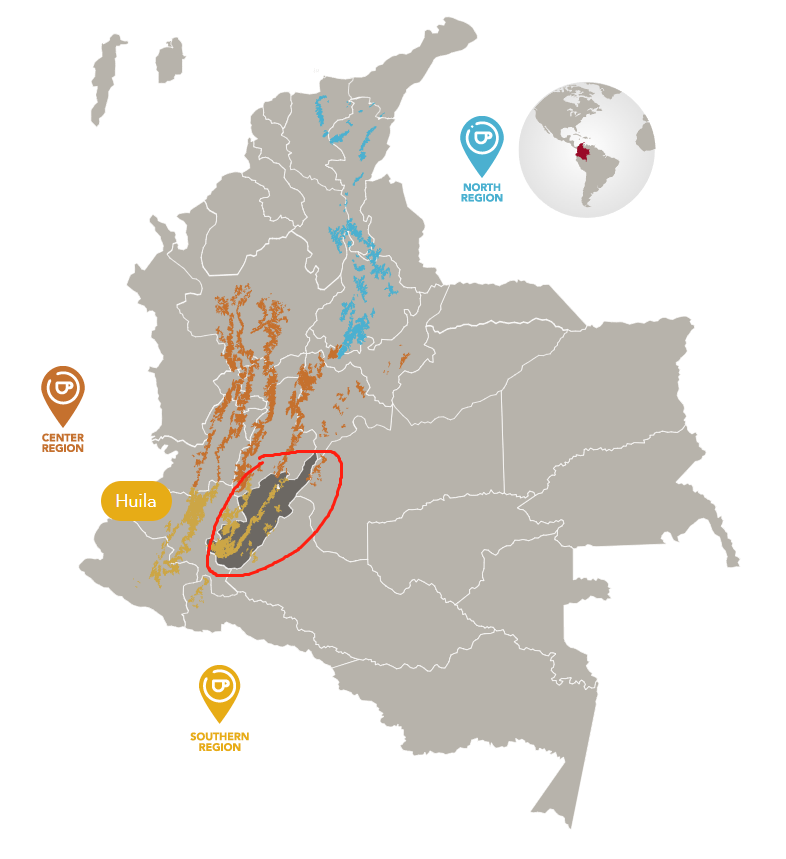
Among Colombia's coffee-growing zones, the central region produces the finest quality. The local area experiences two rainy seasons each year, concentrated from April to May and from September to December. The central mountain range consists of volcanic ash soil, which tends toward higher acidity, so the coffee beans produced there often carry abundant fruit acidity and rich aroma. The three most famous producing regions in this area are Medellin, Armenia, and Manizales, which the industry habitually refers to collectively as "MAM."
Some areas in the central region also have sedimentary rock soil, and coffee cultivated in this type of soil shows more prominent body while acidity is relatively more restrained. The soil in the southern producing region is also mainly volcanic ash, with the highest planting altitude in the country. The main harvest period is concentrated in the first half of the year, with Narino coffee as the specialty representative.
Overall, Colombian coffee beans are plump and uniform in size, with a rich and solid aroma. Whether they present fruit notes or chocolate notes depends on the different growing regions. In terms of taste, the acidity is relatively prominent, the texture is soft and smooth, and the flavor is vivid, with Supremo regarded as the highest grade.
Colombian coffee green bean grading standards: Excelso export grade is currently the most widely used export standard grade adopted by FNC and is also the optimal grade for Colombian green bean exports.
So how exactly are Colombian coffee green beans graded? In short, those currently circulating most widely in the Chinese market can roughly be classified into three categories:
Excelso UGQ 12*60 (1.5%): UGQ is the abbreviation for Usual Good Quality. Green beans must be above screen size 14, with 1.5% of green beans allowed to fall between screen sizes 12 and 14, but all beans must be above screen size 12, and more than 50% of them must be larger than screen size 15.
Excelso EP 12*60 (10%): EP is the abbreviation for European Preparation. Green beans must be above screen size 15, with 10% of green beans allowed to be smaller than screen size 15, but they must be larger than screen size 14. Excelso Supremo 12*60 (5%): Green beans must be above screen size 17, with 5% of green beans allowed to be smaller than screen size 17, but they must be larger than screen size 14.
Of course, Colombian grading goes far beyond these. On the market there are also grades called Extra for those above screen size 16, Premium for those above screen size 18 that are larger than Supremo, and Minama for those whose green beans are almost entirely uniformly distributed at screen size 15, and so on.
Recommended Colombian Specialty Coffee Beans
If you want to experience the charm of the Colombian producing regions, you might consider Front Street Washed Huila. This bean uses a medium-dark roast, fully releasing the sweet aroma of dark chocolate and nuts, with moderate oil and a mellow taste. It can handle both pour-over and French press, and is equally suitable for extraction with a moka pot and espresso machine.
For friends who have a coffee machine at home, the barista recommends Front Street Specialty Blend. This blend combines the creamy nutty flavor of Brazilian coffee with the dark chocolate bittersweetness of Colombian coffee. The overall profile is rich and smooth, very beginner-friendly, and can serve as the base for regular espresso drinks such as Americano, latte, cappuccino, and mocha.
The above content is compiled by CoffeeHunters, a coffee news website.


