








Where Are Arabica Coffee Beans Grown, and How Did Hambela Change?
Hambela is a sub-region of Guji in Ethiopia's Oromia Region, one of the highest cultivation areas in the country, and it is where the Huakui series comes from. Ethiopia is a major African arabica producer widely recognized as coffee's birthplace, and its native Heirloom variety gives each producing region a distinct flavor personality, which is the short answer to where are arabica coffee beans grown.
Guji was classified as an independent producing region by the ECX in 2010. Most farmers there are smallholders working relatively large plots, with coffee trees grown under shade and intercropped with bananas. Comparing Huakui 8.0 with 5.0 shows the new crop's flavor shifts, and arabica beans from such high-altitude sites keep their fruity, sweet-and-tart character.
The fruity, sweet-and-tart taste has changed many people's perception of coffee, and the Huakui coffee from Ethiopia's Sidamo region is a representative of this kind of flavor. Front Street Coffee's Huakui series has now reached version 8.0. Compared with 5.0, what changes does the new crop season bring in flavor performance? This article will guide you through the origin background, naming origin, and processing method of Huakui coffee beans, as well as Front Street Huakui 8.0's roasting and brewing recommendations, offering a comprehensive analysis of this highly anticipated coffee bean.

The fruity sweet-and-tart taste is a sensory experience most people find hard to resist. In the world of coffee, it is not only the bitter "dishwater" flavor remembered by the older generation; there are also many surprising flavors hidden within, and coffee full of juicy fruitiness is one of them. On Front Street Coffee's bean list, Front Street Huakui Coffee from Ethiopia's Sidamo region is exactly this kind of bean.
Huakui Coffee Bean Production Region
Ethiopia is one of the major producers of African Arabica coffee and is also widely recognized as the birthplace of coffee. The country's native Heirloom variety, as an ancient and high-quality coffee variety, always displays a unique flavor personality in each producing region. Guji is one of the earliest coffee-growing regions, and in 2010, due to its superior geographical location and cup performance, it was classified by the ECX (Ethiopia Commodity Exchange) as an independent producing region.
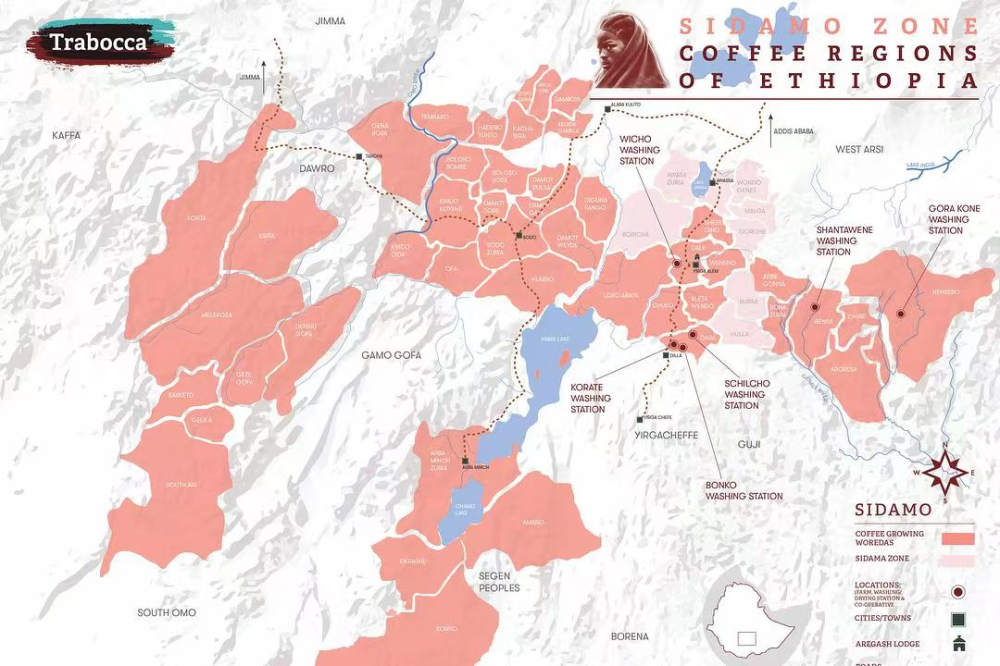
Guji is located in Ethiopia's Oromia Region, bordered to the south by Borena, to the north by the Ganale Dorya River, which separates it from Gedeo and Bale, and to the east by the Somali Region.
Most coffee farmers in Guji are small-scale landowners, and they have relatively large plots of land for growing coffee. The coffee trees grow beneath the trees and canopy of Guji Zone and are intercropped with bananas and other crops. For centuries, coffee here has grown in an ecologically sound and favorable environment, maintaining perfect harmony with a wide range of biodiversity.
Front Street Huakui Coffee comes from the Hambela sub-region of Guji, which is the coffee sub-region with the highest cultivation altitude in Ethiopia. Western Hambela faces Yirgacheffe's Kochere across the mountains, and with a cultivation altitude of 2,000 meters, fertile black soil, and a significant day-night temperature difference, this place is abundant in high-quality specialty coffee beans. In 2017, at the TOH green bean competition hosted by the African Coffee Association, a natural-process coffee bean from Hambela won that year's championship. Later, this bean came to be called Front Street Huakui Coffee.
The place where Huakui coffee beans are grown is a small village located in an extremely high-altitude indigenous tribe within the Hambela area. The villagers plant bananas and sugarcane all around the coffee plants, and the coffee beans harvested here are sent to the Buku Abel processing station for processing.
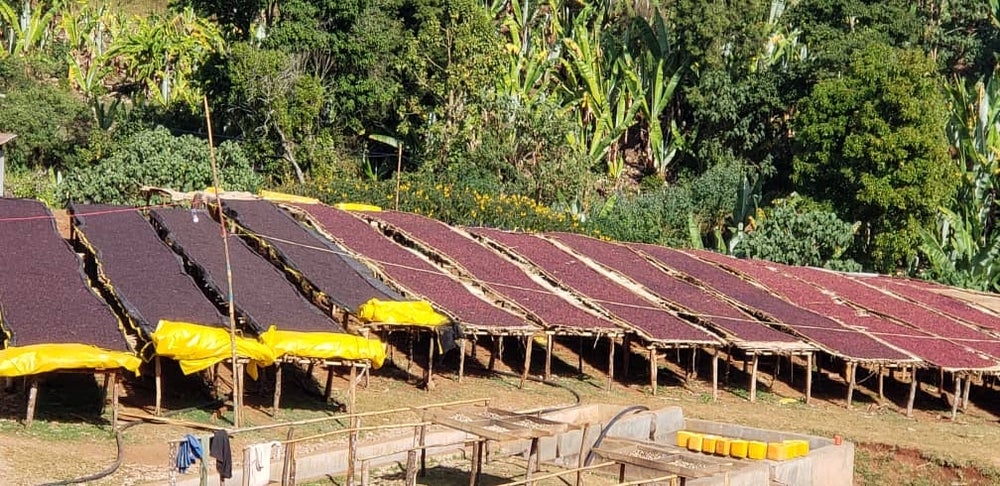
Every year during the coffee harvest season (December to January of the following year), the Buku processing station organizes farmers to pick fully red coffee cherries, and the brix value must reach 30 or above. After screening, the coffee fruits are placed on African raised beds to dry. Because the local day-night temperature difference is extremely large, the coffee farmers shade the sunlight at noon to avoid excessive fermentation caused by overly high temperatures; at night, to prevent sudden rain, they cover them with plastic sheets. They turn them continuously throughout the day and ensure the coffee fruits are not piled too thickly, which allows the fruits to dry evenly while preventing sun damage or unpleasant fermented flavors. After about 18 days of sun drying, once the moisture content of the green coffee beans drops to 13%, the outer shells can be removed by machine and the beans packed.
Why is Huakui Coffee called Huakui?
In 2017, a natural-process coffee bean from DW Company's "Buku Aebl" processing station won the championship in the TOH natural group. At that time, a Chinese green bean merchant introduced this champion bean, with its rich strawberry and creamy aroma, into China and named it "Huakui." The term "Huakui" means "chief of all flowers," expressing the green bean merchant's great expectations for this bean and the belief that it had the potential to become the next Geisha.
In the same year, Li Jianfei from Beijing used this Huakui coffee to win second place in the China region of the 2017 World Brewers Cup. On a stage where other competitors all used Geisha, he defeated many opponents with this bean and took second place, adding considerable fame to Huakui Coffee. It should be noted that the Huakui coffee beans at that time held the title of the 2017 TOH champion bean.
What do the numbers after Huakui mean?
It is not hard to see that the naming method of Huakui X.0 is based on the year. Therefore, when you see Huakui 3.0, you know it is coffee beans from the 2019 crop season; when you see Huakui 4.0, it corresponds to the 2020 crop season. In addition to the year pattern, the 2017 Huakui coffee was only natural beans processed by the "Buku Aebl" processing station, while DW Company expanded its processing stations year by year, adding villages such as "Buku Abel," "Buku Saysay," "Haro Soresa," and "Tirtiro Goye." The most direct result was a sharp increase in coffee production. Its flavor is also clearly different from that of the 2017 Huakui. Strictly speaking, only natural-process coffee beans processed by the "Buku Abel" processing station can truly be called Huakui coffee beans.
With the arrival of 2024, Africa welcomes a new coffee crop season. Barring any unexpected circumstances, the latest version of Front Street Huakui Coffee Beans should be named "Huakui 8.0." Front Street, like everyone else, is very much looking forward to the arrival of this bean. These past few days, the Front Street Huakui 8.0 that Front Street acquired has finally arrived. Since it is fresh and has been awaited for another year, of course it must be properly tasted. In order to present the refined floral and fruity flavors of the Sidamo region while retaining the coffee's caramelized aroma, Front Street's roaster used a medium-light roast to showcase this bean.
The new crop season's Front Street Huakui 8.0 shows a more intense fruity aroma in its dry fragrance than 7.0, with complex notes such as guava, jackfruit, apricot, dried fruit, citrus, and floral fragrance. After hot water is poured in, one can smell the sweet aroma of honey and berries. Through slurping, Front Street first perceives in this Front Street Huakui 8.0 multiple fruity sweet-and-tart notes such as dried mango, jackfruit, orange, and passion fruit. The juice-like quality is clear and the mouthfeel is round. As the temperature drops slightly, the delicate sweetness of honey peach and the acidity of berries begin to be released, and after swallowing, one can feel a sweet aftertaste like drinking black tea.
When roasting this Front Street Huakui 8.0, Front Street Coffee (FrontStreet Coffee), considering the need to highlight its bright acidity, adopted a medium-light roast. Because the roast level is relatively light, the dissolution rate of substances in the coffee beans is slower. During brewing, Front Street recommends using a water temperature of 92 degrees Celsius, a V60 dripper, and a medium-fine grind size.
Dripper: Hario V60
Water temperature: 92 degrees Celsius
Coffee dose: 15 grams
Coffee-to-water ratio: 1:15
Grind size: 80% passing through China standard No. 20 sieve
Friends who often read Front Street articles should have noticed that Front Street often uses a three-pour method when brewing coffee, because compared with a single-pour method, three-pour brewing gives the coffee a richer sense of layering.
First pour 30 grams of water to completely wet the coffee grounds and let them bloom for 30 seconds. Then pour from the center point in a small stream and slowly circle outward to 125 grams for the first stage. When the water level in the dripper drops to the point where the coffee bed is about to be exposed, continue slowly circling and pouring to 225 grams. The total extraction time is about 2 minutes.
For more coffee bean information, please follow Coffee Workshop (WeChat public account cafe_style) For professional coffee knowledge exchange, please add WeChat ID kaixinguoguo0925
The above content is compiled by CoffeeHunters, a coffee news website.


